Drongos: The Master Mimics of the Old World Tropics
In the lush forests and open scrublands of the Old World tropics, there exists a group of highly intelligent, aggressive, and opportunistic birds known as drongos. Members of the family Dicruridae, these passerine birds (perching birds) are renowned not only for their striking appearance but for their sophisticated ability to deceive other animals through vocal mimicry.
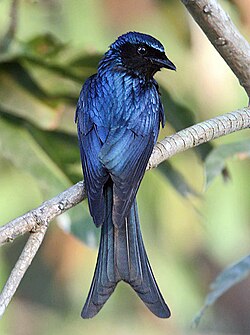
Most drongos are characterized by their dark plumage—typically black or dark grey—and a distinctive upright posture when perched. Their most defining physical feature is the forked tail, which in some Asian species is adorned with elaborate decorations. These birds are primarily insectivorous, catching their prey in mid-air or snatching it from the ground.
Key Facts
- Family: Dicruridae, consisting of 28 species all within the single genus Dicrurus.
- Diet: Primarily insects and small birds.
- Behavior: Known for aggressive nest protection and complex vocal mimicry.
- Distribution: Found across Africa, Asia, and Australasia.
- Origin: Likely originated in the Indo-Malayan region.
Taxonomy and Evolution
The genus Dicrurus was established in 1816 by French ornithologist Louis Pierre Vieillot. The name is derived from the Ancient Greek words dikros (forked) and oura (tail). While the term "drongo" originally referred specifically to the crested drongo in the indigenous language of Madagascar, it is now the standard name for all members of the family.
The type species for the genus is the balicassiao (Dicrurus balicassius). Historically, the family was broader or divided differently; for example, the pygmy drongo (Chaetorhynchus papuensis) was once included but has since been reclassified as the drongo fantail within the family Rhipiduridae due to genetic and morphological differences.
Evolutionary data suggests that drongos originated in the Indo-Malayan region. They are believed to have colonized Africa approximately 15 million years ago (Mya) and crossed the Wallace Line into Australasia more recently, around 6 Mya.
Behavioral Intelligence and Deception
Drongos are among the most fascinating birds in terms of cognitive ability. While many species are accomplished mimics, the greater racket-tailed drongo is particularly noted for imitating the calls of other birds and mammals.
This mimicry is often used for survival and foraging. In the Kalahari Desert, the fork-tailed drongo employs a sophisticated strategy of "false alarms." By uttering fake alarm calls, the drongo scares other animals away from their food, which the drongo then steals. Research indicates that these birds can obtain up to 23% of their food through this deceptive behavior.
What makes this behavior remarkable is the drongo's flexibility. If a specific alarm call fails to trigger a response—perhaps because the victim has become habituated to it—the drongo can switch between as many as 51 different imitated calls to achieve its goal. This level of tactical flexibility has led some researchers to investigate whether drongos possess a theory of mind, a cognitive ability typically associated with humans.
Species Distribution and Diversity
With 28 recognized species, drongos have adapted to various tropical environments. From the Comoros and Seychelles in Africa to the Philippines and Indonesia in Asia, their distribution is widespread.
| Common Name | Scientific Name | Primary Distribution |
|---|---|---|
| Black drongo | Dicrurus macrocercus | Iran, Pakistan, India, Bangladesh, Sri Lanka, Southern China, Indonesia |
| Fork-tailed drongo | Dicrurus adsimilis | Gabon, Congo, Angola, Zambia, Namibia, Botswana, South Africa |
| Greater racket-tailed drongo | Dicrurus paradiseus | India to Borneo and Java |
| Crested drongo | Dicrurus forficatus | Madagascar and Comoros |
| Spangled drongo | Dicrurus bracteatus | Australia, New Guinea, Indonesia |
Cultural Significance
Interestingly, the word "drongo" has entered the lexicon of Australian English as a slang term. Used as a mild insult meaning "idiot" or "stupid fellow," the term is believed to have originated from a 1920s racehorse named Drongo (likely named after the spangled drongo). Despite many attempts, the horse never won a race, leading to the term's association with failure or lack of intelligence.
Frequently Asked Questions
What do drongos eat?
Drongos are primarily insectivorous, feeding on insects and occasionally small birds, which they capture either by flying or on the ground.
How do drongos use mimicry to get food?
Some species, like the fork-tailed drongo, use fake alarm calls to frighten other animals away from their food, allowing the drongo to steal the abandoned meal.
Are drongos aggressive?
Yes. Despite their small size, they are fearless and aggressive, especially when protecting their nests or young, and will attack birds much larger than themselves.
Where are drongos found?
They are found in the Old World tropics, spanning across Africa, Asia, and Australasia, typically inhabiting open forests or bushlands.
Why is "drongo" an insult in Australia?
The term comes from a 1920s Australian racehorse named Drongo that never won a race, eventually becoming a slang term for a stupid person.