Douglas MacArthurGeneral of the ArmyWorld War II PacificKorean WarOccupation of Japan

Douglas MacArthur: The Life and Legacy of a Five-Star General

Douglas MacArthur: The Life and Legacy of a Five-Star General Douglas MacArthur stands as one of the most influential and controversial figures in American military history. A General of ...

Douglas MacArthur: The Life and Legacy of a Five-Star General

Douglas MacArthur stands as one of the most influential and controversial figures in American military history. A General of the Army and a Field Marshal of the Philippine Army, MacArthur's career spanned over six decades, taking him from the battlefields of World War I to the administrative reconstruction of post-war Japan. Known for his strategic brilliance and commanding presence, he navigated the complexities of global conflict and geopolitical diplomacy.

From his early days as a disciplined student to his role as the Supreme Commander for the Allied Powers, MacArthur's life was defined by a relentless pursuit of victory and a deep, lifelong connection to the Philippines.
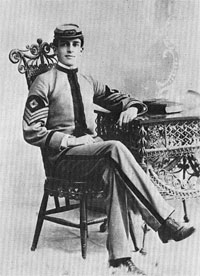
A ornate chair and a table with a book on it. A man sits in the chair, wearing an American Civil War style peaked cap. On his sleeves he wears three stripes pointed down with a lozenge of a First Sergeant.
MacArthur as a student at West Texas Military Academy in the late 1890s

Key Facts

  • Highest Rank: General of the Army (U.S.) and Field Marshal (Philippines).
  • Major Commands: Supreme Commander for the Allied Powers, UN Command, and Far East Command.
  • Key Conflicts: World War I, World War II, and the Korean War.
  • Notable Achievement: Led the occupation of Japan and oversaw its transition to a peaceful democracy.
  • Highest Honor: Recipient of the Medal of Honor.

Early Career and World War I

MacArthur's military journey began at the United States Military Academy at West Point. Upon graduation in 1903, he entered the Corps of Engineers, a branch he served in for the first 14 years of his career. This technical foundation in engineering provided him with a strategic perspective on terrain and infrastructure that would serve him in future campaigns.

MacArthur was an engineer for the first 14 years of his military career. He received these golden castle pins as a gift upon graduation. He carried these pins with him for over 40 years and in 1945 gave them to Major General Leif J. Sverdrup, whom he thought more deserving to wear them. Sverdrup gave them to the Chief of Engineers in 1975. Every Chief of Engineers since then has worn MacArthur's pins.[27]

During World War I, MacArthur rose rapidly through the ranks. He commanded the 84th Infantry Brigade of the 42nd Division, famously known as the "Rainbow Division." His leadership during the Champagne-Marne offensive, the Battle of Saint-Mihiel, and the Meuse-Argonne offensive earned him numerous decorations, including the Distinguished Service Cross.
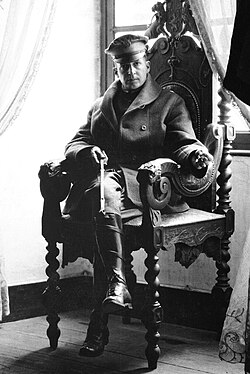
A man sits in an ornate chair. He is wearing a peaked cap, greatcoat and riding boots and holding a riding crop.
Brigadier General MacArthur holding a riding crop at a French château, September 1918
French General Georges de Bazelaire decorates MacArthur with the Croix de Guerre, 18 March 1918
MacArthur (center) in his unauthorized uniform. He never wore a helmet, even in no man's land, and wore a modified cap.[45][46]
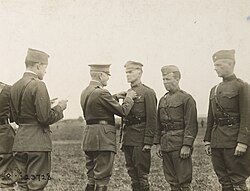
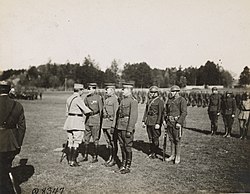
Three men in uniform are standing side by side. The one on the left is wearing a peaked "crush cap" and standing smartly at attention, while the two on the right wear garrison caps and are slouching. A man in a peaked cap and Sam Browne belt is pinning something on the chest of the first man. Behind him stands another man in a garrison cap who is reading a document in his hands.
General John J. Pershing (second from left) decorates MacArthur with the DSC, October 1918. Major General Charles T. Menoher (left) reads out the citation while Colonel George E. Leach (fourth from left) and Lieutenant Colonel William J. Donovan await their decorations.
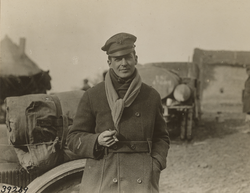
Brigadier General Douglas MacArthur, commanding the 84th Brigade, 42nd Division, standing in front of his staff car, Saint-Juvin, Ardennes, France, 3 November 1918

The Interwar Years and Rise to Leadership

Between the world wars, MacArthur held several high-profile positions. From 1919 to 1922, he served as the 16th Superintendent of the United States Military Academy, returning to the institution that shaped his youth. By 1930, he became the 13th Chief of Staff of the Army, making him one of the youngest officers to ever hold the position.
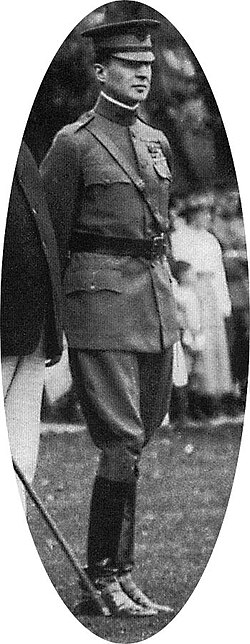
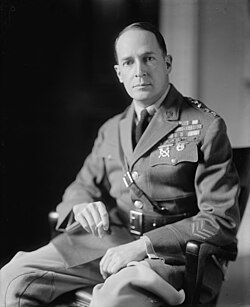
Man wearing peaked cap, Sam Browne belt, and shiny riding boots.
MacArthur as West Point Superintendent
MacArthur c. 1925
MacArthur c. 1925
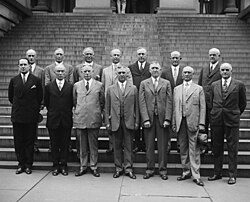
Corps area commanders and division commanders meet with the army chief of staff, Major General Charles Pelot Summerall, at the War Department, May 1927. Stood in the front row, first on the left, is Major General Douglas MacArthur, commanding the Third Corps Area.

His tenure as Chief of Staff was marked by the challenges of the Great Depression, including the "Bonus Army" incident, where veterans marched on Washington D.C. seeking payment. Later, in 1935, he was appointed as the United States Military Advisor to the Philippines, where he helped organize the Philippine Army, eventually attaining the rank of Field Marshal.
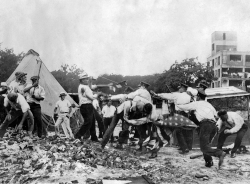
 Police with batons confront demonstrators armed with bricks and clubs. A policeman and a demonstrator wrestle over a U.S. flag.
Bonus Army marchers confront the police.
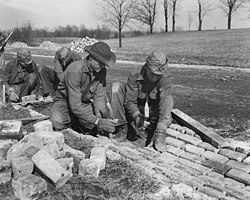
Five workmen. One is holding a shovel, while the other four are laying bricks to form a drainage ditch along the side of a road.
Civilian Conservation Corps workers on a project alongside a road
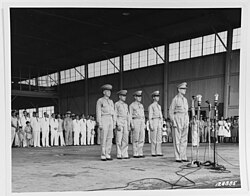
MacArthur stands in uniform at four microphones on stands. Behind him four men in army uniforms stand at attention. There are viewed by a large crowd of well-dressed men, women and children in skirts, suits and uniforms.
Ceremony at Camp Murphy, 15 August 1941, marking the induction of the Philippine Army Air Corps. Behind MacArthur, from left to right, are Lieutenant Colonel Richard K. Sutherland, Colonel Harold H. George, Lieutenant Colonel William F. Marquat and Major LeGrande A. Diller.

World War II and the Pacific Theater

The outbreak of World War II placed MacArthur at the center of the Pacific conflict. As commander of the Philippine Department, he faced the Japanese invasion in 1941. Following the grueling Battle of Bataan and the fall of Corregidor, MacArthur was ordered to evacuate to Australia.
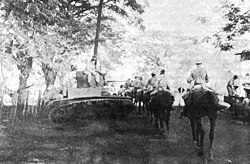
A long column of men on horseback moving down a road. A tank is parked beside the road.
26th Cavalry (Philippine Scouts) move into Pozorrubio past an M3 Stuart tank.
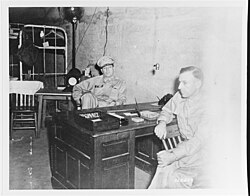
Two men sitting at a desk.
MacArthur (center) with his Chief of Staff, Major General Richard K. Sutherland, in the Headquarters tunnel on Corregidor, Philippines, on 1 March 1942

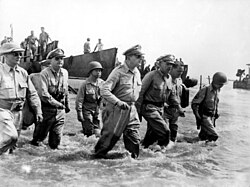
It was during this period that he made his famous pledge to return to the Philippines. He spent the following years executing a "leapfrogging" strategy across New Guinea and the Solomon Islands, bypassing Japanese strongpoints to isolate them. This campaign culminated in the 1944 Leyte landings, where he fulfilled his promise with the iconic words, "I have returned."
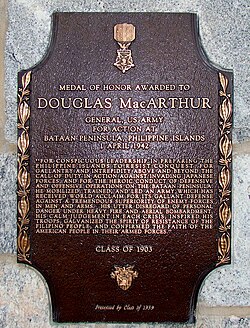
A bronze plaque with an image of the Medal of Honor, inscribed with MacArthur's Medal of Honor citation. It reads: "For conspicuous leadership in preparing the Philippine Islands to resist conquest, for gallantry and intrepidity above and beyond the call of duty in action against invading Japanese forces, and for the heroic conduct of defensive and offensive operations on the Bataan Peninsula. He mobilized, trained, and led an army which has received world acclaim for its gallant defense against a tremendous superiority of enemy forces in men and arms. His utter disregard of personal danger under heavy fire and aerial bombardment, his calm judgment in each crisis, inspired his troops, galvanized the spirit of resistance of the Filipino people, and confirmed the faith of the American people in their Armed Forces."
A plaque inscribed with MacArthur's Medal of Honor citation lies affixed to MacArthur barracks at the U.S. Military Academy.
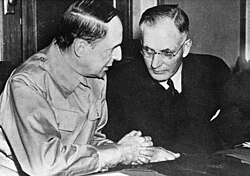
Two men seated at a table side by side talking. One is wearing a suit, the other a military uniform.
Australian prime minister John Curtin (right) confers with MacArthur.
Six men wearing a variety of different uniforms.
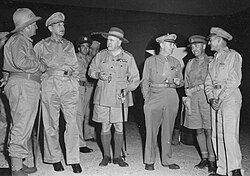
Senior Allied commanders in New Guinea in October 1942. Left to right: Mr Frank Forde (Australian Minister for the Army); MacArthur; General Sir Thomas Blamey, Allied Land Forces; Lieutenant General George C. Kenney, Allied Air Forces; Lieutenant General Edmund Herring, New Guinea Force; Brigadier General Kenneth Walker, V Bomber Command.
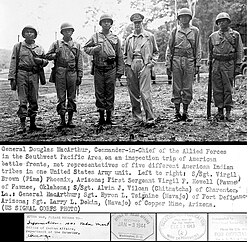
MacArthur with Native American codetalkers in the Southwest Pacific
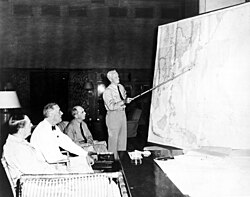
Three men are seated in lounge chairs. One is standing, holding a long stick and pointing to the location of Japan on a wall map of the Pacific.
Conference in Hawaii, July 1944. Left to right: General MacArthur, President Roosevelt, Admiral Leahy, Admiral Nimitz.
A group of men wading ashore. With General MacArthur is Philippine President Sergio Osmeña and other U.S. and Philippine generals.
"I have returned" – General MacArthur returns to the Philippines with Philippine President Sergio Osmeña. This iconic image is re-created in larger-than-life statues at MacArthur Landing Memorial National Park.
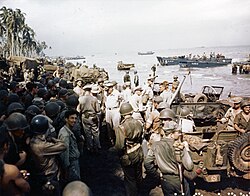
A large crowd of soldiers and jeeps on a beach. There are palm trees in the distance and landing craft offshore. A small group in the center conspicuously wear khaki uniforms and peaked caps instead of jungle green uniforms and helmets.
MacArthur (center) inspecting the beachhead on Leyte on 20 October 1944
Eight men in khaki uniforms, seated.
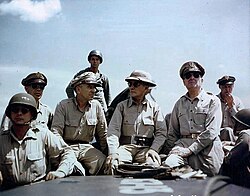
American military officers off Leyte Island in the Philippines, October 1944: Lieutenant General George Kenney, Lieutenant General Richard K. Sutherland, President Sergio Osmeña, General Douglas MacArthur

The Occupation of Japan and the Korean War

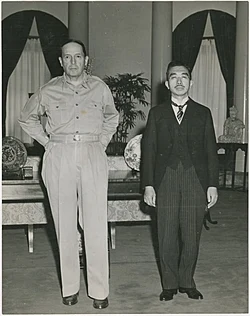
Following the Japanese surrender, MacArthur was appointed the 1st Supreme Commander for the Allied Powers (SCAP). He oversaw the occupation of Japan, focusing on demilitarization and the implementation of democratic reforms. He notably protected Emperor Hirohito to maintain social stability during the transition.
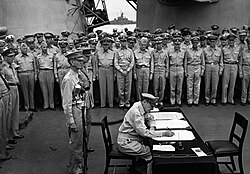
MacArthur is seated a small desk, writing. Two men in uniform stand behind him. A large crowd of men in uniform look on.
MacArthur signs the Japanese Instrument of Surrender aboard the USS Missouri. American General Jonathan Wainwright and British General Arthur Percival stand behind him.
A tall Caucasian male (MacArthur), without hat and wearing open-necked shirt and trousers, standing beside a much shorter Asian man (Hirohito) in a dark suit.
MacArthur and the Emperor of Japan, Hirohito, at their first meeting, September 1945
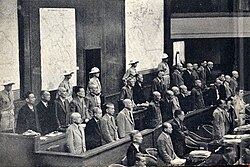
Three rows of benches with a dozen or so men standing behind each. Behind them stand five men in uniform.
The defendants at the Tokyo War Crimes Trials

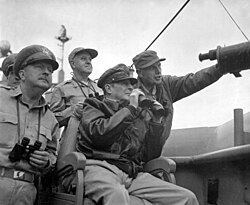
In 1950, MacArthur was called upon to lead the United Nations Command during the Korean War. He is best remembered for the daring amphibious landing at Inchon, which turned the tide of the war by cutting off North Korean supply lines. However, his tenure ended in controversy; after disagreeing with President Harry S. Truman over the expansion of the war into China, MacArthur was removed from command in April 1951.
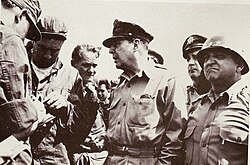
MacArthur confers with Lieutenant General Walton Walker (right) and other soldiers of the Eighth Army in July 1950.
MacArthur is seated, wearing his field marshal's hat and a bomber jacket, and holding a pair of binoculars. Four other men also carrying binoculars stand behind him.
MacArthur observes the naval shelling of Inchon from USS Mount McKinley, 15 September 1950 with Brigadier General Courtney Whitney (left) and Major General Edward M. Almond (right).
MacArthur at the 1st Marine Division headquarters in Inchon in September 1950
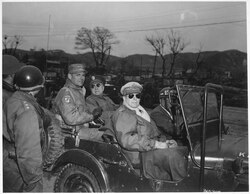
From right to left: MacArthur, Major General Doyle Hickey, and General Matthew Ridgway in a jeep at a UN command post, April 1951, just eight days before MacArthur's removal

Final Years and Legacy

After his removal from command, MacArthur returned to the United States as a celebrated hero, delivering a famous farewell address to Congress. He spent his final years in retirement, occasionally visiting the Philippines. He passed away on April 5, 1964, at the age of 84.
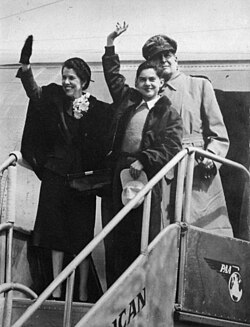
The MacArthur family standing at the top of the stairs leading from a passenger aircraft. Douglas MacArthur stands behind while his wife Jean and son Arthur wave to those below.
Douglas MacArthur (rear), Jean MacArthur, and son Arthur MacArthur IV returning to the Philippines for a visit in 1950
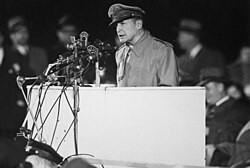
MacArthur, in uniform, speaks from a rostrum with several microphones.
MacArthur speaking at Soldier Field in Chicago in 1951

Today, his legacy is preserved at the MacArthur Memorial in Norfolk, Virginia, and through various honors, including commemorative coins in the Philippines and the MacArthur Leadership Award given to junior officers.
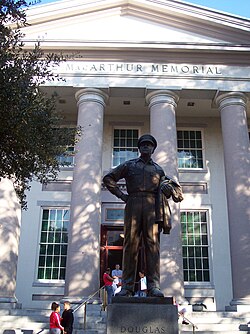
A large bronze statue of MacArthur stands on a pedestal before a large white building with columns. An inscription on the building reads: "Douglas MacArthur Memorial".
Douglas MacArthur Memorial in Norfolk, Virginia. The statue is a duplicate of the one at West Point. The base houses a time capsule which contains MacArthur, Norfolk and MacArthur Foundation memorabilia.[386]
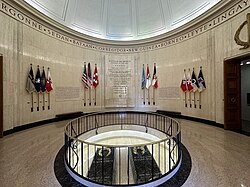
Rotunda with two black granite slabs inscribed with the names "Douglas MacArthur" and "Jean Faircloth MacArthur"
The tomb of Douglas and Jean MacArthur at the MacArthur Memorial in Norfolk, Virginia
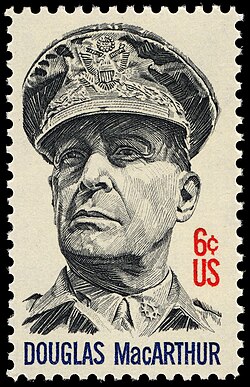
A 1971 MacArthur commemorative postage stamp
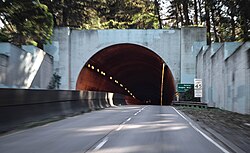
The West entrance of the MacArthur Tunnel in San Francisco, California
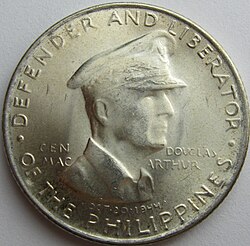
MacArthur was the subject of two different legal tender commemorative coins in the Philippines in 1947. Filipino coins of MacArthur were also struck in 1980, the 100th anniversary of his birth, and in 2014, the 70th anniversary of the Leyte landings.
Summary of Douglas MacArthur's Military Career
Period Key Role Major Conflict/Event Key Outcome
1917–1918 Brigadier General World War I Led 84th Brigade in France
1930–1935 Chief of Staff of the Army Interwar Period Modernized Army administration
1941–1945 General of the Army World War II Liberated the Philippines
1945–1951 Supreme Commander (SCAP) Occupation of Japan Democratic reconstruction of Japan
1950–1951 UN Command Korean War Successful Inchon Landing

Frequently Asked Questions

What was MacArthur's most famous promise?

MacArthur famously promised "I shall return" after being forced to evacuate the Philippines during the Japanese invasion in 1942. He fulfilled this promise in October 1944 during the landings at Leyte.

Why was Douglas MacArthur removed from command during the Korean War?

He was removed by President Harry S. Truman in 1951 due to public disagreements over military strategy, specifically MacArthur's desire to expand the war into China, which Truman feared would trigger a larger global conflict.

What role did MacArthur play in Japan after World War II?

As the Supreme Commander for the Allied Powers, he led the occupation of Japan, overseeing the drafting of a new constitution, the demilitarization of the country, and the transition to a democratic government.

What is the significance of the "Rainbow Division"?

The 42nd Division, known as the Rainbow Division because its soldiers came from 26 different states, was commanded by MacArthur during World War I, where he earned a reputation for bravery and tactical skill.

What were MacArthur's highest military ranks?

He achieved the rank of General of the Army in the United States Army and was honored as a Field Marshal in the Philippine Army.