double bassstring instrumentorchestral bassupright bassbass tuning

Double Bass: History, Design, and Performance of the Orchestral Giant

Double Bass: History, Design, and Performance of the Orchestral Giant The double bass, also known as the contrabass or upright bass, is the largest and lowest-pitched member of the orches...

Double Bass: History, Design, and Performance of the Orchestral Giant

The double bass, also known as the contrabass or upright bass, is the largest and lowest-pitched member of the orchestral string family. A composite chordophone sounded by a bow or plucked with the fingers, it provides the harmonic foundation for orchestras, jazz ensembles, and bluegrass bands alike. Developed between the 15th and 19th centuries, the instrument has evolved from early violone conversions into the versatile powerhouse used in modern music today.

ภาพประกอบบทความ
ภาพประกอบจากบทความต้นฉบับ

Key Facts

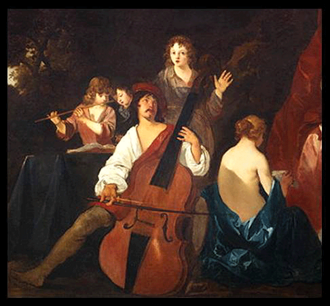
Some early basses were conversions of existing violones. This 1640 painting by Peter Lely, a painter of Dutch origin, shows a violone being played.
  • Standard Tuning: Typically tuned in fourths (E–A–D–G), unlike other orchestral strings tuned in fifths.
  • Physical Size: A common 3/4 size bass stands approximately 182 cm (71.6 inches), while a full-size (4/4) bass averages 190 cm (74.8 inches).
  • Pitch Range: The lowest note on a standard four-string bass is E1 (≈41 Hz), though five-string models can reach C1 (≈33 Hz) or B0 (≈31 Hz).
  • Bow Styles: Players primarily use either the French bow (held with the thumb on the shaft) or the German bow.
  • Versatility: Essential in classical music, jazz, bluegrass, and early rock and roll.

Design and Construction
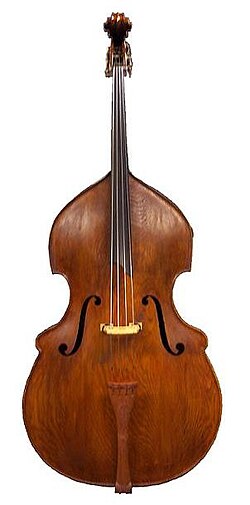
Example of a Busetto-shaped double bass: remake of a Matthias Klotz (1700) by Rumano Solano

The double bass is a massive instrument designed to project low frequencies. While the 4/4 size is the traditional standard, the 3/4 size has become the most widely used in the modern era, including among professional orchestral players, to better accommodate the player's height and hand size. Other smaller sizes, such as 1/2 and 1/4, are available for younger or smaller musicians.
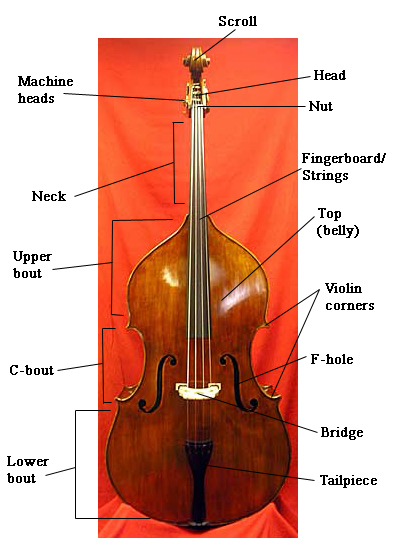
Principal parts of the double bass

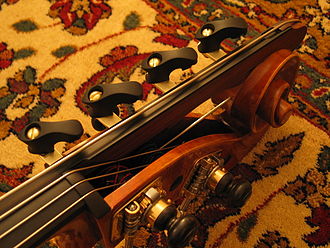
The instrument's construction includes a thick soundpost to support the structural tension and a bridge that transmits string vibrations to the body. Some professional instruments feature a C extension—a mechanical addition to the scroll that allows the player to reach notes below the open E string, such as C# or D.
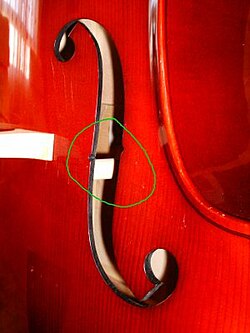
This photo shows the thick soundpost on a double bass (circled in green).

A low-C extension with wooden mechanical "fingers" that stop the string at C♯, D, E♭, or E. For orchestral passages which only go down to a low E, the "finger" at the nut is usually closed.

Strings and Tone

Historically, gut strings were the standard for their warm tone, though modern players often use steel or synthetic alternatives for greater stability and projection. The bridge and strings are critical components in defining the instrument's unique resonance.
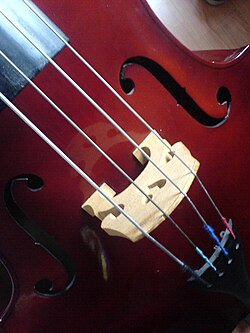
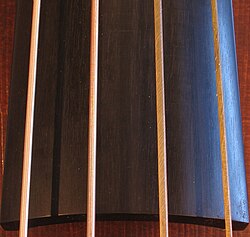
Detail of the bridge and strings

Gut strings
Gut strings

Playing Styles and Techniques

Double bass player Vivien Garry playing a show in New York City in 1947

The double bass is played using two primary methods: arco (using a bow) and pizzicato (plucking the strings). In jazz and bluegrass, pizzicato is the dominant technique, often involving a "slap-style" approach in rockabilly and psychobilly music to create a percussive rhythmic effect.
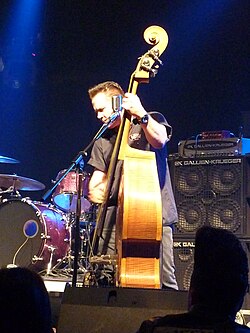
Psychobilly bassist Jimbo Wallace onstage with Reverend Horton Heat; note his large bass stack consisting of a 15-inch cabinet, a quadruple 10-inch cabinet, and an amplifier "head".

The Bow: French vs. German

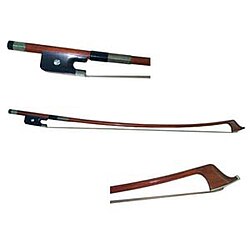
There are two distinct traditions of bowing. The French bow is held similarly to a cello bow, with the thumb resting on the shaft next to the frog. The German bow features a different grip and a shorter frog, which some players find provides more leverage for the heavy strings.
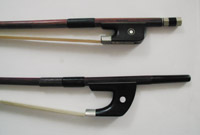
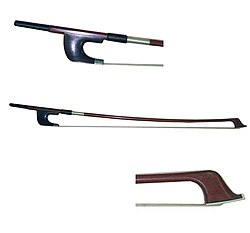
French (upper) and German bows compared

German-style bow
German-style bow

French-style bow
French-style bow

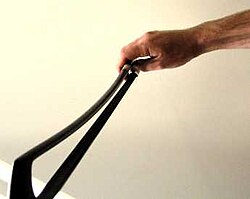
A bassist holding a French bow; note how the thumb rests on the shaft of the bow next to the frog

Tuning and Pitch

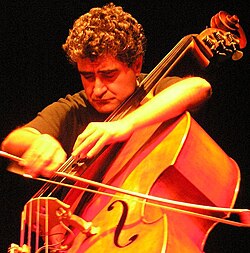
French double-bass player and composer Renaud Garcia-Fons during a performance

Standard double bass tuning is in fourths: E–A–D–G. This differs from the violin, viola, and cello, which are tuned in fifths. This tuning is identical to that of a bass guitar, though an octave lower than a standard guitar's lowest four strings.

Some specialized players use fifths tuning (C–G–D–A), which provides a wider range and aligns the instrument with the rest of the string family. Additionally, some traditional Catalan cobla bands still utilize three-string basses tuned A–D–G.
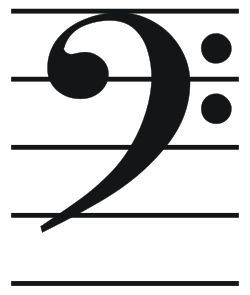
The bass (or F) clef is used for most double bass music.

The Double Bass Across Genres

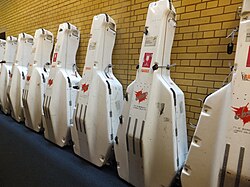
Hard flight cases for double basses

Classical and Solo Repertoire

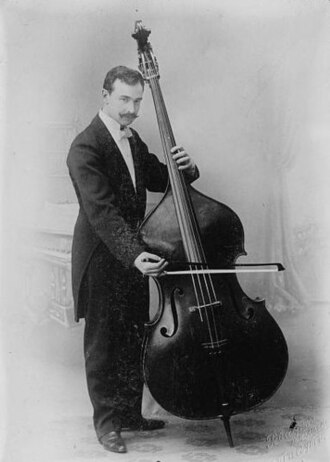
While often relegated to the background, the double bass has a rich solo history. Virtuosos like Domenico Dragonetti and Giovanni Bottesini pushed the instrument's technical boundaries in the 18th and 19th centuries. In the 20th century, Serge Koussevitzky further popularized the bass as a solo instrument.
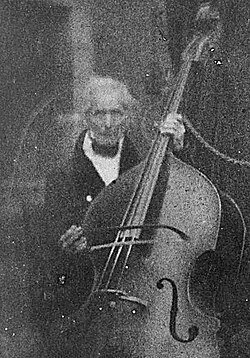
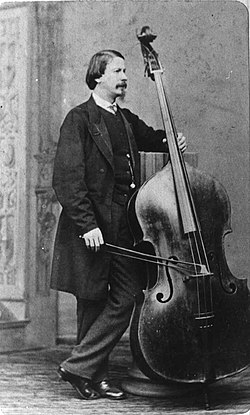
The Italian bass virtuoso Domenico Dragonetti helped to encourage composers to give more difficult parts for his instrument.

The virtuoso nineteenth-century bassist and composer Giovanni Bottesini with his 1716 Carlo Antonio Testore bass

Serge Koussevitzky popularized the double bass in modern times as a solo instrument.

Jazz, Bluegrass, and Popular Music

In jazz, the double bass is the heartbeat of the ensemble, providing both the rhythmic "walk" and harmonic structure. Influential figures like Charles Mingus and Christian McBride have shaped the instrument's role in the genre. In bluegrass and country, the upright bass is a staple, often equipped with piezoelectric pickups for amplification.
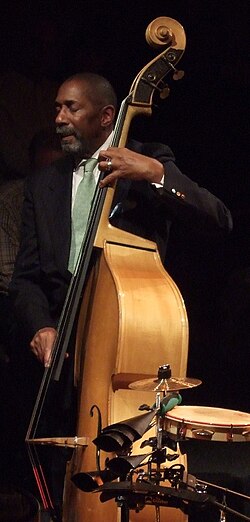

Jazz bassist Ron Carter at Altes Pfandhaus in Cologne

Ellen Andrea Wang performing at the Oslo Jazz Festival

Double bass is a standard instrument in bluegrass groups.

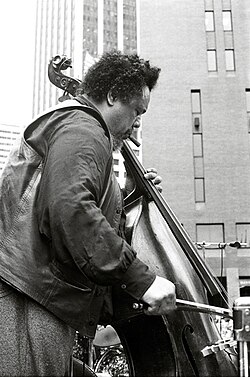
Jazz bassist Charles Mingus was also an influential bandleader and composer whose musical interests spanned from bebop to free jazz.

Upright bass used by a bluegrass group; the cable for a piezoelectric pickup can be seen extending from the bridge.

Country music bassist "Too Slim" (Fred LaBour of Riders in the Sky) performing in Ponca City, Oklahoma, in 2008

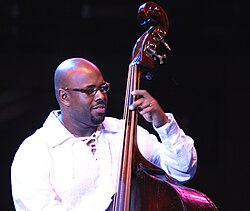
Christian McBride (born 1972), one of the new "young lions" in the jazz scene, has won four Grammy Awards.

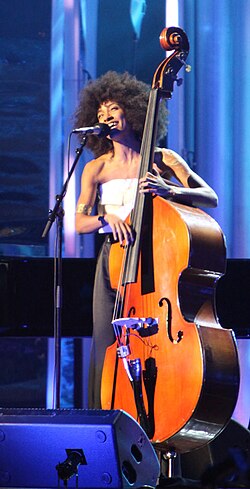
Jazz singer/bassist Esperanza Spalding performing on 10 December 2009 at the Nobel Peace Prize Concert of 2009

The rise of the electric bass guitar, introduced by Leo Fender in 1951, shifted the landscape of popular music. The electric bass offered easier portability, simpler intonation via frets, and higher volume, leading the upright bass to recede from mainstream pop and rock stages.

Summary of Double Bass Specifications
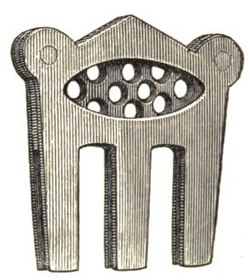
A wooden mute attached to the bass bridge to make the tone darker (a drawing from 1900)
Feature Standard (4/4) Common (3/4) Alternative
Average Height 190 cm (74.8 in) 182 cm (71.6 in) 1/2 or 1/4 sizes
Standard Tuning E–A–D–G (Fourths) E–A–D–G (Fourths) C–G–D–A (Fifths)
Lowest Note E1 (≈41 Hz) E1 (≈41 Hz) C1 or B0 (with 5 strings)
Bow Type French or German French or German N/A

Frequently Asked Questions

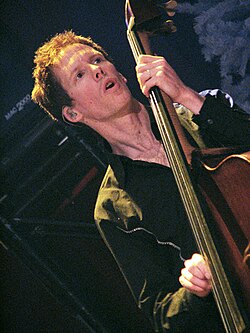
Jim Creeggan of Barenaked Ladies, pictured at a 2009 show
A mid-sized bass amp used to amplify a double bass at a small jazz gig
Double bass soloist Gary Karr
Scott Owen, double bass player for Australian rock band The Living End
Manhattan School of Music professor Timothy Cobb teaching a bass lesson in the late 2000s. His bass has a low C extension with a metal "machine" with buttons for playing the pitches on the extension.
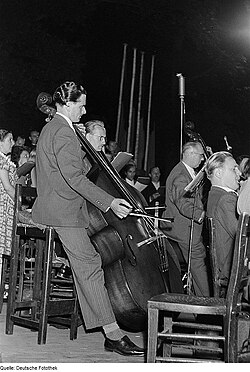
A German double bass section in 1952. The player to the left is using a German bow.

Why is the double bass tuned in fourths instead of fifths?

Tuning in fourths allows the player to cover the necessary range of the instrument more easily with their hand span, as the distance between notes is smaller than in fifths tuning.

What is the difference between a 3/4 and a 4/4 bass?

A 3/4 bass is slightly smaller (averaging 182 cm) than a full-size 4/4 bass (averaging 190 cm). Despite the names, a 3/4 bass is not 75% the size of a 4/4; it is a standard professional size used by many orchestral players for better ergonomics.

What does a C extension do?

A C extension is a mechanical addition to the neck of the bass that allows the musician to play notes lower than the open E string, specifically reaching down to C, C#, or D.

How does a French bow differ from a German bow?

The French bow is held with an overhand grip, similar to a cello bow. The German bow is held with an underhand grip and features a different frog design, providing a different feel and leverage for the player.

Can the double bass be used as a solo instrument?

Yes. While primarily used for accompaniment, virtuosos like Gary Karr and Edgar Meyer have established a significant repertoire of solo works, and composers from the 18th century to the present have written concerti specifically for the instrument.

References

  1. Slatford, Rodney; Shipton, Alyn (2001). "Double bass". Oxford Music Online: Grove Music Online. doi:10.1093/gmo/9781561592630.article.46437. ISBN 978-1-56159-263-0. Retrieved 6 December 2019.
  2. "Ludwig-van.com – The Octobass Is An Instrument Capable of Playing Below Human Hearing Range". 20 May 2015.
  3. The Orchestra: A User's Manual Archived 29 December 2011 at the Wayback Machine, Andrew Hugill with the Philharmonia Orchestra
  4. Alfred Planyavsky, "Chamber music in the Vienna Double Bass Archive" Archived 25 August 2021 at the Wayback Machine, September 1996, translated by James Barket
  5. "Bass basics". Archived from the original on 30 January 2020. Retrieved 30 January 2020.