Donald McBane: The Life and Legacy of a Scottish Fencing Master
In the violent and honor-bound landscape of the late 17th and early 18th centuries, few figures embody the spirit of the era quite like Donald McBane (1664–1732). A Scottish soldier and renowned fencing master, McBane rose from a humble apprenticeship to become one of the most feared and respected swordsmen of his time. His life was a whirlwind of military campaigns, illegal duels, and the pursuit of martial perfection.
McBane is remembered not only for his prowess with the blade but for his written contributions to the art of combat, providing a rare, firsthand glimpse into the practical application of swordsmanship during a period of constant European warfare.
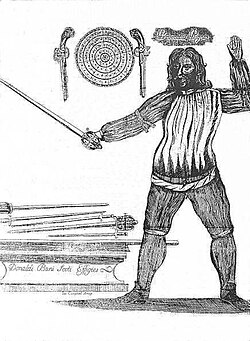
Key Facts
- Born: 1664 in Inverness, Scotland.
- Died: April 12, 1732.
- Major Work: The Expert Sword-Man's Companion (1728).
- Combat Experience: Participated in 16 battles and 15 skirmishes.
- Duelling Record: Claimed nearly 100 duels and 37 prize fights in London.
- Military Service: Served in the Scots Army, Royal Regiment of Scotland, and General Honeywood’s Regiment of Dragoons.
Early Life and Military Beginnings
Born in the Highland town of Inverness, McBane's journey began far from the fencing schools of Europe. In 1687, he abandoned his apprenticeship as a tobacco spinner to enlist in the Scots Army. His early military experience immersed him in the brutal clan warfare between the Macdonalds and Macintoshes, where combatants utilized the targe (a traditional Highland shield), Lochaber axes, and wooden-handled bayonets.
By 1689, McBane was serving in Colonel Alexander Grant's Regiment under King William II of Scots. He saw significant action at the Battle of Killiecrankie, where he opposed the Highland clans fighting for King James VII of Scots.
The Path to Mastery: Lessons and Duels
McBane's obsession with swordsmanship was born out of necessity. While serving in Colonel James Forbes's Regiment in 1691, a dispute over his pay led to a confrontation. Following the customs of the time, McBane was told to fight out the dispute. After an initial defeat that cost him his sword, he sought private instruction from a sergeant, focusing on the dynamics of the small sword (a light thrusting weapon) versus the broad sword (a heavier cutting blade).
His persistence paid off; a rematch resulted in victory and the recovery of his sword. By 1692, McBane had become a dominant presence in fencing schools, publicly defeating other scholars. His military career then took him to the Low Countries during the Nine Years' War, where he fought at the Battle of Steenkerque (1692) and stormed Namur in 1695.
The Price of Honor
Returning to Scotland in 1697, McBane briefly enlisted as a pikeman in the Earl of Angus's Regiment. However, a dispute with a corporal led to a duel in which McBane dealt a mortal wound. Because duelling was illegal, he was forced to flee to Glasgow, aided by the very captain and dying opponent who recognized the strict code of honor governing soldiers of the era.
Establishing Fencing Schools
In Dublin, McBane refined his skills at a French school, where training was often visceral and blood-stained. His proficiency grew to the point that he established his own school in Limerick. Later, while stationed in Baslo, Dutch Brabant, McBane recognized a lucrative opportunity to teach the art of swordsmanship to Swiss and Dutch officers.
To establish his reputation in the Netherlands, McBane fought and defeated a score of rival fencing masters. He even challenged four dominant swordsmen in town who controlled the local social scene and wealth. Despite one opponent attempting to shoot him with a pistol during their bout, McBane eventually secured a profitable arrangement with his rivals, allowing him to live comfortably through the winter.
A Career of War and Prize Fighting
McBane's life as a career soldier spanned much of Europe, most notably during the War of the Spanish Succession (1701–1714). He fought in legendary engagements such as Blenheim (1704) and Malplaquet (1709). Later, during the Jacobite Rising of 1715, he served as a sergeant in General Honeywood’s Regiment of Dragoons, guarding the Colours at the Battle of Preston.
Beyond the battlefield, McBane entered the world of professional prize fighting. He fought as a gladiator at London's Bear Gardens, Hockley-in-the-Hole, and Marybone Fields. He faced some of the most famous masters of the century, including James Figg, Timothy Buck, and James Miller.
Summary of Military and Martial Career
| Category | Details |
|---|---|
| Major Battles | Killiecrankie, Steenkerque, Namur, Blenheim, Malplaquet, Preston |
| Combat Specialties | Small sword, Broad sword, Gunnerie, Pike |
| Professional Fights | 37 prize fights in London; nearly 100 duels total |
| Key Opponents | James Figg, Timothy Buck, James Miller |
Later Years and Literary Legacy
McBane continued to fight well into his old age. In 1726, at the age of 63, he engaged in a duel in Edinburgh where he used a falchion (a short, curved sword) to break his opponent's arm and inflict seven wounds. Shortly after, he resolved to retire.
His most enduring contribution is the 1728 publication The Expert Sword-Man's Companion. This work combines his personal memoirs with a detailed treatise on fencing and the art of gunnerie. Historians and fencing experts, including Captain Alfred Hutton and Egerton Castle, have praised the work for its practical wisdom and the "rough quaintness" of McBane's narrative style. Historian J. D. Aylward described the memoir as perhaps the most ingenuous autobiography in the English language.
Frequently Asked Questions
What was Donald McBane's most famous book?
His most famous work is The Expert Sword-Man's Companion, published in 1728, which serves as both a memoir of his life and a technical manual on the art of fencing.
Which weapons did Donald McBane specialize in?
McBane was proficient in the small sword and broad sword, and he also had experience with the pike, falchion, and the art of gunnerie.
How many battles did McBane fight in?
As a career soldier, McBane participated in sixteen battles and fifteen skirmishes throughout Europe, including major conflicts like Blenheim and Malplaquet.
Who were some of McBane's most notable opponents?
In the professional prize-fighting circles of London, McBane faced celebrated swordsmen such as James Figg, Timothy Buck, and James Miller.
Why did McBane have to flee to Glasgow in 1697?
He had to flee after killing a corporal in a duel. Since duelling was illegal at the time, he escaped with the financial help of his captain and the dying corporal.