Diurnal Temperature Variation: Causes, Regional Differences, and Impacts
In the study of meteorology, diurnal temperature variation refers to the difference between the maximum and minimum air temperatures recorded within a single 24-hour period. This daily cycle is a fundamental aspect of Earth's climate, influencing everything from local weather patterns to the quality of agricultural produce.
The Mechanics of Daily Temperature Shifts
The timing of daily temperature peaks is not instantaneous with the sun's position. This delay is caused by temperature lag, also known as thermal inertia. Because the air continues to absorb net heat from the morning through the afternoon, the peak daily temperature generally occurs after noon. Conversely, the minimum temperature typically occurs around dawn, as the Earth loses heat throughout the entire night. This process is the daily equivalent of seasonal lag.
The heating process begins each morning as solar energy strikes the Earth's surface. This heats a shallow layer of air—approximately 1 to 3 centimeters (0.39 to 1.18 inches) deep—directly above the ground through conduction. Because heat exchange between this thin warm layer and the cooler air above is inefficient, significant temperature gradients can exist. For instance, on a warm summer day, temperatures can vary by as much as 16.5 °C (30 °F) between the ground level and chest height.
While incoming solar radiation often exceeds outgoing heat for several hours after midday, equilibrium is typically reached between 3 p.m. and 5 p.m. This timing can be influenced by several environmental factors, including wind, cloud cover, water vapor, soil type, ground moisture, and the proximity of large bodies of water.
Regional Differences in Temperature Variation
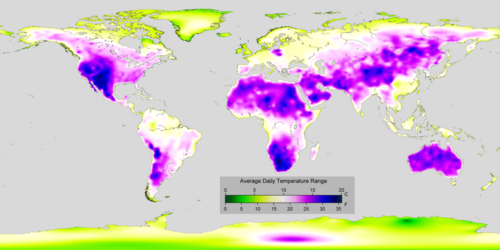
Diurnal variations are most pronounced near the Earth's surface and vary significantly based on geography and climate. High desert regions and high-altitude areas, such as the Tibetan and Andean Plateaus, the Western United States, and parts of southern Africa, exhibit some of the largest daily temperature swings on the planet.
In contrast, low-lying humid areas near coasts—including tropical, oceanic, and arctic regions—experience the least variation. Additionally, urban heat islands (large cities) tend to have lower diurnal variations than the rural areas surrounding them. For example, while Pinnacles National Park might swing from a high of 38 °C (100 °F) to a low of 5–10 °C (41–50 °F), the humid environment of Washington D.C. may only see a variation of 8 °C (14 °F), and urban Hong Kong may see a range of just over 4 °C (7.2 °F).
Extreme Air-Mass Events
While typical variations in humid tropical areas are 10 °F (5.6 °C) or less, and arid high-elevation areas range from 40 to 50 °F (22.2 to 27.8 °C), extreme anomalies can occur due to sharp air-mass changes. Two notable records of 102 °F (56.7 °C) variations were recorded in Montana:
- Browning, Montana (1916): A drastic temperature drop caused by frigid Arctic air from Canada displacing a warmer air mass.
- Loma, Montana (1972): A chinook event, where air from the Pacific Ocean crossed mountain ranges and warmed rapidly during its descent, displacing Arctic air.
Global Patterns
- Europe: Variations are generally less pronounced due to northern latitudes and proximity to warm waters like the Mediterranean. However, inland areas of Southern Europe, such as Southwestern Iberia (Alvega or Badajoz) and the plateaus of Turkey (Kayseri), can see differences around 14 °C (25 °F).
- Australia: Significant variations are commonly found in the Red Centre, specifically around Uluru and Alice Springs.
Impact on Viticulture
Diurnal temperature variation plays a critical role in viticulture (the cultivation of grapes for wine). Vineyards located at high altitudes experience the most dramatic daily temperature swings. This cycle is beneficial for grape quality: high daytime sunlight increases ripening and sugar content, while the sharp drop in nighttime temperatures preserves the natural acids, creating a balanced flavor profile.
Key Facts
- Thermal Inertia: Causes peak temperatures to occur after noon and minimums to occur around dawn.
- Humidity Influence: Higher humidity levels generally lead to lower diurnal temperature variations.
- Extreme Records: The highest recorded single-day variations reached 102 °F (56.7 °C) in Montana due to air-mass shifts.
- Urban Effect: Cities act as heat islands, reducing the gap between daily highs and lows.
- Agricultural Benefit: High diurnal variation in grapes helps balance sugar and acid levels.
| Environment Type | Typical Variation Range | Example Location |
|---|---|---|
| Humid/Tropical/Urban | Low (e.g., <10 °F / 5.6 °C) | Hong Kong, Washington D.C. |
| Arid/High-Elevation | High (40–50 °F / 22.2–27.8 °C) | Elko, NV; Tibetan Plateau |
| Extreme Air-Mass Shift | Very High (up to 102 °F / 56.7 °C) | Browning/Loma, Montana |
Frequently Asked Questions
Why doesn't the hottest part of the day happen at noon?
This is due to temperature lag (thermal inertia). The Earth's surface and the air continue to absorb more heat than they release for several hours after the sun reaches its zenith, pushing the peak temperature to between 3 p.m. and 5 p.m.
How does humidity affect daily temperature swings?
Humidity acts as a stabilizer; the higher the humidity in a region, the lower the diurnal temperature variation typically is.
What is a chinook event?
A chinook is a weather phenomenon where air from the Pacific Ocean moves over mountain ranges and warms significantly as it descends, which can cause a rapid and drastic increase in local temperatures.
Why is diurnal variation important for wine grapes?
The variation allows grapes to develop high sugar content during the warm day while preserving essential natural acids during the cool night, which is vital for the quality of the wine.
Where are the largest daily temperature differences found?
The greatest variations typically occur in high desert regions and high-altitude plateaus, such as those in the Western United States, the Andes, and the Tibetan Plateau.