Distinctive Features in Linguistics: The Building Blocks of Sound
In the study of linguistics, sounds are not merely random noises; they are structured components of a complex system. At the heart of this system lie distinctive features. These are the most basic units of phonological structure used to distinguish one sound from another within a specific language. For instance, the feature [± voice] is what allows a listener to differentiate between the bilabial plosives [p] and [b]. By identifying these tiny, incremental differences, linguists can map out the entire sound inventory of a language.
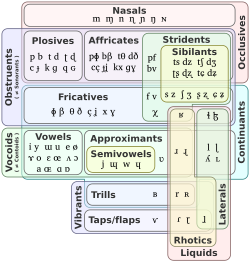
Since the 1950s, phonological analysis has relied heavily on these features to categorize segments. While different systems exist—some designed for a single language and others for universal application—the most influential framework was established by Roman Jakobson in 1941. This was later formalized by Noam Chomsky and Morris Halle in their 1968 work, The Sound Pattern of English. Their approach popularized the use of binary values: a positive value ([+]) indicates the presence of a feature, while a negative value ([−]) indicates its absence.
Key Facts
- Basic Unit: Distinctive features are the smallest units used to differentiate phonemes.
- Binary System: Most features are expressed as [+] (present) or [−] (absent).
- Natural Classes: Features are grouped into categories like major class, laryngeal, manner, and place.
- Unary Features: Modern theories also include "unary" or "privative" features that only describe the presence of a trait.
- Cross-linguistic Variation: A feature's classification can change depending on how a sound patterns within a specific language.
Categories of Distinctive Features
To organize the vast array of human speech sounds, linguists group features into specific categories based on the natural classes of segments they describe. These categories provide a systematic way to understand how sounds are physically produced and perceived.
Major Class Features
Major class features define the broadest categories of sounds:
- [± syllabic]: Determines if a segment can act as the nucleus of a syllable. Generally, [+syllabic] refers to vowels, while [− syllabic] refers to consonants.
- [± consonantal]: Refers to segments produced with an audible constriction in the vocal tract, such as nasals or obstruents.
- [± approximant]: Includes vowels, glides, and liquids, but excludes nasals and obstruents.
- [± sonorant]: Describes the type of oral constriction. [+son] sounds (vowels, glides, liquids, nasals) are produced without air pressure imbalances that cause turbulence, whereas [− son] sounds (obstruents) involve noticeable turbulence.
Laryngeal Features
Laryngeal features specify the state of the glottis (the opening between the vocal folds):
- [± voice]: Indicates whether the vocal folds vibrate during articulation.
- [± spread glottis]: Relates to aspiration; [+sg] indicates the glottis is open enough for friction to occur.
- [± constricted glottis]: Indicates the degree of glottal closure. [+cg] includes sounds like the glottal stop or ejective consonants.
Manner Features
Manner features describe the manner of articulation, or how the airflow is manipulated:
- [± continuant]: Whether air passes through the vocal tract in a continuous stream ([+cont]) or is obstructed ([− cont]).
- [± nasal]: Whether the velum is lowered to allow air into the nasal tract ([+nas]) or raised to block it ([− nas]).
- [± strident]: Applies to obstruents, referring to high-energy, noisy friction.
- [± lateral]: Describes air flowing along the sides of the tongue rather than through the center.
- [± delayed release]: Used to distinguish stops from affricates.
Place Features
Place features specify the place of articulation, or where in the mouth the sound is made:
- Labial: Articulated with the lips (e.g., bilabial or labiodental).
- Coronal: Articulated with the tip or blade of the tongue (e.g., dental, alveolar, or palatal).
- Dorsal: Articulated by raising the back (dorsum) of the tongue (e.g., velar or uvular).
- Radical: Articulated with the root of the tongue (e.g., epiglottal).
- Glottal: Sounds that do not involve the tongue at all.
Summary of Feature Categories
| Category | Focus Area | Example Features |
|---|---|---|
| Major Class | Broad sound types | [± syllabic], [± consonantal], [± sonorant] |
| Laryngeal | Glottal states | [± voice], [± spread glottis] |
| Manner | Airflow manipulation | [± nasal], [± continuant], [± lateral] |
| Place | Location of contact | [LABIAL], [CORONAL], [DORSAL] |
Applications Beyond Phonology
While primarily a tool for phonology, the concept of a distinctive feature matrix has been applied in other fields. In American Sign Language (ASL), features are used to differentiate handshapes in fingerspelling. In Natural Language Processing (NLP), analogous systems are used for part-of-speech tagging, where words are categorized by features like number, person, and tense. Even modern statistical NLP utilizes high-dimensional vectors of features to process language.
Frequently Asked Questions
What is the difference between binary and unary features?
Binary features use two values ([+] and [−]) to show if a trait is present or absent. Unary (or privative) features only describe the presence of a specific trait and do not define the class of sounds that lack it.
How do features help distinguish sounds like [p] and [b]?
They use specific dimensions of articulation. In this case, the feature [± voice] distinguishes them: [b] is voiced (vocal folds vibrate), while [p] is voiceless.
Can a sound have different features in different languages?
Yes. The classification of a sound depends on how it patterns with other sounds in a specific language. For example, the sound [l] might be classified as a continuant in one language but not in another.
What are "natural classes" in linguistics?
Natural classes are groups of sounds that share one or more distinctive features, allowing linguists to describe patterns that apply to the whole group rather than individual sounds.
What is the role of the velum in distinctive features?
The position of the velum determines the [± nasal] feature. When the velum is lowered, air passes through the nose ([+nas]); when it is raised, air is directed through the mouth ([− nas]).