Dime Novels: The Rise and Fall of America's First Mass-Market Paperbacks
Long before the modern paperback or the digital e-book, the American reading public was captivated by the dime novel. These cheap, sensational booklets provided an escape for the working class, blending frontier adventure with urban crime. What began as a specific series of publications eventually evolved into a cultural phenomenon that redefined how stories were consumed in the United States.
The Birth of the Beadle Era
The era began in 1860 when publishers Erastus and Irwin Beadle released Beadle's Dime Novels. The very first entry in this series was Malaeska, the Indian Wife of the White Hunter by Ann S. Stephens, published on June 9, 1860. While the story was a reprint of a serial from 1839, its new format was a massive success, selling over 65,000 copies in just a few months.
These early books typically measured 6.5 by 4.25 inches and contained roughly 100 pages. Initially, the first 28 issues featured simple salmon-colored paper wrappers without illustrations. However, starting with issue 29, woodblock prints were added to the covers, a trend that was retroactively applied to reprints of the earlier issues.
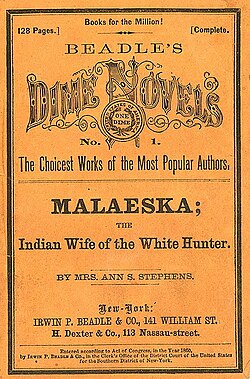
The series ran for 321 issues, establishing the hallmarks of the genre: lurid plots, outlandish scenarios, and melodramatic double titles. While many were original works, many others were reprints from story papers—weekly, eight-page publications that served as the "television of their day," offering a mix of serials and articles for the whole family.
A Literary Mirror of Democracy
The surge in popularity for dime novels coincided with rising literacy rates around the American Civil War. They found a dedicated audience among young, working-class readers who lacked the time or resources for formal higher education. Highbrow critics often derided the fiction as "cheap," but the demand was undeniable.
This phenomenon mirrored the observations of Alexis de Tocqueville in his 1835 work, Democracy in America. Tocqueville argued that in a socially permeable society like the U.S., the lower classes would cultivate literature in their own fashion. He predicted a preference for small productions that could be quickly read and provided "rapid emotions" and "startling passages" rather than complex, learned research.
Diversification and the "Nickel Weekly"
As the market grew, the term "dime novel" became a general descriptor for sensational fiction rather than a specific price point. While many cost ten cents, others ranged from ten to fifteen cents. Competition intensified as publishers like George Munro and Robert DeWitt entered the fray, often distinguishing their books only by the color of the paper wrappers.
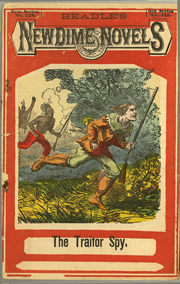
In 1874, Beadle & Adams introduced the New Dime Novels, which brought color to the covers and utilized a dual numbering system to maintain continuity with the original series. This evolution continued into the late 1880s with the introduction of recurring series characters. The Old Sleuth, appearing in 1872, became the first dime-novel detective and popularized the term "sleuth" (originally meaning a bloodhound) to describe a detective.
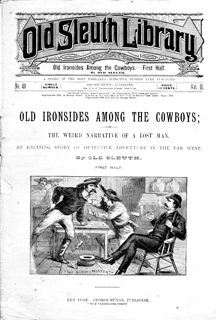
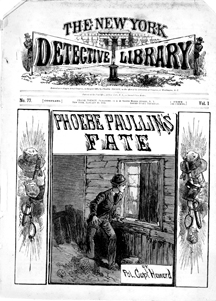
By the 1890s, the format shifted toward "nickel weeklies"—smaller, five-cent magazines designed to be accessible to children. Giants like Frank Tousey and Street & Smith dominated this era. Tousey's "big six" titles, including Secret Service and Pluck and Luck, often pushed more lurid and sensational content than their competitors.
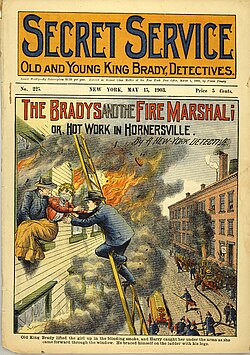
The "Thick-Book" and Final Formats
Parallel to the weeklies were the "thick-book" series. These were larger volumes (roughly 150 to 200 pages) published by firms like Arthur Westbrook and Street & Smith. These books often reprinted and slightly rewrote multiple stories from the weekly magazines to create a cohesive narrative.
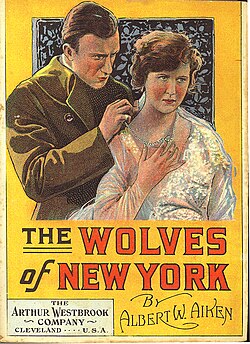
Street & Smith were particularly adept at this recycling process, publishing related tales in weeklies before combining them into editions like the New Magnet Library. Because these thick books often retained the original copyright dates from the 19th century, they are sometimes mistaken by modern collectors for original dime novels.
Key Facts
- First Publication: Malaeska, the Indian Wife of the White Hunter (June 9, 1860).
- Standard Early Size: Approximately 6.5 x 4.25 inches with 100 pages.
- Pricing: Typically 10 cents (a dime), though later "nickel weeklies" cost 5 cents.
- Key Figures: Beadle & Adams (pioneers), Frank Tousey and Street & Smith (market dominators).
- Genre Shift: Transitioned from frontier and Western tales to urban crime and detective stories.
- Legacy: Directly evolved into the pulp magazine era of the early 20th century.
| Format | Typical Price | Key Characteristics | Primary Content |
|---|---|---|---|
| Early Beadle Series | 10 Cents | Salmon wrappers, ~100 pages | Frontier tales, reprints |
| Nickel Weeklies | 5 Cents | Brightly colored covers, 32 pages | Urban crime, series characters |
| Thick-Books | Varied | 150-200 pages, higher-grade stock | Compiled weekly stories |
Frequently Asked Questions
What exactly was a dime novel?
Originally, it referred to a specific series of cheap paperbacks published by Beadle & Adams starting in 1860. Over time, it became a general term for any inexpensive, sensational fiction aimed at the working class, regardless of the exact price or format.
Who was the first detective character in dime novels?
The Old Sleuth, who first appeared in The Fireside Companion in 1872, was the first dime-novel detective. He is credited with popularizing the word "sleuth" to describe a detective and inspiring the "Old [Name]" naming convention for subsequent characters.
How did dime novels differ from story papers?
Story papers were weekly, newspaper-like publications (usually eight pages) that contained a variety of articles and serials for the whole family. Dime novels were standalone booklets that typically focused on a single story or character.
What caused the decline of the dime novel?
The emergence of pulp magazines in the late 1890s, led by Frank Munsey, provided a cheaper and more efficient way to produce fiction. By the mid-1920s, most remaining dime novel series had been converted into pulp formats, effectively ending the era.