Differential Calculus: The Mathematics of Change
In the vast landscape of mathematics, differential calculus serves as the primary tool for studying the rates at which quantities change. Whether it is the acceleration of a rocket, the fluctuation of stock prices, or the growth of a biological population, differential calculus provides the framework to analyze these dynamic processes with precision.
At its core, this field focuses on the derivative—a measure of the instantaneous rate of change of a function at a specific input. While integral calculus focuses on accumulation and the area beneath a curve, differential calculus looks at the opposite: the slope and the steepness of a curve at a single point. These two branches are inextricably linked by the fundamental theorem of calculus, which establishes that differentiation and integration are inverse processes.
Key Facts
- The Derivative: Represents the instantaneous rate of change and the slope of the tangent line to a function's graph.
- Differentiation: The mathematical process used to find the derivative of a function.
- Linear Approximation: The derivative provides the best linear approximation of a differentiable function near a specific point.
- Optimization: Differential calculus is used to find the maximum and minimum values of functions by identifying critical points.
- Physics Link: Velocity is the first derivative of position, and acceleration is the second derivative of position.
The Concept of the Derivative
The central pillar of differential calculus is the derivative. For a real-valued function of one variable, the derivative measures how the output changes relative to the input. Geometrically, if you plot a function on a graph, the derivative at any given point is the slope of the tangent line—a line that just touches the curve at that point.
Mathematically, if we have a function $y = f(x)$, the derivative is denoted as $f'(x)$ or $dy/dx$. It is defined as the limit of the slope of a secant line (a line passing through two nearby points) as the distance between those points approaches zero.
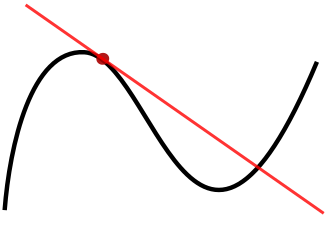
For example, if a function is defined as $f(x) = x^2$, its derivative is $f'(x) = 2x$. This means that at the point where $x = 2$, the slope of the parabola is 4.
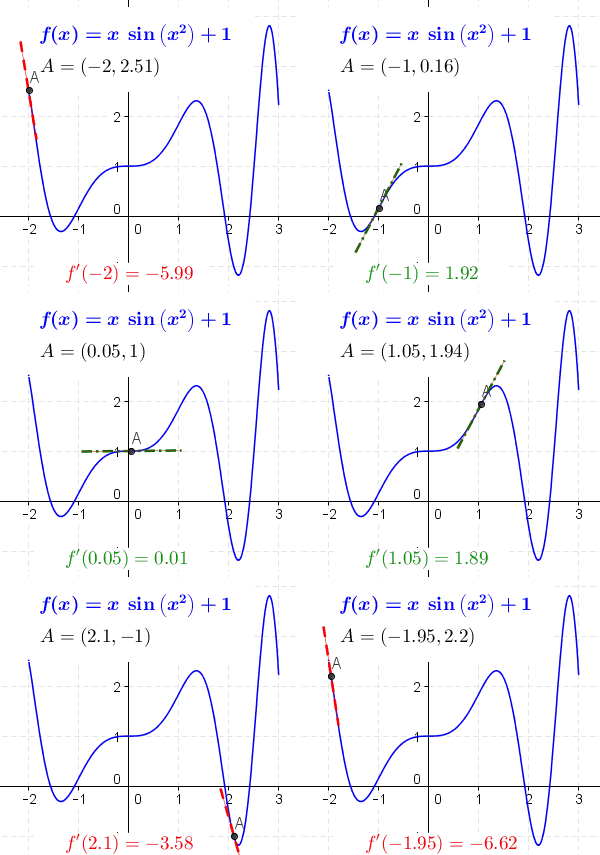
Linear Approximation and Differentials
Beyond slopes, the derivative allows us to create a linear approximation. This means that for values of $x$ very close to a point $a$, the function can be approximated by a straight line. The linear part of this change is known as the differential, which helps mathematicians and scientists estimate changes in complex systems without calculating the full function.
The Evolution of Differentiation
The pursuit of understanding tangents dates back to ancient Greece, with mathematicians like Euclid, Archimedes, and Apollonius of Perga. Later, Bhāskara II in India developed the use of infinitesimals to compute rates of change, and Sharaf al-Dīn al-Tūsī used early derivative-like concepts to find the maxima of cubic polynomials.
The modern era of calculus was forged independently by Isaac Newton and Gottfried Wilhelm Leibniz in the 17th century. While they built upon the work of predecessors like Pierre de Fermat and Isaac Barrow, Newton and Leibniz unified these ideas into a cohesive system. Newton famously applied these tools to theoretical physics, while Leibniz developed the notation (such as $dy/dx$) that remains the global standard today.
In the 19th century, the field became more rigorous through the work of Augustin Louis Cauchy, Bernhard Riemann, and Karl Weierstrass. By the 20th century, the introduction of Lebesgue integration and the theory of distributions extended these concepts to generalized functions, such as the Dirac delta function used in quantum mechanics.
Significant Mathematical Theorems
Several foundational theorems allow mathematicians to derive critical information about functions based on their derivatives.
Interior Extremum Theorem
This theorem states that if a differentiable function has a local maximum or minimum at an interior point, the derivative at that point must be zero. These are known as stationary points or critical points.
Rolle's Theorem
Rolle's theorem posits that if a smooth curve starts and ends at the same height over a closed interval, there must be at least one point between the endpoints where the tangent line is horizontal (the derivative is zero).
Mean Value Theorem
A generalization of Rolle's theorem, the Mean Value Theorem states that for a continuous and differentiable function, there is at least one point where the instantaneous rate of change equals the average rate of change over the entire interval.
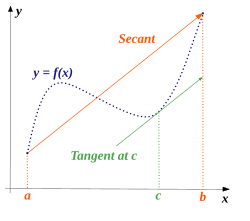
Taylor's Theorem
Taylor's theorem allows a complex function to be approximated by a polynomial. By using the function's derivatives at a single point, we can create a Taylor series that provides increasingly accurate approximations of the function.
| Theorem | Core Concept | Primary Application |
|---|---|---|
| Interior Extremum | Derivative is zero at local extrema | Finding maxima and minima |
| Rolle's Theorem | Horizontal tangent between equal endpoints | Proving existence of critical points |
| Mean Value Theorem | Instantaneous rate = Average rate | Deducing function behavior from derivatives |
| Taylor's Theorem | Polynomial approximation via derivatives | Simplifying complex functions |
Practical Applications
Optimization
One of the most powerful uses of differential calculus is optimization. By finding where the derivative is zero, we can identify the highest or lowest points of a function. The first derivative test checks the sign of the derivative around a critical point to see if it is a maximum or minimum, while the second derivative test uses the curvature (concavity) to confirm the result.
Physics and Engineering
Calculus is the language of physics. The relationship between position, velocity, and acceleration is a direct application of differentiation:
- Velocity: The first derivative of displacement with respect to time.
- Acceleration: The derivative of velocity, or the second derivative of position.
Differential Equations
A differential equation relates a function to its own derivatives. These are essential for modeling real-world phenomena. For example, Newton's second law of motion is expressed as an ordinary differential equation relating force, mass, and acceleration.
Calculus of Variations
This advanced application seeks to optimize entire curves rather than single points. Examples include finding geodesics (the shortest path between two points on a curved surface) or determining minimal surfaces (the smallest area that fills a closed curve in space).
Frequently Asked Questions
What is the difference between a derivative and a differential?
The derivative is the rate of change (the slope) at a specific point. The differential refers to the linear part of the change in the function's value, acting as an approximation of the total change for a small change in the input.
How do Newton and Leibniz contribute differently to calculus?
While both independently discovered the fundamental principles, Newton focused heavily on the application of calculus to physics (fluxions), whereas Leibniz developed the systematic notation and formal logic that mathematicians still use today.
What is a critical point?
A critical point is a point in the domain of a function where the derivative is either zero or undefined. These points are the primary candidates for local maxima and minima.
What does the Mean Value Theorem actually tell us?
It tells us that if you travel from point A to point B, there must have been at least one moment during your trip where your instantaneous speed was exactly equal to your average speed for the whole journey.
Can any shape be represented by a function?
No. Some shapes, like circles, cannot be represented by a single function because one input would have multiple outputs. However, the implicit function theorem allows us to treat these shapes as a collection of smaller function graphs pasted together.