Dieter Hoeneß: The Legacy of a Bundesliga Powerhouse and Executive
Dieter Hoeneß is a name synonymous with the golden eras of German football. Known as a formidable forward during his playing days and a strategic leader in the boardroom, Hoeneß carved out a distinguished career that spanned the pitch and the executive office. From his early days in Ulm to the heights of the 1986 FIFA World Cup, his journey reflects the evolution of the professional game in West Germany.
Key Facts
- Total Career Goals: 192 goals across 432 club domestic league appearances.
- Bayern Munich Success: Won five Bundesliga titles and three DFB-Pokal cups.
- European Prowess: Top scorer of the UEFA Cup (1980) and the European Cup (1982).
- International Peak: Represented West Germany in the 1986 World Cup Final.
- Executive Roles: Served as general manager for VfB Stuttgart, Hertha BSC, and VfL Wolfsburg.
Early Career and Rise Through the Ranks
Born on January 7, 1953, in Ulm, West Germany, Dieter Hoeneß began his footballing journey in an unconventional role, playing as a goalkeeper for VfB Ulm between the ages of six and fourteen. The club held deep family ties, having been co-founded by his father, Erwin Hoeneß, a master butcher.
After transitioning to the outfield, Hoeneß played for TSG Ulm 1846 before moving to VfR Aalen in 1973. His impact was immediate; in his first season at Aalen, he scored 23 goals to help the team win the championship. Despite this success, league reforms prevented promotion, leading Hoeneß to join VfB Stuttgart in 1975.
At Stuttgart, Hoeneß transitioned into the professional ranks, eventually making his Bundesliga debut on August 6, 1977. His ability to find the back of the net helped Stuttgart secure promotion and establish themselves in the top flight, setting the stage for his move to one of the world's most prestigious clubs.
The Bayern Munich Era
In 1979, Hoeneß signed with FC Bayern Munich, where he would spend the next eight years. As a powerful striker renowned for his exceptional heading ability, he became a cornerstone of the Bavarian attack. During his tenure, he scored 102 goals in 224 Bundesliga matches and added another 26 goals in 52 European Cup appearances.
Hoeneß's resilience became legendary during the 1982 DFB-Pokal Final. After suffering a head injury in a collision with Alois Reinhard, he continued to play for nearly an hour while wearing a turban-like bandage, eventually scoring the 4–2 goal with a header in the 89th minute.
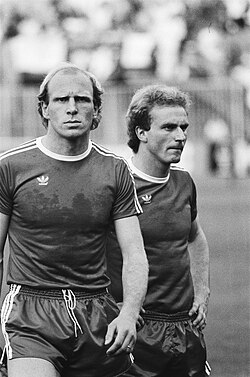
His individual accolades were equally impressive. He finished as the top scorer of the 1979–80 UEFA Cup and the 1982 European Cup, both with seven goals. One of his most dominant performances occurred on February 25, 1984, when he scored five goals in just 21 minutes against Eintracht Braunschweig.
International Career and the 1986 World Cup
Hoeneß's international journey began with the West Germany B team in 1979, where he scored in his first two appearances. He eventually earned six caps for the senior West Germany national team, scoring four goals.
After a seven-year hiatus from the national squad, a stellar 1985–86 season with Bayern Munich earned him a call-up for the 1986 FIFA World Cup in Mexico. Hoeneß played in the final against Argentina, entering the match at the 60-minute mark. At 33 years and 173 days, he was the oldest player on the pitch during the final.
Transition to Football Executive
Following his retirement in 1987, Hoeneß transitioned into sports marketing and management. He initially worked for Commodore International before returning to club management as the general manager of VfB Stuttgart from 1990 to 1995. While he helped the club win the league title in 1991–92, his tenure ended amid criticism regarding his modern management style and use of Anglo-Saxon business terminology.
Hoeneß later found significant success at Hertha BSC, where he served as vice-president and later general manager. Under his leadership, the club qualified for international competitions seven times in twelve seasons. He concluded his executive career with a stint as general manager at VfL Wolfsburg, starting in January 2010.
| Category | Details |
|---|---|
| Playing Position | Forward |
| Total League Apps (Goals) | 432 (192) |
| Major Clubs | VfR Aalen, VfB Stuttgart, Bayern Munich |
| National Team | West Germany (6 caps, 4 goals) |
| Executive Roles | VfB Stuttgart, Hertha BSC, VfL Wolfsburg |
Personal Life and Family Legacy
Beyond football, Hoeneß is an academic and a philanthropist. He earned his Abitur in 1972 and studied English, geography, and sports in Tübingen. He has served as a city sponsor for Ulm and an ambassador for the anti-racism initiative Respect! No place for racism.
Football runs deep in the Hoeneß family. His brother, Uli Hoeneß, was also a professional forward and became one of the most influential executives in football history as the president of Bayern Munich. The legacy continues with Dieter's son, Sebastian Hoeneß, who has transitioned from a playing career to a successful managerial career, including a championship win with FC Bayern Munich II.
Frequently Asked Questions
What was Dieter Hoeneß's primary strength as a player?
Dieter Hoeneß was a powerful striker best known for his exceptional heading ability and fierce competitiveness on the pitch.
How many goals did he score for Bayern Munich in the Bundesliga?
He scored 102 goals in 224 Bundesliga appearances for Bayern Munich.
Which major international tournament did he participate in?
He was part of the West Germany squad for the 1986 FIFA World Cup in Mexico, where he played in the final against Argentina.
What executive roles did he hold after retiring?
He served as a general manager or vice-president at VfB Stuttgart, Hertha BSC, and VfL Wolfsburg.
Is he related to other famous football figures?
Yes, he is the brother of Uli Hoeneß (former Bayern Munich president) and the father of Sebastian Hoeneß (football manager).