Dew Point: The Science of Humidity and Human Comfort
When we talk about the weather, we often mention humidity, but dew point is the more precise measure of how much moisture is actually in the air. While relative humidity tells us how saturated the air is compared to its maximum capacity, the dew point provides a thermodynamic value that describes the air's actual water content.
In simple terms, the dew point is the temperature to which air must be cooled—at a constant pressure and absolute humidity—for the relative humidity to reach 100%. When air temperature drops below this threshold, the air can no longer hold all its water vapor, leading to condensation, where vapor transforms into liquid water.
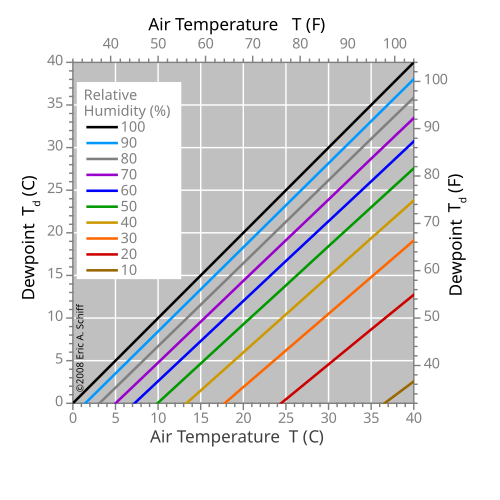
Key Facts
- Definition: The temperature at which air becomes saturated and water vapor begins to condense.
- Humidity Link: Higher absolute humidity (more water vapor) results in a higher dew point.
- Saturation: When air temperature equals the dew point, relative humidity is 100%.
- Frost Point: The equivalent of the dew point when temperatures are below freezing, resulting in ice crystals via deposition.
- Human Comfort: Dew points above 21°C (70°F) are generally considered oppressive or "sticky."
The Mechanics of Humidity and Condensation
The relationship between temperature and moisture is dynamic. As air temperature falls, its capacity to hold water vapor decreases. If the temperature continues to drop until it hits the dew point, the air becomes saturated. If it drops further, water vapor precipitates. Depending on where this happens, it manifests in different forms:
- Dew: Water that condenses on a cold solid surface.
- Fog or Clouds: Water that condenses in the air (fog at low altitudes, clouds at higher altitudes).
- Frost: Water vapor that turns directly into ice when the temperature is below the freezing point.
In some cases, air can become supersaturated. This occurs when the temperature falls below the dew point but no condensation happens because there are insufficient particles, known as condensation nuclei, for the water to cling to.
The Role of Atmospheric Pressure
Barometric pressure also influences the dew point. Increasing the pressure raises the dew point. Consequently, at higher elevations where pressure is lower, the air can contain more water vapor for the same dew point compared to sea level. For example, if Denver and New York City have the same dew point, Denver's air actually contains a greater mass of water vapor due to its higher elevation and lower pressure.
Dew Point and Human Comfort
The dew point is a superior predictor of human comfort and summer energy use for cooling compared to relative humidity. This is because the human body relies on evaporative cooling—the process of perspiration evaporating from the skin to remove heat.
When the dew point is high, the air is closer to saturation, meaning perspiration evaporates more slowly. If the air is fully saturated, sweat cannot evaporate at all, leaving the body coated in moisture and unable to cool itself effectively. Conversely, extremely low dew points (below −5°C or 23°F) can cause discomfort by drying out the airways and causing skin to crack.
Comfort Thresholds and Acclimatization
Comfort is subjective and often depends on acclimatization. People in tropical climates like Singapore or Miami often tolerate higher dew points than those in temperate cities like London or Chicago. Generally, those in temperate climates feel uncomfortable above 15°C (59°F), while dew points above 21°C (70°F) are viewed as oppressive.
Altitude, Clouds, and Measurement
As an air mass rises in the atmosphere, pressure reduces and the air cools. The dew point temperature typically falls by 0.2°C per 100 meters (or 4.5°F per 1000 feet). When the air temperature reaches the dew point, condensation begins, forming the flat bottoms characteristic of cumulus clouds. This process also releases 600 calories of energy per gram of water, which warms the surrounding air.
To measure this accurately, scientists use dew point meters. These devices use a polished metal mirror that is cooled until condensation forms, causing the mirror to lose its clarity. This physical change reveals the exact dew point temperature.
| Dew Point Range | Relative Humidity (at 32°C/90°F) |
|---|---|
| Over 27°C (Over 80°F) | 73% and higher |
| 24–26°C (75–79°F) | 62–72% |
| 21–24°C (70–74°F) | 52–61% |
| 18–21°C (65–69°F) | 44–51% |
| 16–18°C (60–64°F) | 37–43% |
| 13–16°C (55–59°F) | 31–36% |
| 10–12°C (50–54°F) | 26–30% |
| Under 10°C (Under 50°F) | 25% and lower |
Calculating the Dew Point
Meteorologists use several formulas to calculate the dew point based on air temperature and relative humidity. The Magnus formula is a common empirical approximation. For higher precision, the Arden Buck equation (or Bögel modification) is used, which incorporates additional constants to minimize error across wider temperature ranges.
For a quick estimate when relative humidity is above 50%, a simple rule of thumb applies: for every 1°C difference between the air temperature and the dew point, the relative humidity decreases by approximately 5%.
Frequently Asked Questions
What is the difference between dew point and relative humidity?
Relative humidity is a percentage that describes how much moisture the air holds relative to the maximum it could hold at that specific temperature. The dew point is an absolute temperature value that tells you exactly when condensation will begin, regardless of the current air temperature.
Why does a high dew point feel "sticky"?
A high dew point means the air is nearly saturated with moisture. This prevents perspiration from evaporating off your skin, which is the body's primary method of cooling down, leading to a sticky feeling and increased heat stress.
What is the frost point?
The frost point is the temperature to which air must be cooled for water vapor to deposit directly as ice crystals, bypassing the liquid phase. It is always slightly higher than the dew point because of the stronger bonding between water molecules on ice surfaces.
How do pilots use dew point data?
General aviation pilots monitor the dew point to estimate the height of cumuliform cloud bases and to assess the risk of fog formation and carburetor icing.
What is the highest dew point ever recorded?
The highest recorded dew point on Earth was 35°C (95°F), observed in Dhahran, Saudi Arabia, on July 8, 2003, with an accompanying air temperature of 42°C (108°F).