Devlet Bahçeli and the Leadership of the MHP
Devlet Bahçeli has been a central figure in Turkish politics for decades, serving as the long-term chairman of the Nationalist Movement Party (MHP). His leadership has seen the party navigate extreme fluctuations in electoral success, internal legal battles, and strategic shifts in government alliances.
Rise to Leadership
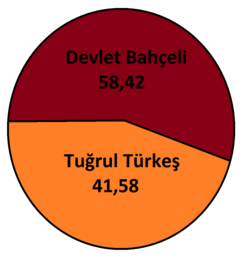
Following the death of Alparslan Türkeş in May 1997, the MHP faced a leadership transition. Bahçeli contested the chairmanship against Tuğrul Türkeş, the son of the party's founder. While most other candidates withdrew in favor of Bahçeli, the initial Extraordinary Congress was postponed due to clashes between supporters of the two nationalists.
The resolution came in July during another extraordinary congress, where Devlet Bahçeli won the run-off election against Tuğrul Türkeş, officially becoming the new chairman of the MHP.
Governmental Role and Electoral Volatility
Under Bahçeli's early leadership, the MHP experienced significant growth. In the 1999 election, the party achieved its highest historical vote share of 17.98%, becoming the second largest party in Turkey. This success led to Bahçeli serving as deputy prime minister in a coalition government led by Bülent Ecevit, consisting of the DSP, Motherland Party, and MHP.
However, this period of influence was short-lived. On July 7, 2002, Bahçeli withdrew his support for the government and called for new elections to address Turkey's economic issues. In the November 3, 2002, general election, the MHP polled 8%, failing to meet the 10% electoral threshold required to enter parliament. Bahçeli initially resigned, taking sole responsibility for the failure, but was re-elected as chairman during the 2003 congress, defeating candidates Ramiz Ongun, Koray Aydın, and Aytekin Yıldırım.
Return to Parliament and Opposition
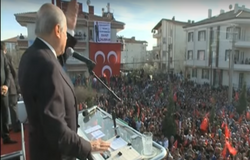
Bahçeli secured his leadership again in November 2006. By the 2007 general election, the MHP successfully re-entered parliament with 14.27% of the vote. Despite subsequent efforts—including a 2011 campaign promising a change in electoral laws and 7% GDP growth—the party's vote share dipped to 13%.
The June 2015 election saw a resurgence under the slogan "Bizimle yürü Türkiye!" (Walk with us, Turkey!), with the party's vote share rising to 16.29%. This resulted in a hung parliament. While CHP leader Kemal Kılıçdaroğlu offered Bahçeli the premiership for a minority government, Bahçeli declined, instead suggesting a grand coalition between the CHP and AKP with himself as the main opposition leader. When these talks failed and President Recep Tayyip Erdoğan called for new elections on November 1, 2015, the MHP's momentum slowed, and its vote share fell below 12%.
Internal Conflict and the MHP Congress Controversy
The 2015 electoral decline sparked internal unrest. High-ranking members, including Meral Akşener, Sinan Oğan, and Koray Aydın, demanded Bahçeli's resignation and called for an extraordinary congress. Bahçeli rejected these demands, scheduling a regular congress for March 2018 instead.
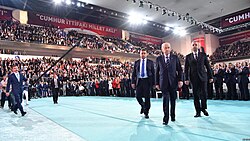
The dispute moved to the courts. The Constitutional Court and the Supreme Court ruled in favor of the opposition, mandating an extraordinary congress. On June 19, 2016, the 6th Extraordinary Grand Congress convened. Although the congress renewed 13 articles of the party bylaws—including a change allowing the election of chairmen during extraordinary congresses—the Court of Cassation stopped the execution of these decisions. This led Meral Akşener to file a complaint with the Supreme Election Council (YSK) citing "complete unlawfulness."
The conflict culminated in the expulsion of Meral Akşener, Yusuf Halaçoğlu, and Ümit Özdağ from the MHP. On October 25, 2017, these expellees founded the Good Party under Akşener's leadership.
The People's Alliance and Recent Years
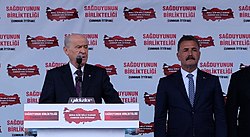
A strategic shift occurred in 2017 when Bahçeli supported President Erdoğan in the constitutional amendment referendum. This evolved into the People's Alliance, an electoral pact between the AKP and MHP for the 2018 general election. Bahçeli declined to run for president, throwing the MHP's support behind Erdoğan.
In the 2018 election, the MHP received 11% of the vote and secured 49 deputies. Since then, the MHP has provided confidence and supply to an AKP minority government. This alliance continued into the 2019 local elections, where the MHP and AKP avoided nominating candidates against each other in several key cities. The MHP won mayorships in provinces including Amasya, Kastamonu, Kütahya, Çankırı, Erzincan, Bayburt, Bartın, and Karabük.
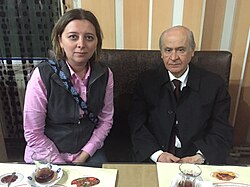
Bahçeli has remained chairman through congresses in 2018 and 2021. Notably, from June 2 to 7, 2023, he served as the temporary speaker of the 28th Grand National Assembly as the oldest member of the body.
Key Facts
- Highest Vote Share: 17.98% in the 1999 general election.
- Government Role: Served as Deputy Prime Minister in the DSP-Motherland-MHP coalition.
- Strategic Alliance: Co-founded the People's Alliance with the AKP.
- Internal Split: The 2016-2017 leadership dispute led to the formation of the Good Party.
- Legislative Role: Temporary speaker of the 28th Grand National Assembly in June 2023.
| Year | Event/Election | Outcome/Vote Share |
|---|---|---|
| 1997 | Extraordinary Congress | Bahçeli elected Chairman |
| 1999 | General Election | 17.98% (Second largest party) |
| 2002 | General Election | 8% (Failed to enter parliament) |
| 2007 | General Election | 14.27% (Re-entered parliament) |
| 2011 | General Election | 13% |
| June 2015 | General Election | 16.29% |
| Nov 2015 | General Election | Less than 12% |
| 2018 | General Election | 11% (49 deputies) |
Public Image and Rhetoric
Beyond policy, Bahçeli is known in Turkish politics for his unique speaking style, characterized by malapropisms (the mistaken use of a word in place of a similar-sounding one) and gaffes. One of his most famous moments involved a viral pronunciation of the word "biscuit." He is also remembered for a complex mathematical explanation during a 2009 campaign speech to illustrate the party's 40th anniversary, which subsequently became a popular internet meme.
Frequently Asked Questions
How did Devlet Bahçeli become the leader of the MHP?
He was elected chairman in July 1997 during an extraordinary congress, winning a run-off election against Tuğrul Türkeş following the death of Alparslan Türkeş.
What is the People's Alliance?
The People's Alliance is an electoral alliance formed in 2018 between the AKP and the MHP to support the candidacy of Recep Tayyip Erdoğan and coordinate parliamentary representation.
Why was the Good Party formed?
The Good Party was founded in October 2017 by MHP members, including Meral Akşener, who were expelled from the MHP after demanding an extraordinary congress to challenge Bahçeli's leadership.
Did the MHP ever fail to enter the Turkish parliament?
Yes, in the 2002 general election, the MHP polled 8%, which was below the 10% electoral threshold required to enter parliament at that time.
What role did Bahçeli play in the 28th Grand National Assembly?
Due to being the oldest member, Bahçeli served as the temporary speaker of the assembly from June 2 to June 7, 2023.