Deuterostomes: The Evolutionary Lineage of the Second Mouth
In the vast tree of animal life, deuterostomes represent one of the most significant branches of bilaterian animals—organisms characterized by bilateral symmetry and three primary germ layers. The term originates from the Ancient Greek deúteros (second) and stóma (mouth), a direct reference to the unique way these animals develop in the womb or egg.
While they encompass a diverse array of creatures, from the simplest sea squirts to the complexity of human beings, deuterostomes share a fundamental biological blueprint that distinguishes them from their evolutionary cousins, the protostomes.
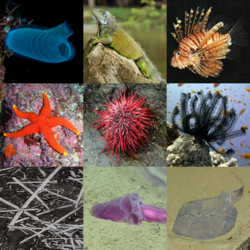
Key Facts
- Defining Trait: During embryonic development, the first opening (the blastopore) becomes the anus, while the mouth forms secondarily.
- Major Phyla: Includes Chordata (vertebrates and relatives), Echinodermata (sea stars, urchins), and Hemichordata (acorn worms).
- Temporal Range: Present from the Cambrian period (approximately 538.8 million years ago) to the present day.
- Developmental Style: Typically exhibit indeterminate cleavage, allowing separated early embryonic cells to develop into complete larvae.
- Coelom Formation: Known as enterocoelomates because their body cavity (coelom) develops through the pouching of the gut.
Embryonic Development and Characteristics
The primary distinction of the superphylum Deuterostomia is the fate of the blastopore, the first opening formed in the developing embryo. In deuterostomes, this opening becomes the anus or cloaca, and the mouth is created later at a different site. This contrasts with protostomes, where the mouth typically develops first.
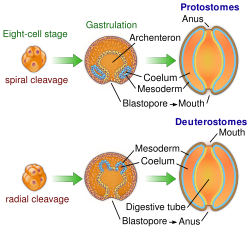
Beyond the blastopore, deuterostomes are characterized by indeterminate cleavage. In this process, the developmental fate of early embryonic cells is not predetermined. If cells are separated during the early stages, each can potentially grow into a complete, albeit smaller, larva. This biological flexibility is the mechanism that allows for the occurrence of identical twins.
Structurally, many deuterostomes share ancestral traits. Chordates possess a hollow nerve cord, a feature also mirrored in the early embryonic stages of some hemichordates. Evidence suggests that the common ancestor of all modern deuterostomes likely possessed a segmented body, circular and longitudinal muscles, a hollow nerve cord, and pharyngeal gill slits.
Taxonomy and Classification
The classification of deuterostomes has evolved significantly. Originally, groups like Brachiopoda and Phoronida were included based on physical traits. However, DNA molecular sequence analyses in 1995 redefined the group, moving those organisms into the protostome superphylum Lophotrochozoa. Genetic research has since identified over 30 genes unique to deuterostomes, which may have been acquired via horizontal gene transfer or preserved from ancient ancestors.
The current consensus divides the superphylum into several key groups:
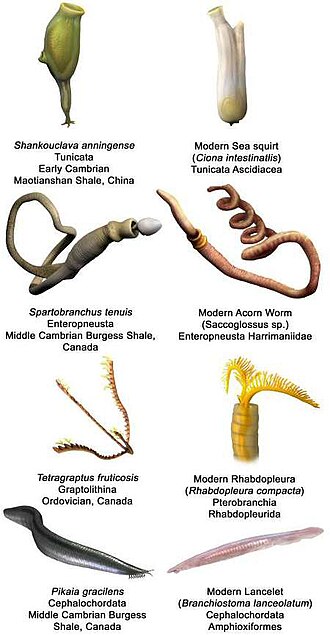
- Chordata: Includes vertebrates (fish, mammals, birds), Cephalochordata (lancelets), and Tunicata (tunicates).
- Ambulacraria: A clade comprising Echinodermata (sea stars, sea cucumbers, sea lilies) and Hemichordata (acorn worms, pterobranchs).
- Cambroernida: An extinct clade of early deuterostomes.
| Phylum | Common Examples | Key Distinguishing Feature |
|---|---|---|
| Chordata | Humans, Fish, Tunicates | Hollow nerve cord, notochord |
| Echinodermata | Sea Stars, Sea Urchins | Pentaradial symmetry (adults) |
| Hemichordata | Acorn Worms | Proboscis and collar |
Evolutionary History and Fossil Record
The split between protostomes and deuterostomes likely occurred during the Ediacaran Period, well before the Cambrian explosion. This is suggested by the existence of Kimberella (a protostome) approximately 555 million years ago. The ancestral deuterostome is hypothesized to have been a benthic worm with a cartilaginous skeleton, a central nervous system, and gill slits, utilizing an active suspension feeding strategy.
The fossil record provides a rich timeline of this evolution. While Ediacaran fossils like Arkarua may represent early echinoderms, the Cambrian period saw a surge in diversity. Notable early fossils include Pikaia (a primitive chordate) and Haikouichthys (one of the earliest fish). By 508 million years ago, fossils such as Spartobranchus indicate that the main deuterostome lineages were already firmly established.
Frequently Asked Questions
What is the main difference between a deuterostome and a protostome?
The primary difference is the development of the blastopore in the embryo; in deuterostomes, the blastopore becomes the anus, whereas in protostomes, it typically becomes the mouth.
Why are deuterostomes called enterocoelomates?
They are called enterocoelomates because their coelom, or main body cavity, forms through a process called enterocoely, where the cavity develops from pouches budding off the gut.
How do identical twins occur in deuterostomes?
Identical twins are possible due to indeterminate cleavage, where early embryonic cells are not yet committed to a specific fate. If these cells separate, each can develop into a complete individual.
Which animals are considered deuterostomes?
Deuterostomes include all vertebrates (mammals, birds, reptiles, amphibians, fish), as well as invertebrates such as sea stars, sea urchins, sea cucumbers, and acorn worms.
When did deuterostomes first appear in the fossil record?
While some disputed fossils exist in the Ediacaran period, they are prominently established by the start of the Cambrian period, approximately 538.8 million years ago.