Derna: A Comprehensive History of a Libyan Coastal City
Derna is a city of profound historical depth, situated on the coast of Libya. From its origins as a Greek colony to its role in global conflicts and its resilience in the face of natural disasters, Derna has served as a strategic crossroads for empires and ideologies. Its journey reflects the broader turbulence and transformation of the North African region over two millennia.
Ancient Origins and the Middle Ages
During the Hellenistic period, the ancient city of Darnis was a key part of the Libyan Pentapolis, a group of five cities colonized by the Greeks. As the region transitioned to Roman rule, Darnis evolved into a significant administrative and religious center, serving as the civil and later the religious metropolis of the province of Libya Secunda (also known as Libya Inferior), which encompassed the Marmarica region.
The city's religious importance is evidenced by the records of its metropolitan bishops. Notable figures include Piso, who participated in the Council of Philippopolis in 347 after withdrawing from the Council of Sardica; Dioscorus, known for a 5th-century dispute with the bishop of Erythrum; and Daniel, who attended the Council of Ephesus in 431. Additionally, the mid-5th century saw Bishop Thedodorus report a vision of Saint Leo the Great. While no longer a residential bishopric, the Catholic Church maintains Darnis as a titular see.
In 1493, the city saw a new wave of settlement when refugees from Islamic Spain, known as Moriscos (Muslims who remained in Spain after the Reconquista), resettled on the site of the ancient settlement.
The Ottoman Era and Early Modern Conflicts
Under Ottoman rule, Derna's administration shifted several times. Initially governed from Tripoli, it fell under the Karamanli sultanate shortly after 1711. By 1835, it became a dependency of the autonomous sanjak of Benghazi in Cyrenaica, governed directly from Constantinople, and eventually became part of the vilayet of Cyrenaica in 1875. By the 1850s, the city supported approximately 4,500 residents who relied on fishing, agriculture, and coastal trade.
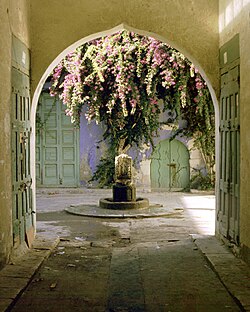
The city's architecture reflects the available resources of the Cyrenaica region. The Al-masjeed al-ateeq (Old Mosque), restored in 1772 by wali Mahmoud Karamanli, features 42 small cupolas—a design choice necessitated by the local scarcity of timber and stone. Another significant structure, the Masjeed az-zawiyah, was built in 1846 into the side of a hill.
Derna's strategic location often drew foreign military interest. In June 1800, French Admiral Gantheaume attempted to land troops to reinforce Napoleon in Egypt, but was repelled by the local garrison. Later, in 1805, the city became a focal point of the First Barbary War. U.S. Lieutenant William Eaton, after marching 800 km (500 miles) from Alexandria across the Libyan Desert, captured the city in the Battle of Derne.
The 20th Century: Italian Rule and World War II
The Ottoman era ended on October 16, 1911, when Italian troops captured the city during the Italo-Turkish War. Italian administration lasted for just over 29 years, ending on January 30, 1941, when Australian troops seized the city during the North African Campaign of World War II.
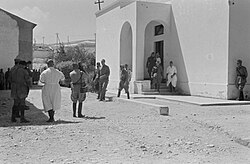
The city changed hands rapidly during the war: German forces retook Derna on April 6, 1941, and British forces recaptured it on November 15, 1942. During this period, the RAF Derna airbase and the nearby Martuba Airbase served as critical hubs for Mediterranean shipping attacks and land campaign air support.
Modern Libya: Political Unrest and Conflict
In the 21st century, Derna gained a reputation as one of Libya's most fundamentalist cities. In 2007, U.S. troops in Iraq discovered that 52 of the 112 Libyans listed as foreign fighters for the Iraqi insurgency originated from Derna.
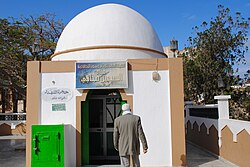
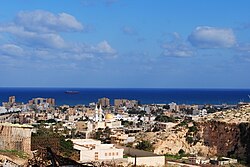
Following the mass protests of February 18, 2011, Derna broke away from the government and came under the control of the National Transitional Council. The city remained outside the control of the Gaddafi regime until his eventual ouster. However, stability remained elusive. In October 2014, local militants from the Islamic Youth Shura Council pledged allegiance to Abu Bakr al-Baghdadi, the leader of the Islamic State, which al-Baghdadi formally accepted in November 2014.
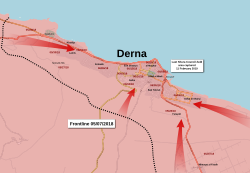
This period of instability culminated in a two-year siege, ending on June 28, 2018, when forces loyal to Khalifa Haftar claimed full control of the city after a month-long battle.
The Tragedy of Storm Daniel
On September 10, 2023, Storm Daniel made landfall near Benghazi, bringing torrential rains to the region. The resulting extreme flooding led to the collapse of the Derna dam and the Mansour dam on the morning of September 11. The resulting floodwaters inundated the areas surrounding the Wadi Derna.
The catastrophe was immense: at least 4,352 people were confirmed dead, with initial casualty estimates exceeding 11,300. A government minister reported that approximately 25% of the city had "disappeared," with vast sections of the urban area washed into the sea.
Key Facts
- Ancient Name: Known as Darnis during the Hellenistic and Roman periods.
- Strategic Importance: Served as a religious metropolis for the province of Libya Secunda.
- Military History: Site of the 1805 Battle of Derne during the First Barbary War.
- WWII Shifts: Captured by Australians (1941), then Germans (1941), then British (1942).
- Recent Disaster: Storm Daniel (2023) caused two dam collapses and the loss of 25% of the city.
| Era/Period | Ruling Power/Influence | Key Event/Characteristic |
|---|---|---|
| Hellenistic/Roman | Greek/Roman Empire | Part of Libyan Pentapolis; Religious Metropolis |
| 1493 | Moriscos | Resettlement by refugees from Islamic Spain |
| Ottoman Era | Ottoman Empire / Karamanli | Construction of Al-masjeed al-ateeq |
| 1911 – 1941 | Kingdom of Italy | Colonial rule for 29+ years |
| 1941 – 1942 | Allied/Axis Forces | WWII North African Campaign battles |
| 2011 – 2018 | NTC / Islamic State / Haftar | Civil war and ideological conflict |
| 2023 | Natural Disaster | Storm Daniel and dam collapses |
Frequently Asked Questions
What was the significance of the Battle of Derne in 1805?
The Battle of Derne was a key event in the First Barbary War, where U.S. forces led by Lieutenant William Eaton captured the city after a grueling 800 km march across the Libyan Desert.
Why does the Old Mosque in Derna have 42 small cupolas?
The Al-masjeed al-ateeq was built with small cupolas because the Cyrenaica region lacked sufficient quantities of timber and stone required for larger, traditional vaults.
Which foreign powers controlled Derna during World War II?
Derna was captured by Australian troops in January 1941, retaken by German forces in April 1941, and finally recaptured by British forces in November 1942.
What caused the massive destruction in Derna in 2023?
Storm Daniel brought torrential rainfall that caused the Derna and Mansour dams to collapse, sending floodwaters through the city and washing approximately 25% of the urban area into the sea.
Who were the Moriscos that settled in Derna?
The Moriscos were refugees from Islamic Spain who were expelled during the Reconquista and resettled in Derna in 1493.