Department of the Army Organizational Structure and Governance
The Department of the Army serves as a critical military department within the United States Department of Defense. Its structure is designed to balance civilian oversight with professional military expertise, ensuring that the land forces of the United States are organized, trained, and equipped to meet national security objectives.
At the highest level, the department is led by the Secretary of the Army. By statute, this individual must be a civilian, appointed by the President and confirmed by the United States Senate. While the Secretary of the Army holds the authority to conduct all affairs of the department, this power is subject to the direction and control of the Secretary of Defense.
Key Facts
- Civilian Leadership: The Secretary of the Army is a Senate-confirmed civilian appointed by the President.
- Dual Staff System: The headquarters consists of the civilian-led Office of the Secretary and the military-led Army Staff.
- Operational Control: Most Army forces are assigned to the operational command of Combatant Commanders by the Secretary of Defense.
- Highest Military Rank: The Chief of Staff of the Army is a four-star general and a member of the Joint Chiefs of Staff.
- Legal Framework: The organization operates under specific mandates of the United States Code, including Title 10.
Headquarters, Department of the Army
The Headquarters, Department of the Army (HQDA) acts as the corporate office for the entire organization, exercising directive and supervisory functions. It is split into two distinct staffs that mirror each other's program areas to ensure seamless coordination between civilian policy and military execution.
The first is the Office of the Secretary of the Army (the Army Secretariat), which is primarily composed of civilian personnel. The second is the Army Staff, which is primarily composed of military personnel.
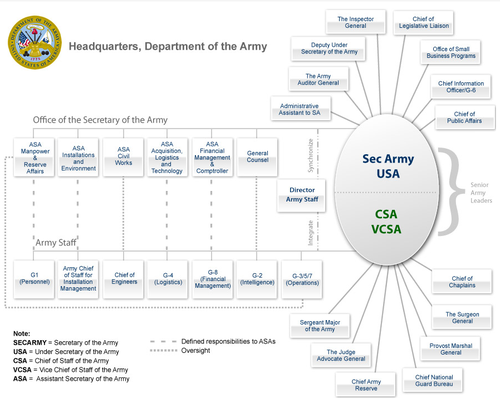
The Office of the Secretary (Army Secretariat)
Led by the Secretary of the Army, this office is supported by the Under Secretary of the Army and the Administrative Assistant to the Secretary of the Army—the department's senior civilian career official. The Secretariat is divided into functional branches, with the most critical areas managed by five Assistant Secretaries of the Army and the General Counsel of the Army, all of whom are presidential appointees confirmed by the Senate.
The Army Staff
The Army Staff is led by the Chief of Staff of the Army, a four-star general who serves as the highest-ranking officer in the Army and represents the service on the Joint Chiefs of Staff. He is assisted by the Vice Chief of Staff of the United States Army, also a four-star general.
The staff is organized into directorates led by three-star generals known as Deputy Chiefs of Staff (DCS). These include:
- G-1: Personnel
- G-2: Intelligence
- G-3/5/7: Operations, Plans, and Training
- G-4: Logistics
- G-6: Network/Communications/IT
- G-8: Finance
A pivotal role within this structure is the Director of the Army Staff (a three-star general), who synchronizes the work between the Army Secretariat and the Army Staff to meet the Secretary's goals. Other essential leaders include the Sergeant Major of the Army, the Army Staff Senior Warrant Officer, the Chief Warrant Officer of the Army, the Judge Advocate General, the Chief of the Army Reserve, the Provost Marshal General, and the Surgeon General.

Army Commands and Component Structure
The Department of the Army manages a vast array of commands, ranging from training and materiel to regional service components that support global operations.
| Category | Command/Unit | Headquarters Location |
|---|---|---|
| Army Command | Army Materiel Command (AMC) | Redstone Arsenal, Alabama |
| Army Command | Transformation and Training Command (T2COM) | Austin, Texas |
| Service Component | Army Europe and Africa (USAREUR-AF) | Wiesbaden, Germany |
| Service Component | Army Pacific (USARPAC) | Fort Shafter, Hawaii |
| Service Component | Army Cyber Command (ARCYBER) | Fort Gordon, Georgia |
| Direct Reporting | Army Corps of Engineers (USACE) | Washington, D.C. |
| Direct Reporting | United States Military Academy (USMA) | West Point, New York |
While the Department of the Army is responsible for organizing, training, and equipping forces (as per 10 US Code § 7013), the actual operational command of these forces is typically transferred to the commanders of the Combatant Commands. Only the President and the Secretary of Defense have the authority to approve the transfer of forces to and from these Combatant Commands.
Frequently Asked Questions
Who is the highest-ranking military officer in the U.S. Army?
The Chief of Staff of the Army, a four-star general, is the highest-ranking officer and serves as the Army's representative on the Joint Chiefs of Staff.
What is the difference between the Army Secretariat and the Army Staff?
The Army Secretariat (Office of the Secretary) is the civilian-led side of the headquarters focused on policy and oversight, while the Army Staff is the military-led side focused on the professional management and execution of Army operations.
Who has the authority to transfer Army forces to Combatant Commands?
Under 10 United States Code § 162, only the President and the Secretary of Defense possess the authority to approve the transfer of forces to and from Combatant Commands.
What is the role of the Director of the Army Staff?
The Director of the Army Staff is a three-star general responsible for integrating and synchronizing the activities of both the Office of the Secretary and the Army Staff to ensure the Secretary of the Army's priorities are met.
Is the Secretary of the Army a military officer?
No, by statute, the Secretary of the Army must be a civilian appointed by the President and confirmed by the Senate.