Deoksugung Palace: A Symbol of Korea's Imperial Ambition and Modernization
Located in the heart of Seoul, Deoksugung is a royal palace that stands as a poignant testament to Korea's transition from a traditional kingdom to a modern empire. Unlike other palaces that strictly adhere to traditional Joseon architecture, Deoksugung is unique for its blend of Eastern and Western styles, reflecting the aspirations of Emperor Gojong to modernize the nation during a period of intense geopolitical pressure.
Originally used as a temporary residence by King Seonjo during the Imjin War (1592–1598) after other palaces were destroyed, it became an official palace in 1611 under the name Gyeongungung. It remained largely dormant until the late 19th century, when it rose to prominence as the center of the Korean Empire.
Key Facts
- Official Name: Deoksugung Palace (formerly Gyeongungung).
- Inaugurated: 1611 as an official palace.
- Imperial Status: Became the main palace of the Korean Empire in 1897.
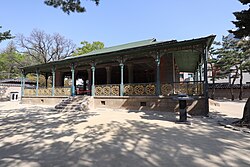
- Architectural Style: A unique mix of traditional Korean and Neoclassical Western architecture.
- Designation: Recognized as a Historic Site of South Korea since January 18, 1963.
The Rise and Fall of the Korean Empire
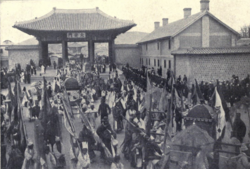
In 1897, Emperor Gojong declared the creation of the Korean Empire and designated Gyeongungung as the empire's primary palace. Gojong envisioned the site as a symbol of Korea's modernization. To achieve this, he expanded the grounds by acquiring nearby land and commissioned buildings that mirrored the global trends of the era.
During this period, the palace saw the construction of Junghwajeon, the main throne hall, and Seokjojeon, a Western-style building. However, the dream of an independent, modern empire was cut short. Gojong was forced to abdicate in 1907 in favor of his son, Sunjong. In 1907, the palace was renamed Deoksugung. Despite the political shift, Gojong continued to reside there until his death in 1919.
Colonial Erasure and Survival
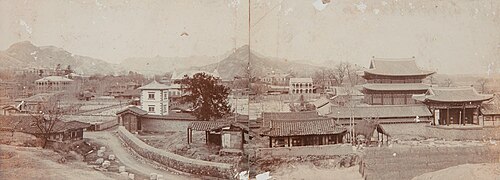
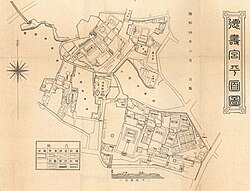
Following Gojong's death in 1919, the Japanese colonial government began a systematic effort to dismantle the palace. Portions of the property were sold off, and many buildings were demolished. By 1930, only 18 of the original structures remained. In 1933, the palace was converted into a public park, and by 1938, the number of original buildings had dwindled to just eight.
The palace survived the Korean War (1950–1953) largely intact, thanks in part to the intervention of U.S. Lieutenant James Hamilton Dill, who persuaded his superiors not to shell the complex despite North Korean soldiers using it as a base. For this act of cultural preservation, the South Korean government awarded him a plaque of gratitude in 1996.
![Seokjojeon and its newly-constructed West Wing as the Yi Royal Family Art Museum [ko] (1938)](/images/32/de/32de17c1d8e479eb0e2d895317f898814513016d80866db71167b72515b561fa.png)
Architectural Landmarks of Deoksugung
The East Section and Gates
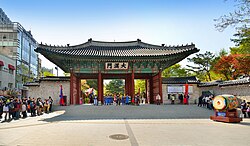
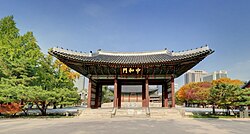
Daehanmun serves as the current main gate. Originally called Daeanmun and completed in 1898, it was renamed Daehanmun in 1906. The gate is renowned for its dancheong (traditional multicolored decorative coloring) and protective beast statues.
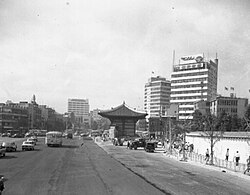
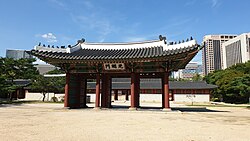
Gwangmyeongmun, the southern gate to the king's sleeping quarters, was reconstructed in 2018 to its original location to commemorate the 100th anniversary of the March First Movement.
Royal Living and Governance
Hamnyeongjeon served as Emperor Gojong's sleeping quarters. It is notable for its ondol (traditional Korean underfloor heating system), which ironically caused a great fire in 1904 that destroyed much of the palace. Gojong passed away in this building in 1919.
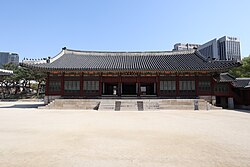
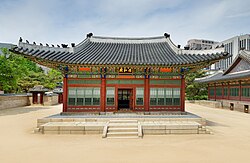
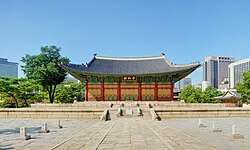
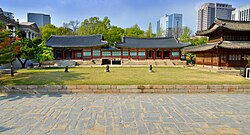
Junghwajeon is the palace's central hall. Originally a two-story structure completed in 1902, it was rebuilt as a one-story building after the 1904 fire. Its ceiling features two dragon statues, symbolizing the authority of the emperor.
The Western Influence: Seokjojeon
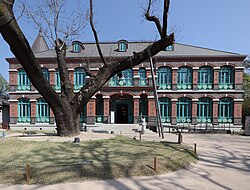
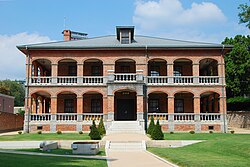
Seokjojeon is a striking Neoclassical building completed in 1910, designed and furnished by British architects. It represents the peak of Gojong's modernization efforts. After serving as an art museum for decades, it was restored and reopened in 2014 as the Daehan Empire History Museum.
Restoration and Modern Legacy
Since the 1980s, South Korea has worked to restore Deoksugung to its pre-colonial state. The 2004 Deoksugung Restoration and Maintenance Basic Plan led to the restoration of Jungmyeongjeon (2009) and Seokjojeon (2014). These efforts aim to reclaim the architectural heritage that was systematically erased during the colonial period.
![The overpass bridge leading to Gyeonghuigung.[111] Photo taken presumably just after the bridge's completion (late 1902 to mid 1903).[112]](/images/8d/e1/8de1d0611d32bcfe1329b52be6044e561c6cc258378054791cd3fe1097143431.jpg)
| Building/Gate | Primary Function | Key Feature |
|---|---|---|
| Daehanmun | Main Entrance | Dancheong coloring and beast statues |
| Junghwajeon | Main Throne Hall | Imperial dragon ceiling statues |
| Seokjojeon | Western-style Palace | Neoclassical British design |
| Hamnyeongjeon | Sleeping Quarters | Traditional ondol heating system |
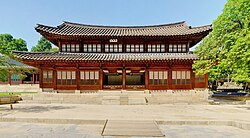
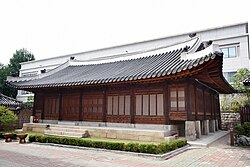
| Junmyeongdang | Reception Hall | Used to receive foreign envoys |
Frequently Asked Questions
Why is Deoksugung different from other Korean palaces?
Deoksugung is unique because it blends traditional Korean architecture with Western Neoclassical styles, reflecting Emperor Gojong's efforts to modernize Korea at the turn of the 20th century.
What caused the great fire of 1904?
The fire was caused by the ondol (underfloor heating system) in the Hamnyeongjeon building, leading to the destruction of several major structures, including the original Junghwajeon.
Who was James Hamilton Dill and why is he important to the palace?
Lieutenant James Hamilton Dill was a U.S. officer during the Korean War who persuaded his superiors not to shell the palace despite the presence of North Korean soldiers, thereby saving its cultural heritage.
What is the significance of Seokjojeon today?
Once a symbol of imperial modernization and later an art museum, Seokjojeon now houses the Daehan Empire History Museum, focusing on the history of the short-lived Korean Empire.
How many original buildings remain at the palace?
Due to colonial-era dismantling and urban expansion, the number of original buildings dropped significantly; by 1938, only eight of the original structures remained, though many have since been restored.