Decca Records: A Legacy of Technical Innovation and Musical Excellence
From its humble beginnings as a manufacturer of gramophones to its status as a global powerhouse in the recording industry, Decca Records has shaped the way the world experiences music. Founded in 1929 by Edward Lewis, the company evolved from a hardware business into a pioneer of high-fidelity sound, bridging the gap between the early era of shellac discs and the modern digital age.
Decca is perhaps best known for its relentless pursuit of sonic realism. Whether capturing the sweeping scale of Wagnerian opera or the intimate nuances of a solo vocalist, the label consistently pushed the boundaries of what was technically possible in audio engineering. Today, as part of the Universal Music Group, Decca continues to preserve a vast catalogue that documents the evolution of 20th-century music.
Key Facts
- Founded: February 7, 1929, by Edward Lewis in the United Kingdom.
- Technical Milestones: Pioneered the ffrr (full frequency range recording) system and early digital recording.
- Major Achievement: Produced the first complete recording of Wagner's Der Ring des Nibelungen (1958–1965).
- Commercial Success: Released Bing Crosby's "White Christmas," the world's best-selling single.
- Current Ownership: A subsidiary of Universal Music Group.
The Early Years: From Gramophones to Records
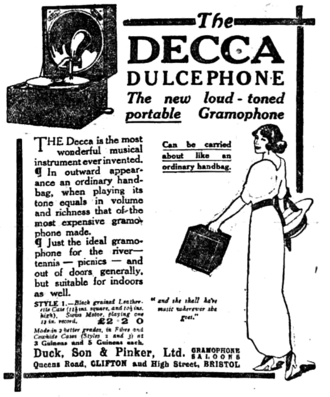
Decca's journey did not begin with recording artists, but with the machines used to play them. Before the official founding of the record label, the company marketed the "Decca Dulcephone," a portable gramophone manufactured by Barnett Samuel and Sons Ltd. These early devices laid the groundwork for the brand's entry into the music market.
The 1930s brought the challenges of the Great Depression, prompting Edward Lewis to take a more active role in leadership. To survive the economic downturn, Decca aggressively lowered record prices and expanded its reach by acquiring rights to the Polydor, Fonit, and Ultraphon catalogues. This era also saw the expansion into the United States with the establishment of Decca Records US in 1934, which quickly gained traction by signing popular acts like the Andrews Sisters and the Mills Brothers.
War and the Rise of High Fidelity
While the Second World War disrupted operations in Britain, the American subsidiary flourished, becoming an independent company listed on the New York Stock Exchange in 1942. This period saw the release of iconic recordings, including the 1942 version of "White Christmas" by Bing Crosby and the first original cast albums for Broadway musicals, starting with Oklahoma! in 1943.
In the UK, Decca focused on technical superiority. On June 8, 1945, the company announced its ffrr (full frequency range recording) system. This innovation dramatically expanded the audible frequency range, providing a level of realism previously unheard in commercial recordings. To support this new standard, Decca moved its primary London recording operations to the acoustically superior Kingsway Hall in 1944.

The LP Revolution
The introduction of the long-playing record (LP)—pressed on vinyl rather than shellac—revolutionized the industry by offering five times the playing capacity of 78 r.p.m. discs. While pioneered in the US by Columbia, Decca led the European adoption. This technology made the recording of complete operas viable, leading to landmark releases of Mozart's Die Entführung aus dem Serail and Wagner's Die Meistersinger.
Dominance in Classical and Popular Music
By the mid-20th century, Decca's technical edge attracted world-class talent. The label signed the Vienna Philharmonic and the Suisse Romande Orchestra, building a symphonic catalogue that rivaled any in the world. Between 1958 and 1965, Decca achieved what is widely considered the gramophone's greatest feat: the first complete recording of Wagner's operatic tetralogy, Der Ring des Nibelungen.
In the 1950s, Decca embraced stereophony—the use of separate microphones and speakers to create a spatial audio effect. Their first stereo recording, Rimsky-Korsakov's Antar symphonic suite, was produced by James Walker in 1954. Simultaneously, the label expanded into the burgeoning rock and roll scene, licensing artists like Chuck Berry and Jerry Lee Lewis for the UK market via the London label.
The Digital Transition and Modern Era
As the 1970s progressed, Decca continued to lead in technology despite internal organizational stagnation. In 1978, the company developed its own digital recorders for mixing and mastering. This led to the first digital recording of the Vienna Philharmonic in December 1978 and the world's first digital recording of an opera, Fidelio, in May 1979.

The corporate landscape shifted in 1980 when PolyGram acquired British Decca. Following a series of mergers, including the acquisition of MCA (which had owned American Decca), both entities were consolidated under the Universal Music Group in 1999. This merger integrated the classical catalogues of Decca and Philips Records, ensuring the preservation of a century of musical history.
Summary of Decca's Evolution
| Period | Key Milestone | Technical/Artist Highlight |
|---|---|---|
| Pre-1929 | Hardware Phase | Decca Dulcephone portable gramophone |
| 1930s | Market Expansion | Establishment of Decca Records US (1934) |
| 1940s | High Fidelity | Introduction of ffrr system (1945) |
| 1950s | Format Innovation | Adoption of LP and Stereophony |
| 1960s | Classical Peak | Complete recording of Wagner's Ring Cycle |
| 1970s | Digital Era | First digital opera recording (1979) |
| 1980-Present | Consolidation | Acquisition by PolyGram, then Universal Music Group |
Frequently Asked Questions
What does "ffrr" stand for in Decca's history?
ffrr stands for full frequency range recording. It was a technical system introduced by Decca in 1945 that significantly enhanced the range of sound frequencies that could be captured and reproduced, leading to much greater realism in audio recordings.
Who founded Decca Records?
Decca Records was founded on February 7, 1929, by Edward Lewis, who had previously acquired The Decca Gramophone Company.
What is Decca's most significant classical achievement?
Decca is widely celebrated for producing the first complete recording of Richard Wagner's operatic tetralogy, Der Ring des Nibelungen (The Ring of the Nibelung), between 1958 and 1965.
How did Decca contribute to the popular music market in the US?
American Decca was a pioneer in original cast albums for Broadway musicals (starting with Oklahoma! in 1943) and released the world's best-selling single, Bing Crosby's "White Christmas." They also had a strong presence in country music through the work of Owen Bradley.
Who currently owns Decca Records?
Decca Records is currently owned by the Universal Music Group, following the merger of PolyGram and MCA in 1999.