Brunswick Records: A Century of American Music History
Founded in 1916, Brunswick Records stands as a cornerstone of the American recording industry. From its origins as a side venture of a sporting goods company to its evolution into a powerhouse of R&B and soul, the label has mirrored the technological and cultural shifts of the 20th century. Over its long history, Brunswick has transitioned through various owners, including Warner Bros. and Decca, while consistently capturing the sounds of the era's most influential artists.
Key Facts
- Founded: 1916 by the Brunswick-Balke-Collender Company.
- Origin: Dubuque, Iowa, United States.
- Technological Milestone: Introduced the "Light-Ray" photoelectric recording process in 1925.
- Major Eras: Early acoustic/electric era (1916–1940), the Decca/Rock and Roll era (1945–1956), and the R&B/Soul era (1957–1982).
- Chart Success: Topped the R&B charts 10 times between the late 1950s and 1982.
- Current Status: Revived in 1995 by the children of Nat Tarnopol.
The Early Years: 1916–1929
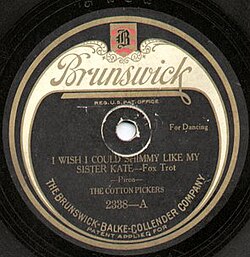
Brunswick Records began not as a music venture, but as an extension of the Brunswick-Balke-Collender Company, a firm known since 1845 for pianos and sporting equipment. In 1916, the company entered the phonograph market, initially producing records using a vertical cut system (similar to Edison Disc Records). These early releases were recorded in the U.S. but sold exclusively in Canada.
By January 1920, the label shifted to the lateral cut system, which was becoming the industry standard for 78 rpm discs. This move allowed Brunswick to compete with the "big three"—Edison, Victor, and Columbia. The label gained prestige by signing world-class classical musicians, such as violinists Bronislaw Huberman and Max Rosen, and pianists Leopold Godowsky and Josef Hofmann.
The "Light-Ray" Experiment
In 1925, Brunswick attempted to innovate with the "Light-Ray" process, an electrical recording method using photoelectric cells licensed from General Electric. While ambitious, the system suffered from sonic inconsistencies and harsh equalization. This led the company to eventually adopt the Western Electric condenser microphone process in 1927, which provided significantly better audio quality.
Jazz and Race Records
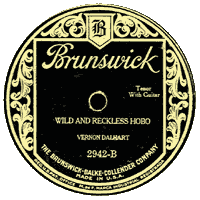
Based primarily in Chicago, Brunswick became a hub for the city's elite jazz performers. The label's roster included legends like Duke Ellington (recording as the Jungle Band), Fletcher Henderson, and King Oliver. Brunswick also launched a dedicated "race series" (the 7000 series), featuring a distinctive lightning bolt label design to market hot jazz, gospel, and urban and rural blues.
Ownership Shifts and the Great Depression: 1930–1944
In 1930, the label was sold to Warner Bros. Pictures, which sought to create soundtracks for its Vitaphone sound-on-disc system. This era saw the signing of Bing Crosby, who became the label's biggest star, alongside the Mills Brothers and Cab Calloway.
The Great Depression devastated record sales, leading Warner Bros. to lease the operation to the American Record Corporation (ARC) in 1931. Under ARC, Brunswick served as a flagship premium label. However, by 1940, the label was discontinued by the Columbia Broadcasting System (CBS) after ARC was acquired. The trademark eventually reverted to Warner and was later sold to American Decca in 1941.
The Rock and Roll Transition: 1945–1956
Following World War II, Brunswick was managed under Decca's Coral Records subsidiary. In 1952, it resumed releasing new material, initially focusing on rhythm and blues before expanding into pop in 1957. During the mid-1950s, it became a primary outlet for early rock and roll.
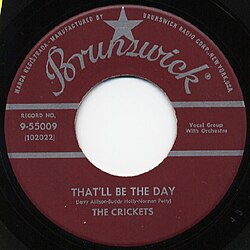
One of the most notable artists of this period was Buddy Holly. Interestingly, Holly's recordings were split between Brunswick and Coral; those released on Brunswick typically featured backup vocals from The Picks or The Roses and were credited to the group name rather than Holly individually.
The Golden Age of Soul and R&B: 1957–1982
The late 1950s marked a pivotal shift as Brunswick focused heavily on R&B and soul. This era was defined by the leadership of Nat Tarnopol, who joined as head of A&R in 1957 and eventually acquired full ownership of the company by 1969.
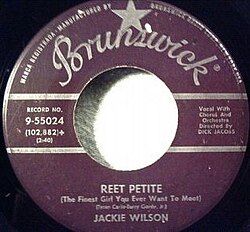
The label's most iconic artist during this period was Jackie Wilson. His debut single marked the start of the modern Brunswick era, and his collaboration with producer Carl Davis led to the massive hit "Higher And Higher," which sold over two million copies.
The Chicago Soul Sound
Under the supervision of Carl Davis in Chicago, Brunswick and its sister label, Dakar Records, became dominant forces in soul music. The Chi-Lites achieved significant success, with their song "Oh Girl" topping the Billboard Hot 100—the label's only post-1957 release to reach the top of that specific chart. Other key artists included Tyrone Davis, Gene Chandler, and Little Richard.
Despite its musical success, legal disputes in the early 1980s left the company in financial distress. Brunswick became dormant after 1982, though it was later revived in 1995 by the Tarnopol family.
Summary of Brunswick Records Evolution
| Period | Primary Owner/Manager | Musical Focus | Key Artists/Tech |
|---|---|---|---|
| 1916–1929 | Brunswick-Balke-Collender | Classical, Jazz, Popular | Light-Ray Process, Duke Ellington |
| 1930–1940 | Warner Bros. / ARC | Pop, Soundtracks | Bing Crosby, Cab Calloway |
| 1945–1956 | American Decca / Coral | R&B, Early Rock and Roll | Buddy Holly & the Crickets |
| 1957–1982 | Nat Tarnopol | Soul, R&B | Jackie Wilson, The Chi-Lites |
Frequently Asked Questions
What was the "Light-Ray" process?
The Light-Ray process was an early electrical recording system introduced by Brunswick in 1925. It used photoelectric cells licensed from General Electric, though it was often criticized for sonic inconsistencies compared to the systems used by Victor and Columbia.
Who was the most successful artist for Brunswick in the soul era?
Jackie Wilson was the label's leading artist in the late 1950s and early 1960s. His hit "Higher And Higher" became one of the label's biggest sellers, moving over two million copies.
How did Buddy Holly's releases differ between Brunswick and Coral?
Records released on Brunswick typically featured backup vocals (by The Picks or The Roses) and were credited to the group name. Releases on Coral were generally without backup vocals, with a few exceptions like "Rave On" and "Early In The Morning."
Who currently owns the Brunswick Records archives?
Ownership is split: Universal Music (via Decca) controls pre-Tarnopol recordings, Sony Music Entertainment controls the 1931–1939 era, and the Tarnopol family owns recordings from 1957 onwards.
What happened to Brunswick Records in the 1980s?
The label became dormant after 1982 due to legal problems and financial difficulties surrounding Nat Tarnopol, though it was eventually cleared of charges and revived by his children in 1995.