Debye Length: The Physics of Electric-Field Screening
In substances containing mobile charges—such as plasmas (ionized gases), electrolyte solutions, or semiconductors—electric fields do not behave the same way they do in a vacuum. Instead, these materials possess a natural ability to "screen out" induced electric fields. The characteristic distance over which this screening occurs is known as the Debye length.
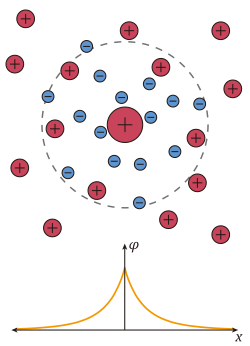
When a charge is introduced into such a medium, the surrounding mobile charges rearrange themselves to counteract the field of the intruder. This process creates a cloud of opposite charge that effectively shields the rest of the medium from the electric influence of the original charge.
Key Facts
- Definition: The Debye length is the characteristic scale over which mobile charges screen out electric fields in a medium.
- Applicability: It is a fundamental concept in plasma physics, chemistry (electrolytes), and solid-state physics (semiconductors).
- Effect: It transforms a long-range Coulomb potential into a short-range exponentially screened potential.
- Dependencies: The length depends on the medium's permittivity, temperature, and the concentration and charge of the mobile species.
The Mathematical Origin of Debye Length
To determine the Debye length, physicists analyze the distribution of charged particles. For a system with multiple species of charged particles, the electric potential is governed by Poisson's equation. This equation relates the potential to the sum of the charges of the mobile species and any static external charge density.
The Role of Thermal Motion
Mobile charges are not static; they are influenced by the Coulomb force and thermal energy. According to mean field theory, if a system is at a specific temperature, the concentration of these charges tends to follow the Boltzmann distribution. This means the particles distribute themselves based on the balance between electrical attraction/repulsion and thermal agitation.
The Poisson–Boltzmann Equation
By combining Poisson's equation with the Boltzmann distribution, we derive the Poisson–Boltzmann equation. Because this equation is nonlinear, it is often simplified for systems in the high-temperature (weak coupling) limit. In this state, the electrical potential energy is much smaller than the thermal energy.
Applying a Taylor expansion to the exponential terms leads to the linearized Poisson–Boltzmann equation, also known as the Debye–Hückel equation. For electrically neutral systems, this simplification reveals a specific length scale, $\lambda_D$, which defines how the potential varies across the medium.
Calculating the Debye Length
The Debye length is mathematically defined by the properties of the medium. All charged species contribute to this length regardless of whether their charge is positive or negative.
| Symbol | Term | Effect on Debye Length |
|---|---|---|
| $\varepsilon$ | Permittivity | Higher permittivity increases the length. |
| $k_B T$ | Thermal Energy | Higher temperature increases the length. |
| $n_j^0$ | Mean Concentration | Higher concentration decreases the length. |
| $q_j$ | Particle Charge | Higher charge magnitude decreases the length. |
The Debye length can also be expressed using the Bjerrum length ($\lambda_B$), which relates the charge of the ionic species to the elementary charge $e$ via an integer charge number $z_j$.
Debye Screening in Practice
A classic example of this phenomenon is placing a point charge $Q$ into a plasma. In a vacuum, this charge would create a bare Coulomb potential that extends infinitely. However, in a plasma, the mobile charges create a shielding effect. The resulting potential is exponentially decayed over the distance of the Debye length.
This Debye screening (or shielding) ensures that the electric influence of a charge is confined to a small local region, preventing the long-range interactions that would otherwise dominate the system.
Frequently Asked Questions
What is the physical meaning of the Debye length?
It represents the distance over which a mobile charge carrier screens out the electric field of another charge. Beyond this distance, the electric field is effectively zero.
How does temperature affect the Debye length?
As temperature increases, the thermal motion of the particles becomes more energetic, making it harder for them to cluster around a charge. This results in a larger Debye length, meaning the screening is less effective.
Does the sign of the charge matter for the Debye length?
No. In the calculation of the Debye length, the charge $q_j$ is squared, meaning both positive and negative ions contribute equally to the screening effect.
What is the difference between the Poisson-Boltzmann and Debye-Hückel equations?
The Poisson-Boltzmann equation is the general, nonlinear description of the system. The Debye-Hückel equation is a linearized version used specifically for high-temperature or weak-coupling limits where the potential is small.
In what materials is the Debye length most relevant?
It is most relevant in any medium with mobile charge carriers, specifically plasmas, semiconductor materials, and electrolyte solutions (such as salt dissolved in water).