DBR Class Locomotives: Versatility and Service History
The DBR class locomotives served as a flexible backbone for New Zealand's rail network, primarily handling freight duties while occasionally supporting passenger services. Their design provided a significant weight advantage over other locomotive classes, making them indispensable for routes with lighter infrastructure. However, as bridges and lines were upgraded—most notably with the opening of the Kaimai Tunnel on the East Coast Main Trunk (ECMT) route—this weight advantage became less critical, and the DBRs were integrated into a general operational pool.
Initially deployed across the North Island, the DBRs eventually expanded their reach. Due to their lightweight construction, they were ideally suited for South Island lines following the withdrawal of the DI and DJ class locomotives in the early 1990s. This cross-island utility continued until the final DBR returned to the North Island around 2007.
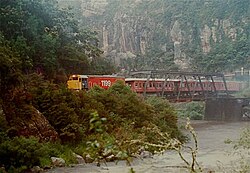
Key Facts
- Primary Role: Freight duties, with occasional passenger service.
- Regional Reach: Operated in both the North and South Islands.
- Specialized Use: Provided banking services in Wellington and commuter services in Auckland.
- Design Advantage: Lightweight build allowed operation on restricted lines and bridges.
- Livery Evolution: Transitioned from deep red to International Orange, Toll Rail yellow/green, and MAXX Blue.
Auckland Transport and Commuter Services
Between June 2003 and April 17, 2014, the DBR class played a specialized role in urban transit. Two locomotives, DBR1199 and DBR1254, were leased to the Auckland Regional Transport Authority (and later Auckland Transport), with operations managed by Transdev. These units operated in a top and tail configuration—meaning a locomotive was placed at both ends of the train to avoid the need for shunting—hauling five-car SX carriage sets.
To match the city's branding, these locomotives wore the MAXX Blue livery. A third unit, DBR1226, was also painted in MAXX Blue (though without the logo). While DBR1226 primarily handled KiwiRail freight and work trains, it was modified to be compatible with suburban carriages, allowing it to serve as a backup for the primary Auckland units. All leases expired in 2014, returning the locomotives to freight service.
The Wellington Bankers
In Wellington, two DBR locomotives served as bankers—engines used to provide extra power to push or pull a train on steep gradients. This set primarily assisted trains traveling between Wellington and Paekakariki, though they also handled Hutt Workshops shunting and various regional work trains.
The original pair, DBR1199 and DBR1200, earned the nickname "Bobsy Twins," a play on the Bobbsey Twins, due to their consecutive numbers—a rarity under the Traffic Management System (TMS) numbering. After DBR1199 suffered a failure in the early 2000s, it was replaced by DBR1267, and the pair became known simply as "The Twins." Eventually, DBR1199 was repaired at Hillside for use in Auckland, and DBR1267 was also transferred to Auckland to replace DBR1282, ending the DBRs' tenure in the Wellington banking role.
Visual Evolution and Liveries
The aesthetic appearance of the DBR class changed significantly over the decades to reflect changing ownership and branding. They were originally delivered in a deep red livery featuring white side stripes and "wings" on the ends, with large white TMS road numbers on the long hoods.
As the fleet evolved, most DBRs adopted the "Fruit Salad" scheme—an International Orange palette consisting of red and grey with yellow safety ends. Some original DB units, specifically DB 1082 and 1099, also received this look in the 1980s. Later variations included the yellow and green "Corn Cob" scheme for DBR 1295 (Toll Rail), the deep blue and yellow MAXX Blue for Auckland units, and the modern grey, red, and yellow KiwiRail scheme for DBR 1267.
| Livery Name | Colors | Associated Operator/Era |
|---|---|---|
| Original | Deep Red with White Stripes | Initial Delivery |
| Fruit Salad | Red, Grey, and Yellow Ends | International Orange Era |
| Corn Cob | Yellow and Green | Toll Rail |
| MAXX Blue | Deep Blue and Yellow | Auckland Transport |
| KiwiRail | Grey, Red, and Yellow | Modern Era |
Frequently Asked Questions
What was the primary advantage of the DBR class?
Their lightweight nature allowed them to operate on lines and bridges that could not support heavier locomotive classes, making them highly versatile across both the North and South Islands.
What does "top and tail configuration" mean in the context of Auckland services?
It refers to placing a locomotive at each end of the passenger carriage set, allowing the train to change direction without having to decouple and move the locomotive to the other end.
Who were the "Bobsy Twins"?
The "Bobsy Twins" were DBR1199 and DBR1200, a pair of locomotives used as bankers in Wellington, so named because of their rare consecutive numbering.
When did the DBR locomotives stop operating in the South Island?
The last DBR locomotive returned to the North Island around 2007.
Which locomotives were used for the Auckland commuter services?
DBR1199 and DBR1254 were the primary leased units, with DBR1226 serving as a modified backup unit.