Dahlem: Berlin's Hub of Academic Excellence and Affluence
Located in the southwestern borough of Steglitz-Zehlendorf, Dahlem is one of Berlin's most prestigious and affluent localities. Situated between the upscale mansion settlements of Grunewald and Lichterfelde West, it is widely recognized as a premier center for academic research and high-end residential living.
The district is characterized by its blend of intellectual rigor and serene landscapes, serving as the home to the renowned Freie Universität Berlin and numerous world-class research institutions. Its unique atmosphere is further enhanced by the presence of the Grunewald forest and a rich history tied to both Prussian nobility and Cold War geopolitics.
Key Facts
- Founded: 1275
- Borough: Steglitz-Zehlendorf, Berlin
- Population: 16,726 (as of December 31, 2024)
- Total Area: 8.39 km²
- Primary Transport: U-Bahn Line U3
- Key Identity: A center for academic research and affluent residential villas.
Historical Evolution
The first written records of Dahlem date back to 1275. Much of the area's early development was tied to the Dahlem Demesne (Domäne Dahlem), first mentioned in 1450. In 1841, the Prussian state acquired these estates, subsequently dividing the land into lots for the construction of mansions and villas, mirroring the development of nearby Lichterfelde West and Grunewald.
Dahlem was integrated into Greater Berlin in 1920. During the 1930s, the district was linked to the Confessing Church through Pastor Martin Niemöller of the United Protestant Sankt-Annen-Kirche, who served there from 1931 until his arrest by the Nazi regime in 1937.
During the Cold War, Dahlem was part of the American Sector of West Berlin. From 1945 to 1991, it hosted the Allied Kommandatura of Berlin on Kaiserswerther Straße. The district also served as a strategic military hub; until 1994, the Berlin Brigade and the United States Army Berlin command were headquartered on Clayallee. Today, the U.S. Embassy still utilizes portions of these facilities.
The geopolitical divide of Berlin also shaped Dahlem's academic landscape. In 1948, students and scholars established the Freie Universität Berlin (Free University of Berlin) as a democratic alternative to the communist-influenced Universität Unter den Linden, aiming to preserve the Humboldtian ideal of academic freedom.
Academic and Cultural Institutions
Dahlem is a global epicenter for science and humanities. The Freie Universität Berlin is a cornerstone of the district, featuring the architecturally striking Philological Library, often referred to as "The Brain."
The area hosts a dense concentration of specialized research centers, including:
- Julius Kühn-Institut: The Federal Research Centre for Cultivated Plants.
- Zuse Institute Berlin: A leading center for computational science.
- Prussian Privy State Archives: Part of the Prussian Cultural Heritage Foundation.
- German Archaeological Institute and the Institute for Museum Research.
Furthermore, several branches of the Max Planck Institute (formerly the Kaiser Wilhelm Institute) are located here, focusing on the History of Science, Molecular Genetics, Human Development, the Fritz Haber Institute, and the Max Planck Institute Archives.
Main Sights and Landmarks
Visitors to Dahlem can explore a variety of cultural and historical sites. The Allied Museum preserves the history of American, British, and French forces in West Berlin, while the Brücke Museum and the Museum of European Cultures offer deep dives into art and sociology.
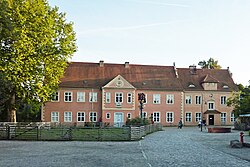
For those interested in architecture and nature, the Jagdschloss Grunewald, a Renaissance hunting lodge built in 1543, provides a glimpse into the region's royal past.
The district is also home to the Jesus-Christus church, renowned for its exceptional acoustics, which made it the preferred recording location for the Berlin Philharmonic from the 1950s through the 1980s.
Transportation and Infrastructure
Dahlem is efficiently connected to central Berlin via the U3 line of the Berlin U-Bahn. The district is noted for its historic metro stations, which maintain a classic aesthetic. Key stops include:
- Breitenbachplatz
- Podbielskiallee
- Dahlem-Dorf
- Thielplatz
- Oskar-Helene-Heim
District Overview
The following table summarizes the key administrative and geographic details of Dahlem.
| Attribute | Detail |
|---|---|
| State/City | Berlin, Germany |
| Borough | Steglitz-Zehlendorf |
| Area | 8.39 km² |
| Population Density | 1,990/km² |
| Elevation | 50 m |
| Postal Codes | 12203, 14169, 14195 |
Frequently Asked Questions
What is the significance of the Freie Universität Berlin in Dahlem?
Founded in 1948, the university was established as an "antipole" to the communist-influenced Universität Unter den Linden in East Berlin, serving as a bastion for academic freedom and traditional educational ideals.
Which museums can be visited in Dahlem?
Key museums include the Allied Museum, the Brücke Museum, and the Museum of European Cultures.
What is the history of the Jagdschloss Grunewald?
The Jagdschloss Grunewald is a Renaissance hunting lodge that was constructed in 1543 and is located within the Grunewald forest.
How is Dahlem connected to the rest of Berlin?
Dahlem is primarily served by the U3 line of the Berlin U-Bahn system, which connects the district to the city center through several historic stations.
Who are some notable people associated with Dahlem?
Notable figures who lived in or are associated with the area include boxer Max Schmeling, politician Jens Spahn, and student movement spokesman Rudi Dutschke, who is buried at the Sankt-Annen-Kirche cemetery.