Cyclophilins: Protein Folding, Cellular Signaling, and Clinical Significance
Cyclophilins (CYPs) are a versatile family of proteins found across all domains of life. They are primarily recognized for their ability to bind to ciclosporin (cyclosporin A), a potent immunosuppressant commonly used to prevent organ rejection following internal transplants. Beyond their interaction with drugs, these proteins play a fundamental role in the biological machinery of the cell by acting as peptidyl prolyl isomerases.
As isomerases, cyclophilins catalyze the conversion of peptide bonds at proline residues from the trans form to the cis form. This specific chemical shift is a critical step in facilitating proper protein folding, ensuring that proteins achieve the correct three-dimensional shape required to function.
Key Facts
- Primary Function: Catalyze the cis-trans isomerization of proline residues to aid protein folding.
- Drug Interaction: Bind to ciclosporin A to modulate immune responses and mitochondrial pore activity.
- HIV-1 Role: Cyclophilin A is essential for the infectivity of the HIV-1 virus.
- Mitochondrial Impact: Cyclophilin D regulates the mitochondrial permeability transition pore, influencing cell death.
- Clinical Links: Overexpression is associated with cancer metastasis, aging, and inflammatory disease.
The Diversity of Mammalian Cyclophilins
In mammals, cyclophilins exist as a group of isozymes—enzymes that differ in amino acid sequence but catalyze the same chemical reaction. While some are highly abundant in the cytosol, others are located within the endoplasmic reticulum or are secreted from the cell.
Human genes encoding these proteins include a wide array of PPI (peptidyl-prolyl isomerase) genes, such as PPIA, PPIB, PPIC, PPID, PPIE, PPIF, PPIG, and PPIH, as well as several PPIL variants (PPIL1 through PPIL6) and PPWD1.
Cyclophilin A (CYPA)
Cyclophilin A, also known as PPIA, is a highly abundant cytosolic protein. Structurally, it is characterized by a beta-barrel formation featuring two alpha helices and a beta-sheet. This structure is common among most members of the cyclophilin family.
The interaction between Cyclophilin A and ciclosporin creates a complex that inhibits calcineurin, a calcium/calmodulin-dependent phosphatase. By inhibiting calcineurin, the production of pro-inflammatory molecules—specifically TNF alpha and interleukin 2—is halted, which is the mechanism that suppresses organ rejection.
Beyond immunology, Cyclophilin A is critical for viral pathology. During an HIV-1 infection, the virus's Gag polyprotein recruits Cyclophilin A. The incorporation of this protein into new virus particles is essential for the virus to remain infectious.
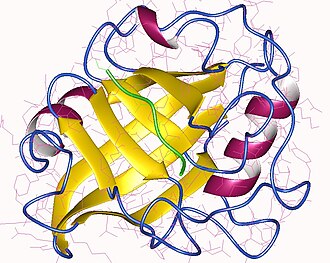
Cyclophilin D (PPIF) and Mitochondrial Health
Unlike its cytosolic counterparts, Cyclophilin D (encoded by the PPIF gene) is located within the mitochondrial matrix. It serves as a regulator for the mitochondrial permeability transition pore.
When this pore opens, the permeability of the mitochondrial inner membrane increases, allowing cytosolic molecules to flood the matrix. This leads to increased matrix volume and the eventual disruption of the mitochondrial outer membrane. This functional disorder is a key driver of cell death. Because ciclosporin A binds to Cyclophilin D and inhibits the opening of this pore, it can modulate these cell-death pathways.
Interestingly, this mechanism is not universal across all species; for example, mitochondria from the cysts of Artemia franciscana do not exhibit this permeability transition pore.
Clinical Significance and Therapeutic Potential
The dysregulation of cyclophilins is linked to several serious health conditions. The overexpression of Cyclophilin A has been associated with the progression and metastasis of cancer, the biological process of aging, and poor responses to inflammatory diseases.
Due to these links, cyclophilin inhibitors are being explored as promising therapeutic targets:
- Neurodegenerative Diseases: Inhibitors like ciclosporin are under development to treat these conditions.
- Liver Diseases: Cyclophilin inhibition is being researched as a potential therapy for hepatic disorders.
- Viral Infections: Because of its role in HIV-1 replication, inhibiting CypA may reduce viral infectivity.
- Oncology: Cyp inhibition is being investigated for its potential as a tumor suppressor.
| Type | Gene Symbol | Primary Location | Key Biological Role |
|---|---|---|---|
| Cyclophilin A | PPIA | Cytosol | Protein folding; HIV-1 infectivity; Calcineurin inhibition |
| Cyclophilin D | PPIF | Mitochondrial Matrix | Regulates mitochondrial permeability transition pore; Cell death |
Frequently Asked Questions
What is the primary function of cyclophilins?
Cyclophilins act as peptidyl prolyl isomerases, meaning they catalyze the isomerization of peptide bonds from the trans form to the cis form at proline residues, which is essential for proper protein folding.
How does ciclosporin work to prevent organ rejection?
Ciclosporin binds to Cyclophilin A to form a complex that inhibits calcineurin. This inhibition prevents the production of pro-inflammatory molecules like TNF alpha and interleukin 2, thereby suppressing the immune response that causes organ rejection.
What is the relationship between Cyclophilin A and HIV-1?
Cyclophilin A is recruited by the HIV-1 Gag polyprotein and incorporated into new virus particles. This process is essential for the virus to be infectious.
How does Cyclophilin D affect cell death?
Cyclophilin D regulates the opening of the mitochondrial permeability transition pore. When the pore opens, it disrupts the mitochondrial membrane and causes functional disorder, which plays a significant role in triggering cell death.
What diseases are linked to the overexpression of Cyclophilin A?
Overexpression of Cyclophilin A has been linked to the progression and metastasis of cancer, aging, and a poor response to inflammatory diseases.