Glycoproteins: Structure, Function, and the Role of Glycosylation
Glycoproteins are specialized proteins that contain oligosaccharide (sugar) chains covalently attached to amino acid side-chains. This essential biological process, known as glycosylation, occurs as a cotranslational or post-translational modification—meaning the sugars are added either during or after the protein is synthesized. These molecules are ubiquitous in eukaryotic cells, frequently appearing in secreted extracellular proteins, the extracellular matrix, and as integral membrane proteins that facilitate critical cell-cell interactions.
Glycosylation is not a uniform process; it varies significantly depending on the cellular location. Secretory glycosylation occurring in the endoplasmic reticulum (ER) and Golgi apparatus is often structurally essential. For instance, inhibiting N-linked glycosylation can prevent a protein from folding correctly and may be toxic to the cell. In contrast, glycosylation in the cytosol and nucleus involves the reversible addition of a single GlcNAc residue, acting as a regulatory mechanism similar to phosphorylation.
![N-linked protein glycosylation (N-glycosylation of N-glycans) at Asn residues (Asn-x-Ser/Thr motifs) in glycoproteins.[1]](/images/f0/80/f080d0dc297b5dd607a72da09c808072a61223b7ac0d596ca914d3b420313986.webp)
Key Facts
- Composition: Carbohydrates can make up between 1% and 70% of a glycoprotein's total mass.
- Primary Types: The most common forms are N-linked (attached to nitrogen) and O-linked (attached to oxygen).
- Critical Roles: They are vital for protein folding, stability, cell signaling, and immune recognition.
- Medical Relevance: Glycoproteins include essential hormones, antibodies, and viral coat proteins (such as gp120 in HIV).
- P-glycoprotein: A specific transporter (MDR1) that can hinder cancer treatment by pumping drugs out of tumor cells.
Types of Glycosylation
While several methods of attaching sugars to proteins exist, they are primarily categorized by the atom to which the sugar bonds.
N-glycosylation
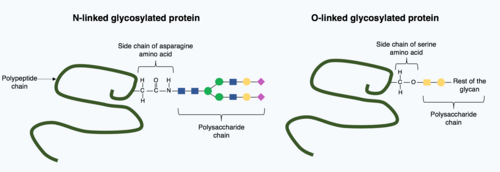
In N-glycosylation, sugars are attached to the nitrogen atom, typically on the amide side-chain of the amino acid asparagine.
O-glycosylation
In O-glycosylation, sugars bond to an oxygen atom. This typically occurs on serine or threonine, though it can also occur on tyrosine or non-canonical amino acids like hydroxylysine and hydroxyproline.
Other Forms of Glycosylation
- P-glycosylation: Sugars attach to phosphorus on a phosphoserine.
- C-glycosylation: Sugars attach directly to carbon (e.g., mannose attached to tryptophan).
- Glycation: Also called non-enzymatic glycosylation, this occurs via a Maillard reaction where sugars bond to proteins or lipids without enzymatic control.
Monosaccharides and Structure
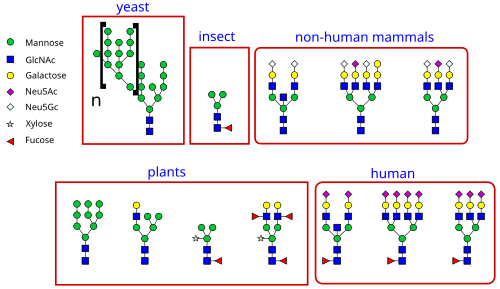
The structural diversity of glycoproteins stems from the variety of monosaccharides (single sugar units) used to build the glycan chains. In mammals, these sugars influence the protein's solubility, polarity, and resistance to enzymes.

| Sugar | Type | Abbreviation |
|---|---|---|
| β-D-Glucose | Hexose | Glc |
| β-D-Galactose | Hexose | Gal |
| β-D-Mannose | Hexose | Man |
| α-L-Fucose | Deoxyhexose | Fuc |
| N-Acetylgalactosamine | Aminohexose | GalNAc |
| N-Acetylglucosamine | Aminohexose | GlcNAc |
| N-Acetylneuraminic acid (Sialic acid) | Aminononulosonic acid | NeuNAc |
| Xylose | Pentose | Xyl |
These glycans can create a protective shield; for example, a high density of negatively charged sugars can repel proteolytic enzymes, protecting the protein from degradation.
Biological Functions and Examples
Glycoproteins serve a vast array of roles, from structural support to complex hormonal signaling.
Immune System and Recognition
Glycoproteins are essential for white blood cell recognition. The Major Histocompatibility Complex (MHC) molecules on cell surfaces interact with T cells to drive the adaptive immune response. Additionally, the ABO blood group system is a primary example of how glycan processing affects biological identity.
Protective and Structural Roles
Mucins, found in the respiratory and digestive tracts, use their sugar chains to hold significant amounts of water and resist digestion by enzymes. Other structural examples include collagens and the antifreeze proteins found in coldwater fish.
Hormones and Transport
Many critical hormones are glycoproteins, including:
- Follicle-stimulating hormone (FSH)
- Luteinizing hormone (LH)
- Thyroid-stimulating hormone (TSH)
- Human chorionic gonadotropin (HCG)
- Erythropoietin (EPO)
Glycomics and Analysis
Glycomics is the comprehensive study of the carbohydrate components of cells. Because glycoproteins are so complex, scientists use a variety of analytical tools to determine their structure and the exact sites of glycosylation.
- Mass Spectrometry: Used to determine molecular mass, sequence, and glycan branching.
- NMR Spectroscopy: Provides detailed structural information.
- Lectin Affinity Chromatography: Used to purify glycoproteins that bind to specific lectins (proteins that interact with carbohydrates).
- Periodic acid-Schiff stain: A method to detect glycoproteins as pink bands during electrophoresis.
Glycoproteins vs. Proteoglycans
While the terms are similar, IUPAC distinguishes them based on the nature of the carbohydrate. A glycoprotein is any protein with a covalently linked carbohydrate (monosaccharide, oligosaccharide, etc.). A proteoglycan is a specific subclass where the carbohydrates are long polysaccharides containing amino sugars, known as glycosaminoglycans.
Frequently Asked Questions
What is the difference between N-linked and O-linked glycoproteins?
The difference lies in the attachment point: N-linked glycoproteins bond the sugar to the nitrogen atom of an asparagine residue, while O-linked glycoproteins bond the sugar to the oxygen atom of a serine or threonine residue.
How does P-glycoprotein affect cancer treatment?
P-glycoprotein (MDR1) acts as a multidrug transporter that pumps compounds, including chemotherapy drugs, out of cells. This reduces the accumulation of the drug within tumor cells, thereby decreasing the effectiveness of the treatment.
What happens if glycosylation is inhibited?
Inhibition of N-linked glycosylation can prevent proteins from folding properly and can be toxic to individual cells. Perturbations in glycan processing can lead to human diseases known as congenital disorders of glycosylation.
What are mucins and why are they important?
Mucins are glycoproteins secreted in the mucus of the digestive and respiratory tracts. Their sugar chains provide high water-holding capacity and protect the proteins from being broken down by digestive enzymes.