Cuenca, Ecuador: The Athens of the Andes
Nestled in the south-central inter-Andean region of Ecuador, Santa Ana de los Ríos de Cuenca—commonly known simply as Cuenca—is a city where colonial elegance meets vibrant modern culture. As the capital of the Azuay province, it is celebrated as the "Athens of Ecuador" due to its profound contributions to the arts, sciences, and literature, as well as its stunning architectural heritage.
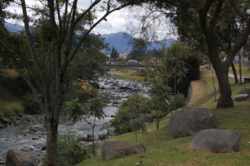
The city is defined by its relationship with water, being crossed by four rivers: the Tomebamba, Tarqui, Yanuncay, and Machángara. Situated at an average altitude of 2,538 meters, Cuenca enjoys a temperate Andean climate that makes it a sanctuary for residents and international visitors alike.
Key Facts
- Founded: April 12, 1557, by Gil Ramírez Dávalos.
- Status: Third most populous city in Ecuador (596,101 inhabitants as of 2022).
- UNESCO Recognition: The historic center was declared a World Heritage Site in 1999.
- Geography: Located in the Paute river basin at an elevation of approximately 2,560 meters.
- Economy: A major hub for commerce, industry, and international tourism.
A Journey Through History
Pre-Columbian Origins
Long before the Spanish arrival, the region was inhabited by nomadic hunters as early as 8060 BC, evidenced by discoveries in the Cave of Chopsi. Over millennia, these populations evolved into organized societies with specialized religious authorities known as shamans and advanced water management systems. By the 15th century, the Cañari people were absorbed by the Inca Empire.
The Inca emperor Tupac Yupanqui later ordered the construction of Pumapungo ("the door of the Puma"), a city said to rival the magnificence of Cuzco. Though much of this splendor fell into ruin before the Spanish arrived, the site remains a testament to the region's imperial past.
![Cuenca in 1615 by the Inca painter Guamán Poma in his work "Nueva corónica y buen gobierno". Royal Library, Denmark.[12]](/images/94/e7/94e7ffd40fb06137b4e060f47482d0e8bfb86c8e49095cf41754f129b1732ae6.jpg)
Spanish Settlement and Growth
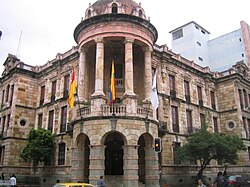
Cuenca was officially founded on April 12, 1557, by Gil Ramírez Dávalos under the orders of the Viceroy of Peru, Andrés Hurtado de Mendoza. The city was named after the founder's hometown of Cuenca, Spain. Over the centuries, it grew into one of Ecuador's most vital administrative and financial centers, blending Spanish colonial planning with local Andean influences.
City Landmarks and Culture
Architectural Marvels
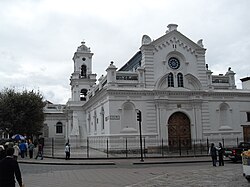
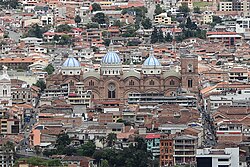
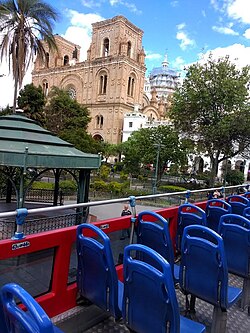
The city's skyline is dominated by its two great cathedrals. The Old Cathedral (Iglesia de El Sagrario), built in 1557, now serves as a museum. In contrast, the New Cathedral (Catedral Metropolitana de la Inmaculada Concepción), completed in 1975, is a masterpiece of Romanesque Revival and Neo-Gothic styles. Its iconic blue and white domes are symbols of the city, though its towers remain truncated due to an original architectural calculation error regarding the foundation's weight capacity.
Cultural Heritage
Beyond the churches, the city is home to the Monastery of Carmen de la Asunción, founded in 1682, and the Museo Banco Central. Cuenca is also world-renowned for its traditional craftsmanship, particularly the handwoven toquilla straw hats.
![Monastery of Carmen de la Asunción, founded in 1682 for the Order of the Barefoot Carmelites and it was built in 1730.[14][15][16]](/images/bb/50/bb50606c1e71abe3df8fb390a7db6b6711fa69288b4fbc33b53478243da2d841.jpg)

Education and Urban Life
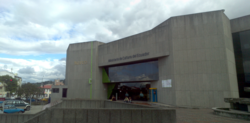
Cuenca is recognized as the "City of Universities" by the National Assembly of Ecuador. This title stems from its long academic tradition, beginning with the Universidad de Cuenca in 1867. Today, the city hosts several major institutions, including the Universidad Politécnica Salesiana, Universidad del Azuay, and Universidad Católica de Cuenca.
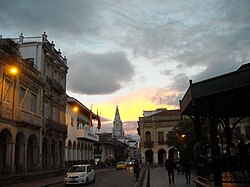
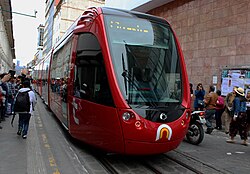
The urban experience is characterized by the walkable Historic Center and modern transit options. The Tranvía de Cuenca, a light rail system opened in 2020, spans 10.5 km and connects the Industrial Park in the north to the Baños area in the south.
Natural Surroundings
The beauty of Cuenca extends far beyond its city limits. The Cajas National Park is a premier destination for bird watchers and trout fishermen, featuring a high-altitude landscape of rivers and mirrored lakes between 3,500 and 4,200 meters.
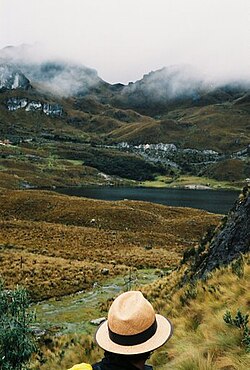
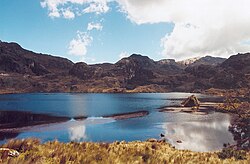
Other nearby attractions include Jima, a hiking hotspot offering trails from the Andean peaks down to the Amazon basin, and the rural area of Molleturo, which provides a glimpse into the traditional Andean lifestyle.
City Overview Summary
| Category | Details |
|---|---|
| Official Name | Santa Ana de los Ríos de Cuenca |
| Population (2022) | 596,101 |
| Elevation | 2,560 m (8,400 ft) |
| Climate | Marine / Temperate Andean (Avg 16.3°C) |
| GDP per capita (2023) | $14,600 |
| Main Airport | Mariscal Lamar International Airport |
Frequently Asked Questions
Why is Cuenca called the "Athens of Ecuador"?
It earned this nickname due to its rich cultural diversity, its significant contributions to Ecuadorian arts, sciences, and literature, and its beautiful architecture.
What is the significance of the New Cathedral's towers?
The towers are truncated (unfinished) because of a calculation error by the architect; the foundations would not have been able to support the full weight of the towers as originally planned.
How do I get around Cuenca?
The city offers a modern tram system (Tranvía), an efficient bus network with affordable flat rates, and a highly walkable historic center.
What can visitors do in Cajas National Park?
Visitors can enjoy bird watching, trout fishing, and exploring the unique high-altitude ecosystem of lagoons and streams.
Is the historic center of Cuenca protected?
Yes, the historic center was declared a UNESCO World Heritage Site in 1999 to preserve its cultural and architectural value.