Crush Syndrome: Treatment, Field Management, and Hospital Care
Crush syndrome is a systemic manifestation of rhabdomyolysis, a condition where muscle tissue undergoes necrosis—the premature death of cells. Because necrosis is irreversible, there is no treatment that can undo the cellular damage. However, early and consistent medical intervention can significantly decrease the rate of pathology and prevent life-threatening complications.
The primary goals of treatment are to prevent kidney failure (renal failure) through aggressive rehydration and the alkalinization of urine, which involves making the urine pH more basic to protect the kidneys.
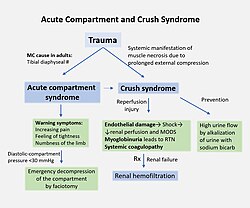
Key Facts
- Irreversibility: Necrosis cannot be reversed, but complications can be managed.
- Primary Risk: Kidney failure is a major threat, managed via rehydration and urine pH adjustment.
- Critical Timing: First-aiders in the UK are advised not to release victims trapped for more than 15 minutes without medical support.
- Lethal Phases: Death can occur immediately (trauma/asphyxia), early (hyperkalemia/shock), or late (renal failure/sepsis).
Progression of Untreated Crush Syndrome
The causes of death in untreated crush syndrome vary depending on the timeframe following the injury:
- Immediate: Severe head injuries, torso injuries involving abdominal organ damage, and asphyxia (excessive loss of oxygen).
- Early: Hypovolemic shock (severe fluid loss) and hyperkalemia (dangerously high potassium levels in the blood).
- Late: Renal failure, sepsis, and coagulopathy combined with hemorrhage.
Field Management and First Aid
Immediate field care focuses on stabilizing the patient and preventing the sudden release of toxins into the bloodstream. For those trapped for more than 15 minutes, nonprofessional first-aiders are recommended to avoid releasing the patient until medical help arrives.
In cases where immediate medical treatment is unavailable, a tourniquet may be used to trap toxins within the ischemic limb (a limb with restricted blood flow). This is generally considered if the person has been trapped for more than two hours, though it is a method of postponing medical attention rather than a cure.
Fluid Resuscitation
Restrictive fluid therapy, known as permissive hypotension, is considered unwise in these scenarios. Instead, careful fluid administration is required. If a patient has been crushed for more than one hour—and especially more than four hours—intravenous sodium bicarbonate and fluid overload are advised.
The San Francisco emergency services protocol suggests a standard adult dose of a 2 L bolus of normal saline, followed by 500 mL/h. This protocol is limited for pediatric patients and those with a history of renal or cardiac dysfunction.
Initial Hospital Management
Upon arrival at a hospital, clinicians must protect the patient against acidosis, hypotension, hypocalcemia (low calcium), hyperkalemia, and kidney failure. Even patients who appear stable require observation, often in an intensive care unit specializing in trauma medicine.
Immediate Clinical Interventions
- Wound Care: Open wounds require surgical debridement (removal of dead tissue), antibiotics, and tetanus toxoid. Ice is applied to injured areas.
- Respiratory Support: Breathing and circulation are monitored, and oxygen is administered if necessary.
- Hydration: Intravenous hydration of up to 1.5 L/h is maintained to prevent hypotension.
Renal Protection and Electrolyte Balance
To prevent the deposition of uric acid and myoglobin in the kidneys, intravenous sodium bicarbonate is used to maintain a urine pH of 6.5 or higher. A urinary output of at least 300 mL/h is targeted using IV fluids and mannitol; if this is not achieved, hemodialysis may be necessary.
To manage hyperkalemia and hypocalcemia, clinicians may administer the following adult doses:
- Calcium: 10 mL of 10% calcium gluconate or 5 mL of 10% calcium chloride IV over 2 minutes.
- Sodium Bicarbonate: 1 meq/kg IV slow push.
- Insulin and Glucose: 5–10 U of regular insulin with 1–2 ampules of 50% glucose IV bolus.
- Kayexalate: 25–50 g with 20% sorbitol (100 mL) administered orally or rectally.
Because abnormal heart rhythms can develop, continuous electrocardiographic monitoring is advised.
Treatment Summary Table
| Phase | Primary Goal | Key Interventions |
|---|---|---|
| Field Care | Toxin Containment & Stabilization | Controlled release, tourniquets (if >2 hrs), isotonic saline. |
| Initial Hospital | Systemic Protection | Debridement, oxygen, IV fluids (up to 1.5 L/h). |
| Renal Care | Prevent Kidney Failure | Sodium bicarbonate (pH >6.5), mannitol, hemodialysis. |
| Electrolyte Care | Stabilize Heart/Blood | Calcium gluconate, insulin/glucose, Kayexalate. |
Frequently Asked Questions
Can the muscle damage from crush syndrome be reversed?
No. Crush syndrome involves necrosis, which is the premature death of body cells and tissue. Once this occurs, the damage cannot be undone, though medical treatment can prevent further complications.
Why is it dangerous to release a trapped person immediately?
Releasing a patient who has been trapped for a significant amount of time (such as more than 15 minutes) can cause toxins trapped in the limb to flood the system, potentially leading to hyperkalemia and shock.
How is kidney failure prevented in crush syndrome patients?
Kidney failure is prevented through aggressive rehydration with IV fluids and the use of sodium bicarbonate to keep the urine pH at 6.5 or higher, which prevents myoglobin and uric acid from depositing in the kidneys.
When should a tourniquet be used in the field?
A tourniquet may be used as a second option to stall life-threatening consequences if medical fluid replacement is not immediately available, specifically if the person has been trapped for more than two hours.
What medications are used to treat high potassium (hyperkalemia)?
Clinicians may use a combination of regular insulin and glucose, sodium bicarbonate, or Kayexalate with sorbitol to manage potassium levels.