Crossing of the Andes: The Epic Military Feat that Liberated Chile
The Crossing of the Andes (Spanish: Cruce de los Andes) stands as one of the most daring and significant military achievements in the history of the Spanish American wars of independence. Between January 19 and February 13, 1817, a combined force of Argentine soldiers and Chilean exiles traversed the formidable Andes mountain range to launch a surprise invasion of Chile, ultimately ending Spanish colonial rule in the region.
Led by General José de San Martín, this expedition is frequently compared to the legendary crossings of the Alps by Hannibal and Napoleon due to its scale, difficulty, and strategic brilliance.
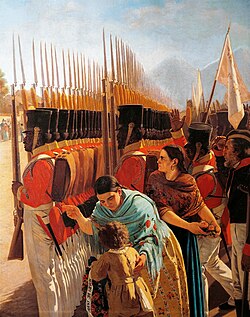
Key Facts
- Dates: January 19 to February 13, 1817.
- Route: From Mendoza, Argentina, to Santiago, Chile.
- Leadership: General José de San Martín and General Bernardo O'Higgins.
- Terrain: Average altitudes of 3,000 meters over a 500-kilometer journey.
- Outcome: Argentine-Chilean victory and the independence of Chile.
Strategic Background
The crossing was not a random act of bravery but a calculated component of General San Martín's broader strategy to secure South American independence. His ultimate goal was to defeat the royalist stronghold in Lima, the capital of the Viceroyalty of Peru. After determining that an attack through Upper Peru was too difficult, San Martín adopted a plan influenced by the Maitland Plan—a strategy designed by Thomas Maitland and supported by secret lodges advocating for independence.
At the time, Chile was under the Reconquista, a period where Spanish royalists had regained control following the defeat of the First Government Junta (the Patria Vieja) at the Battle of Rancagua in 1814. This forced Chilean leaders, including Bernardo O'Higgins, to flee to Mendoza, where they joined forces with San Martín to organize the Army of the Andes.
Preparation and Logistics
The city of Mendoza served as the operational headquarters for the campaign. The local population played a vital role, manufacturing gunpowder, ammunition, and even casting cannons to equip the army.
Logistics were a primary concern given the extreme environment. The army relied on valdiviano, a regional dish made of charqui (dried meat), raw sliced onions, potatoes, and boiling water. To sustain the troops and animals, the army transported:
- Forty tons of charqui and maize cakes.
- Brandy and rum to combat freezing nighttime temperatures.
- Garlic and onions to stimulate appetite.
- Over 4,000 cattle to provide food throughout the campaign.
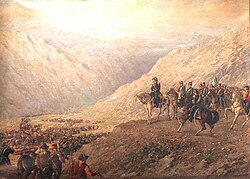
Troop Deployment
On January 19, 1817, the army departed from their base camp at El Plumerillo. San Martín led 4,000 men, supported by 1,200 auxiliaries. To maximize the element of surprise and manage the terrain, the force was split into two divisions:
- The Main Division: Led by San Martín, Miguel Estanislao Soler, and Bernardo O'Higgins, traveling via the Pass of Los Patos.
- The Secondary Division: Led by Juan Gregorio de Las Heras, traveling through the southerly Uspallata Pass.
The Path to Victory
The journey spanned 500 kilometers of rugged mountain terrain. The physical toll was immense; by the time the army reached its destination, San Martín had lost one-third of his men. Despite these losses, the army successfully entered Santiago on February 13, 1817.
While most royalist forces had retreated north, a contingent of 1,500 men remained at the valley of Chacabuco. This encounter led to the Battle of Chacabuco, which paved the way for the liberation of Chile and allowed San Martín to proceed with his long-term plan to reach Lima by sea.
| Category | Details |
|---|---|
| Belligerents | Patriots (United Provinces/Army of the Andes) vs. Royalists (Spain/Captaincy General of Chile) |
| Key Commanders | José de San Martín, Bernardo O'Higgins, Miguel Estanislao Soler vs. Francisco Marcó del Pont, Mariano Osorio |
| Duration | 21 Days |
| Distance | 500 Kilometers |
| Primary Result | Independence of Chile |
Frequently Asked Questions
Why did San Martín choose to cross the Andes instead of attacking through Upper Peru?
San Martín realized that attacking the royalist stronghold of Lima through Upper Peru presented too many difficulties. He instead implemented a strategy to cross the mountains, liberate Chile, and then attack Lima by sea.
What was the main food source for the soldiers during the trek?
The soldiers primarily ate a dish called valdiviano, which consisted of charqui (dried meat), potatoes, and raw onions mixed with boiling water.
How many men participated in the crossing?
San Martín began the journey with 4,000 soldiers and approximately 1,200 auxiliaries, though he lost one-third of his troops during the crossing.
What was the significance of the Battle of Chacabuco?
The Battle of Chacabuco occurred shortly after the crossing when the Patriot army encountered 1,500 royalist troops near Santiago, leading to a victory that secured the liberation of Chile.
How is the Crossing of the Andes remembered today?
It is considered one of the greatest military achievements in history. In 2010, the Argentine and Chilean armies recreated the crossing to celebrate the bicentennial of the Revolution.