Crested Jayshrike: The Unique Bird of Southeast Asian Forests
The Crested Jayshrike (Platylophus galericulatus), also known as the crested shrikejay, is a distinctive bird species native to the lush landscapes of Southeast Asia. While it was historically grouped with jays, modern science has revealed that this bird is far more unique than previously thought, occupying its own singular place in the avian tree of life.
Found across Brunei, Indonesia, Malaysia, Myanmar, and Thailand, the crested jayshrike is a specialist of the region's dense greenery. Its presence is often signaled by a highly distinctive alarm call that observers have compared to the sound of a machine gun.
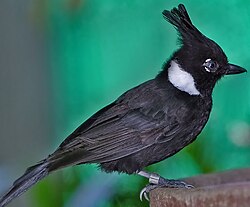
Key Facts
- Scientific Name: Platylophus galericulatus
- Conservation Status: Near Threatened (IUCN 3.1)
- Distribution: Brunei, Indonesia, Malaysia, Myanmar, and Thailand
- Unique Status: The only member of both its genus (Platylophus) and its family (Platylophidae)
- Primary Habitats: Subtropical and tropical moist lowland and montane forests
Taxonomic Evolution and Classification
The classification of the crested jayshrike has been a subject of scientific debate since the early 2000s. For many years, it was placed within the family Corvidae (the family of crows and jays). However, phylogenetic analyses—the study of evolutionary relationships through genetic data—indicated that it is not a true corvid.
Instead, research suggests it is a basal member of the Corvoidea radiation, a broad group of songbirds. While some experts previously suggested a link to helmetshrikes, the species was eventually granted its own distinct family. In 2019, eBird and the Clements Checklist introduced the name Platylophidae, which was officially described in 2021 and adopted by the International Ornithological Congress in 2022.
There remains a minor nomenclatural debate regarding the name Lophocittidae, described in 1855 by Johann Jakob Kaup. If this name is determined to refer to the crested jayshrike, it may eventually take precedence over Platylophidae.
Habitat and Distribution
The crested jayshrike is primarily found in the Thai-Malay Peninsula, as well as the islands of Sumatra, Java, and Borneo. It thrives in two main types of environments:
- Subtropical or tropical moist lowland forests: Low-altitude rainforests characterized by high humidity.
- Subtropical or tropical moist montane forests: Higher-altitude forests found on mountain slopes.
Conservation Challenges
Currently listed as Near Threatened by the IUCN, the crested jayshrike faces several significant pressures. The primary threat is habitat loss, driven by illegal logging and the conversion of wild forests into agricultural land. Additionally, the species is impacted by wildfires and the illegal wildlife trade, where birds are captured for sale.
| Category | Details |
|---|---|
| Binomial Name | Platylophus galericulatus |
| Family | Platylophidae |
| Order | Passeriformes |
| Range | Southeast Asia (Thai-Malay Peninsula, Sumatra, Java, Borneo) |
| Threats | Logging, farming, wildfires, wildlife trade |
Frequently Asked Questions
Is the crested jayshrike a true jay?
No. Although it was formerly called the crested jay, phylogenetic analyses have shown it is not a member of the Corvidae family, but rather a basal member of the Corvoidea radiation.
What does the crested jayshrike sound like?
The bird is known for a very distinctive alarm call that has been described as sounding like a machine gun.
Where can the crested jayshrike be found in the wild?
It is native to Brunei, Indonesia, Malaysia, Myanmar, and Thailand, specifically within moist lowland and montane forests.
Why is the species considered Near Threatened?
Its population is pressured by the loss of its natural forest habitat due to illegal logging and land conversion for farming, as well as threats from wildfires and capture for the wildlife trade.
What is the current scientific family of this bird?
As of 2022, the International Ornithological Congress classifies it in the family Platylophidae, of which it is the only member.