Crescent City Connection: New Orleans' Iconic Twin Spans
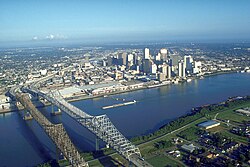
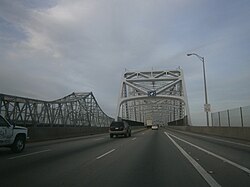
The Crescent City Connection (CCC) is a pair of massive cantilever bridges that serve as a vital artery for New Orleans, Louisiana. Carrying U.S. Highway 90 Business (US 90 Bus.) across the Mississippi River, these spans connect the city's East Bank with the West Bank. Tied as the fifth-longest cantilever bridges in the world, they are not only engineering marvels but also defining features of the New Orleans skyline.
As the farthest downstream bridge on the Mississippi River, the CCC is the widest and most heavily traveled crossing on the lower Mississippi. Its scale is comparable only to major crossings in the St. Louis area, such as the Poplar Street Bridge and the Stan Musial Veterans Memorial Bridge.
Key Facts
- Total Length: 13,428 feet (4,093 meters).
- Traffic Volume: Approximately 180,000 vehicles daily.
- Design: Twin steel truss cantilever bridges.
- Longest Span: 1,575 feet (480 meters).
- Clearance: 170 feet (52 meters) above the water.
- Current Status: Toll-free since May 2013.
Bridge Design and Traffic Flow
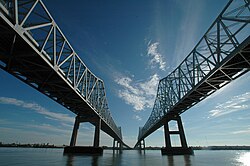
The connection consists of two separate spans, each providing four general-use automobile lanes. To accommodate varying traffic demands, the westbound span includes two reversible HOV (High Occupancy Vehicle) lanes.
Due to the winding nature of the Mississippi River—which actually flows north at the point of crossing—the bridge features unique "wrong-way concurrencies." This means the eastbound span technically carries Business US 90 West, while the westbound span carries Business US 90 East.
While primarily designated as Business US 90, the bridge and its approach roads (the Pontchartrain and Westbank Expressways) were once proposed as Interstate 910. This was a federal designation intended as a placeholder until the completion of Interstate 49 between New Orleans and Lafayette, though funding issues have largely stalled that plan.
A History of Two Spans
The Original Span (1958)
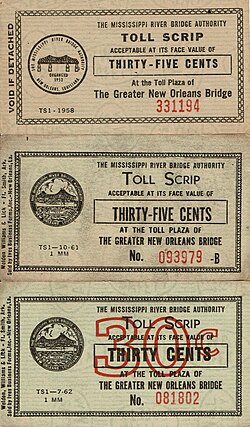
Construction on the first span began in November 1954. When it opened on April 15, 1958, as the Greater New Orleans Bridge, it was the longest cantilever bridge in the world. This initial crossing spurred significant growth in the West Bank suburban area.
Initially, the bridge was a toll facility, charging 35 cents for cars and light trucks. Following a campaign promise by Governor John McKeithen, these tolls were removed on May 16, 1964.
The Second Span and Renaming (1988)
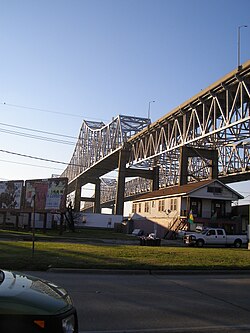
To meet growing traffic demands, construction on a second span began in March 1981. Although intended for the 1984 Louisiana World Exposition, it did not open until September 1988. Following the opening of the new span, the original bridge underwent a phased closure to replace its asphalt-on-steel deck with concrete.
In 1989, a public contest was held to rename the twin structures. A student named Jennifer Grodsky won the contest with the name "Crescent City Connection," which was subsequently officially designated by the Louisiana Legislature.
Tolls and Electronic Innovation
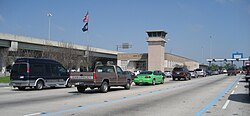
The CCC is notable for being the first toll facility in the United States to implement electronic toll collection, introducing toll tags on January 4, 1989. This system evolved into the "GeauxPass," a statewide electronic toll system compatible with other Louisiana toll roads.
Tolls on the second span were a point of contention for years. While they generated significant revenue—averaging $20 million annually before 2005—critics argued the funds did not sufficiently benefit the users. After a legal battle and a 2013 referendum where 78% of voters opposed the extension, tolls were officially eliminated on May 4, 2013.
Resilience During Hurricane Katrina
During the approach of Hurricane Katrina in August 2005, toll collections were halted to expedite evacuations. While the storm caused minor damage to overhead signs, the bridges remained structurally sound. In the immediate aftermath, the CCC became the only open highway into or out of the east bank of Orleans Parish, as other routes were severely flooded.
The bridge reopened to general traffic in mid-September 2005, though it faced temporary closures again during the evacuation for Hurricane Rita later that month.
Cultural Impact and Popularity
The CCC is a favorite for filmmakers due to its striking silhouette and the utility of the HOV lanes, which are separated from main traffic by barriers. It has appeared in films such as Déjà Vu, 21 Jump Street, and A Love Song for Bobby Long, as well as the series NCIS: New Orleans and the finale of The Amazing Race 32.
Locally, the bridge is the centerpiece of the annual Crescent Connection Road Race, held every September. The race takes place in the HOV lanes and originally served as a fundraiser for the bridge's decorative lighting system, which consists of 256 lights lining the top profiles of the spans.
| Feature | Original Span (Eastbound) | Second Span (Westbound) |
|---|---|---|
| Opened | April 1958 | September 1988 |
| Construction Cost | $50 Million | $550 Million |
| Width | 52 ft (16 m) | 92 ft (28 m) |
| Toll Period | 1958–1964 | 1989–2013 |
| Lanes | 4 general-use | 4 general-use + 2 reversible HOV |
Frequently Asked Questions
Why is the bridge called the "Pelican Bridge" by some?
Local Vietnamese American communities often refer to it as Cầu Con Cò (Pelican Bridge) because of the blue signs at either end of the bridge that feature a pelican, the state bird of Louisiana.
Are there still tolls on the Crescent City Connection?
No. Tolls were officially ended on May 4, 2013, following a public referendum in which the majority of voters in Orleans, Jefferson, and Plaquemines Parishes voted against the toll extension.
What is a "wrong-way concurrency" on the CCC?
Because the Mississippi River curves and flows north at this location, the eastbound bridge span actually carries traffic for Business US 90 West, and the westbound span carries Business US 90 East.
How did the bridge perform during Hurricane Katrina?
The bridges suffered very little structural damage, with only a few overhead signs being blown down. It served as a critical lifeline, being the only open highway into the east bank of Orleans Parish immediately after the storm.
What is the purpose of the HOV lanes?
The High Occupancy Vehicle (HOV) lanes are designed to move traffic more efficiently for vehicles with multiple passengers. They are also frequently used for filming movie scenes and the annual Crescent Connection Road Race.