Creatine: Chemical Properties, Biological Functions, and Health Applications
Creatine is a naturally occurring compound that plays a critical role in energy homeostasis, particularly in tissues with high energy demands like skeletal muscle and the brain. While widely recognized as a staple in sports nutrition, it is a complex molecule with significant implications for neurology, geriatrics, and metabolic health.
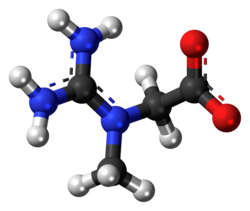
Chemically, creatine is known by its systematic IUPAC name 2-[Carbamimidoyl(methyl)amino]acetic acid. It is also referred to as N-Carbamimidoyl-N-methylglycine or Methylguanidoacetic acid. In its pure form, it appears as odorless white crystals.

Chemical Profile and Properties
Creatine exists in various forms, including a neutral form and several zwitterionic forms (molecules that contain an equal number of positively and negatively charged functional groups, resulting in a net neutral charge).

The molecular structure consists of a chemical formula of C4H9N3O2 with a molar mass of 131.135 g/mol. It is moderately soluble in water (13.3 g/L at 18 °C) and has a high melting point of 255 °C. Its chemical behavior is defined by an isoelectric point of 8.47 and a pKa of 3.429.
Physical and Safety Data
From a safety perspective, creatine is generally stable. It has a flash point of 118.1 °C and an autoignition temperature exceeding 400 °C. According to GHS labeling, it carries a "Warning" signal word with hazard statements H315, H319, and H335, indicating potential irritation to the skin, eyes, and respiratory tract.

The Phosphocreatine System
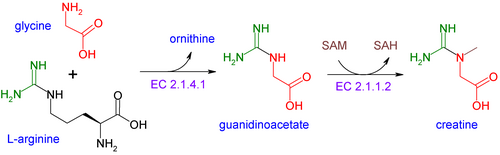
The primary biological function of creatine is to serve as a buffer for adenosine triphosphate (ATP), the primary energy currency of the cell. Through the phosphocreatine system, creatine is phosphorylated to become phosphocreatine.

When the cell consumes ATP during intense activity, phosphocreatine quickly relays its phosphate group to adenosine diphosphate (ADP) to regenerate ATP, ensuring a continuous energy supply for muscle contraction and brain function. Over time, creatine spontaneously converts into creatinine, a cyclic derivative that exists in equilibrium with its tautomer and creatine.

Applications in Exercise and Sport
Creatine is one of the most researched supplements in athletic performance. A 2014 survey of 21,000 US college athletes indicated that 14% utilize creatine supplements to enhance their training outcomes.
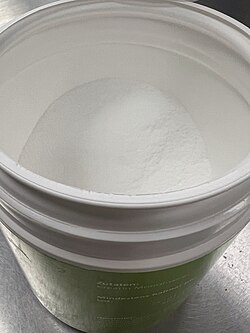
Supplementation typically involves two phases: a loading phase to rapidly saturate muscle stores and a maintenance phase to keep those levels elevated. Research indicates that carbohydrate ingestion can augment the accumulation of creatine in skeletal muscle.
Different forms of creatine have been studied for their efficacy in raising plasma levels, including creatine monohydrate (CrM), tri-creatine citrate (CrC), and creatine pyruvate (CrPyr).
![This graph shows the mean plasma creatine concentration (measured in μmol/L) over an 8-hour period following ingestion of 4.4 grams of creatine in the form of creatine monohydrate (CrM), tri-creatine citrate (CrC), or creatine pyruvate (CrPyr).[37]](/images/aa/be/aabe3098a70515d8dd0cfd68e408a11c9f642f1f075c8e9fc48b277e5c1c7ee4.jpg)
Clinical Research and Therapeutic Potential
Beyond athletics, creatine is being investigated for its role in treating various medical conditions:
- Neurological Disorders: Research has explored its use in Parkinson's disease, Huntington's disease, and Amyotrophic Lateral Sclerosis (ALS).
- Cognitive Health: Studies have examined its impact on cognitive performance, particularly during sleep deprivation, and its potential role in treating depression.
- Aging: Creatine is studied for the treatment of sarcopenia (age-related loss of muscle mass and strength) and the prevention of falls in the elderly.
- Mitochondrial Diseases: It is used in the context of genetic deficiencies and mitochondrial dysfunction.
Key Facts
- Chemical Formula: C4H9N3O2
- Primary Role: Regenerates ATP via the phosphocreatine system.
- Common Form: Creatine monohydrate is the most widely used supplement.
- Metabolism: Naturally converts to creatinine.
- Common Side Effects: Weight gain (due to water retention in muscles) and upset stomach.
- Safety: LD50 is > 2000 mg/kg (dermal, rat).
Summary of Chemical and Physical Properties
| Property | Value |
|---|---|
| Molar Mass | 131.135 g/mol |
| Appearance | White crystals |
| Density | 1.33 g/cm3 |
| Melting Point | 255 °C |
| Water Solubility | 13.3 g/L (at 18 °C) |
| Biological Half-life | 3 hours |
Frequently Asked Questions
Does creatine cause kidney damage?
Systematic reviews and meta-analyses generally indicate that recommended doses of creatine monohydrate do not impair renal function in healthy individuals, though those with pre-existing kidney disease should exercise caution.
What are the most common side effects of creatine?
The most frequently reported side effects include weight gain resulting from increased water retention within the muscle cells and occasional gastrointestinal upset.
How does creatine help with athletic performance?
It increases the availability of phosphocreatine in the muscles, which allows for the rapid regeneration of ATP during high-intensity, short-duration exercise, thereby improving strength and power output.
Can creatine improve brain function?
Some research suggests that creatine may improve cognitive performance, particularly in situations of stress or sleep deprivation, although systematic reviews show mixed results regarding its general effect on cognition.
Is creatine safe for long-term use?
Evidence from various studies, including those on football players and resistance-trained individuals, suggests that long-term supplementation does not negatively affect clinical health markers or liver and kidney functions in healthy populations.