Copa América 1983: Uruguay's Return to Glory
The 1983 Copa América was a landmark tournament in South American football, held between August 10 and November 4. Featuring all ten members of CONMEBOL (the South American Football Confederation), the competition served as a stage for intense regional rivalry and the resurgence of one of the continent's most storied programs.
The tournament culminated in a triumphant victory for Uruguay, who secured their 12th title. This win was particularly significant as it ended a 16-year drought without an official championship, a streak dating back to the 1967 South American Championship. By winning the cup, the Celestes (the Sky Blues) earned the right to compete in the inaugural Artemio Franchi Trophy in 1985 against France, the winners of UEFA Euro 1984.
Key Facts
- Champion: Uruguay (12th title)
- Runner-up: Brazil
- Best Player: Enzo Francescoli
- Total Goals: 55 (Average of 2.29 per match)
- Total Attendance: 1,013,889 spectators
- Top Scorers: Carlos Aguilera, Jorge Luis Burruchaga, and Roberto Dinamite (3 goals each)
Tournament Format and Group Stage
The competition began with ten teams. As the defending champions, Paraguay received a bye directly into the semi-finals. The remaining nine teams were divided into three groups of three. Each team played a home-and-away series against their group opponents, with two points awarded for a win and one for a draw.
Group A
Uruguay dominated Group A, finishing top of the table with 6 points. While they suffered a 2-0 loss to Chile, they secured critical victories over Chile (2-1) and Venezuela (3-0, 2-1) to advance.
Group B
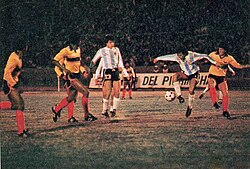
Group B saw a tight battle between Brazil and Argentina. Brazil eventually advanced to the knockout stage with 5 points, edging out Argentina, who remained undefeated but drew three of their four matches.
Group C
Peru emerged as the winner of Group C with 6 points, utilizing a strong defensive showing and key wins over Bolivia and Colombia to secure their spot in the semi-finals.
The Road to the Final
The knockout stage featured a high-stakes semi-final round. Uruguay faced Peru, winning the first leg 1-0 and drawing the second 1-1, advancing with a total of 3-1 on points. In the other semi-final, Brazil and Paraguay played to a 1-1 draw and a 0-0 draw. Because they were tied on points, Brazil advanced to the final via a drawing of lots.
The final was a two-legged affair between Uruguay and Brazil. Uruguay took a commanding lead in the first match with a 2-0 victory, featuring goals from Enzo Francescoli and Diogo. The second leg ended in a 1-1 draw, allowing Uruguay to claim the championship with a 3-1 aggregate point lead.
Tournament Summary
The 1983 edition was characterized by balanced scoring and high fan engagement, with over a million spectators attending the 24 matches played across the continent.
| Category | Detail |
|---|---|
| Dates | 10 August – 4 November 1983 |
| Participating Teams | 10 |
| Total Matches | 24 |
| Total Goals | 55 |
| Average Attendance | 42,245 per match |
| Tournament MVP | Enzo Francescoli |
Frequently Asked Questions
Who won the 1983 Copa América?
Uruguay won the tournament, marking their 12th title and their first official championship since 1967.
How was the winner decided in the semi-finals between Brazil and Paraguay?
After two matches resulted in a tie on points (one 1-1 draw and one 0-0 draw), Brazil advanced to the final through a drawing of lots.
Who were the top scorers of the tournament?
Three players tied for the top scorer position with 3 goals each: Carlos Aguilera, Jorge Luis Burruchaga, and Roberto Dinamite.
What was the significance of Uruguay's victory for future competitions?
Winning the 1983 Copa América qualified Uruguay to play in the first Artemio Franchi Trophy in 1985 against France.
Which player was named the best player of the tournament?
Enzo Francescoli was recognized as the best player of the 1983 Copa América.