Continuum Mechanics: Principles of Deformable Bodies and Material Motion
Continuum mechanics is a specialized branch of mechanics that examines how forces are transmitted through and how deformation occurs within materials. Unlike classical particle mechanics, it models materials as a continuum—a continuous medium where the substance is assumed to completely fill the space it occupies. By ignoring the discrete nature of atoms, this approach provides a highly accurate description of matter on length scales significantly larger than inter-atomic distances.
This framework allows scientists and engineers to analyze bulk matter using differential equations based on fundamental physical laws, including the conservation of mass, momentum, and energy. To ensure these descriptions remain accurate regardless of the observer's perspective, physical properties are represented by tensors—mathematical objects that remain independent of any particular coordinate system.
Key Facts
- Continuum Assumption: Matter is treated as a continuous mass rather than discrete particles.
- Deformable Bodies: Focuses on materials that change shape or size, as opposed to rigid bodies.
- Core Disciplines: Forms the theoretical foundation for elasticity, plasticity, and fluid mechanics.
- Coordinate Independence: Uses tensors to define physical properties at any point in the medium.
- Governing Laws: Based on the conservation of mass, energy, and momentum.
Major Areas of Study
Continuum mechanics serves as the umbrella for several critical fields of physics and engineering, categorized by how materials respond to applied stress:
- Elasticity: The study of materials that return to their original rest shape once applied stresses are removed.
- Plasticity: The study of materials that undergo permanent deformation after a specific threshold of stress is reached.
- Fluid Mechanics: The study of continuous materials that deform continuously when subjected to a force.
Formulation of Models and Kinematics
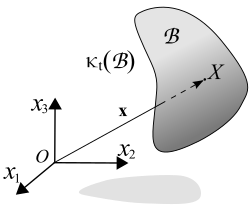
To model a continuum, a region in three-dimensional Euclidean space is assigned to the material body. The points within this region are referred to as material points or particles. The state of the body at any given time is defined by its configuration in space.
A particle's position is characterized by a position vector. For a model to be physically realistic, the mapping of these particles over time must be continuous (to ensure realistic movement) and globally invertible (to prevent the body from intersecting itself).
Motion and Deformation
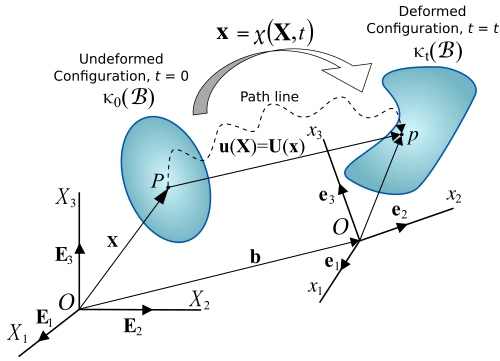
When a continuum body changes configuration, it experiences displacement. This is divided into two components: rigid-body displacement (translation and rotation without shape change) and deformation (a change in the body's actual shape or size).
The motion of a body is a continuous sequence of these displacements, where each particle traces a path line through space over time.
Descriptions of Motion: Lagrangian vs. Eulerian
There are two primary mathematical perspectives used to describe the motion and physical properties of a continuum:
Lagrangian Description
Commonly used in solid mechanics, the Lagrangian description tracks individual particles from a reference configuration (usually the initial state at time zero). An observer monitors the changes in position and properties of specific material points as they move through space.
A key concept here is the material derivative (also known as the substantial or convective derivative), which represents the time rate of change of a property for a specific group of particles as they move.
Eulerian Description
The Eulerian description focuses on specific points in space rather than specific particles. Instead of tracking a particle's journey, it observes the physical properties of whatever material happens to be passing through a fixed spatial location at a given time.
Forces and Stress in a Continuum
Forces acting on a continuum are categorized into two types: surface forces and body forces.
- Surface Forces: These are contact forces acting on the boundary of the body. The distribution of these forces is represented by the Cauchy traction field (or stress vector).
- Body Forces: These are forces that act throughout the volume of the body (such as gravity).
Materials are further classified by their response to these forces. Non-polar materials are the basis for classical stress theory, while polar materials exhibit additional body couples and couple stresses.
Governing Equations and Balance Laws
The behavior of a continuum is governed by balance laws that describe how physical quantities flow through the body or are generated within it. These laws are expressed through the Cauchy stress tensor, mass density, and internal energy.
Additionally, the Clausius–Duhem inequality is used to ensure that the model adheres to the laws of thermodynamics, specifically regarding entropy and heat flux.
| Feature | Lagrangian Perspective | Eulerian Perspective |
|---|---|---|
| Focus | Individual material particles | Fixed points in space |
| Primary Use | Solid Mechanics | Fluid Mechanics |
| Reference | Initial configuration (t=0) | Current spatial position |
| Key Variable | Material coordinates | Spatial coordinates |
Frequently Asked Questions
What is the difference between a continuum and a discrete model?
A continuum model assumes matter is continuously distributed throughout a volume, ignoring the gaps between atoms. A discrete model treats matter as a collection of individual particles.
What is a tensor in the context of continuum mechanics?
A tensor is a mathematical object used to represent physical properties (like stress or strain) such that the description remains valid regardless of the coordinate system used by the observer.
How does elasticity differ from plasticity?
Elasticity refers to the ability of a material to return to its original shape after stress is removed, whereas plasticity refers to permanent deformation that remains after the stress is gone.
What is the material derivative?
The material derivative is the rate of change of a physical property (such as temperature or velocity) as measured by an observer moving along with a specific group of particles in the continuum.
What are the primary applications of continuum mechanics?
It is fundamental to various engineering fields, including civil, mechanical, aerospace, biomedical, and chemical engineering, as it allows for the design and analysis of structures and fluids.