Compact of Free Association: 21st Century Renewals and Updates
The Compact of Free Association (COFA) represents a unique diplomatic and financial relationship between the United States and three sovereign Pacific nations: the Republic of the Marshall Islands (RMI), the Federated States of Micronesia (FSM), and the Republic of Palau. These agreements balance national sovereignty with strategic security and economic support, ensuring stability in the Pacific region.
As these agreements reach their expiration dates, they undergo rigorous renewal processes to address evolving economic needs, environmental challenges, and security requirements.
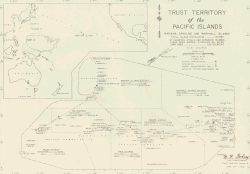
The 2003 Renewal: Establishing Compact II
In 2003, the United States renewed its compacts with the RMI and FSM for a period of 20 years. This phase, often referred to as Compact II, provided a total of US$3.5 billion in funding for both nations. For the FSM, the agreement took effect on June 25, 2004, and for the RMI on June 30, 2004.
Compact Impact Funding and Logistics
To manage the societal effects of migration, the U.S. disbursed US$30 million annually in "Compact Impact" funding. This money was allocated to American Samoa, Guam, Hawaii, and the Northern Mariana Islands to help these local governments provide essential services to immigrants arriving from the RMI, FSM, and Palau.
The renewal also introduced specific administrative changes:
- Immigration: Citizens of the RMI and FSM were now required to hold passports when traveling to the United States.
- Postal Services: The US Postal Service (USPS) briefly attempted to apply international postage rates for mail between the U.S. and RMI/FSM starting in January 2006, but reverted to domestic rates in November 2007.
- Military Access: The U.S. maintained its use of the Kwajalein Atoll for missile testing for the duration of the period.
The Palau Transition
Palau's economic provisions, which included US$18 million in annual grants and subsidies, expired on September 30, 2009. While military and civil defense provisions lasted until 2015, the Compact Trust Fund—designed to replace direct U.S. aid—underperformed due to the Great Recession. Consequently, U.S. financial support for Palau was maintained through continuing resolutions passed by Congress until a Compact Review Agreement was signed in 2018, extending financial provisions to September 30, 2024.
The 2023 Renewal Process
Negotiations for the next generation of compacts faced significant hurdles, stalling in December 2020. Ambassador Gerald Zackios of the RMI noted that the impasse was caused by a lack of a U.S. negotiator empowered to discuss critical non-economic issues, such as climate-change mitigation, the legacy of nuclear testing, and the presence of U.S. military bases.
To resolve this, Secretary of State Antony Blinken announced the creation of the Special Presidential Envoy for Compact Negotiations on March 22, 2022. President Joe Biden appointed Ambassador Joseph Yun to this role to lead the amendments and continuation of the COFA.
Finalizing the New Agreements
Following extensive negotiations between March 2022 and October 2023, the three nations signed their respective extensions:
- Palau: Signed May 22, 2023, by Finance Minister Kaleb Udui Jr. and Ambassador Yun.
- FSM: Signed May 23, 2023, by negotiator Leo Falcam and a State Department representative.
- RMI: Signed October 16, 2023, by Minister of Foreign Affairs and Trade Jack Ading and Ambassador Yun.
These renewed compacts were officially signed into law on March 8, 2024, as part of the Consolidated Appropriations Act.
Key Facts
- Total 2023 Funding: US$7.1 billion distributed over 20 years.
- Funding Breakdown: FSM ($3.3B), RMI ($2.3B), Palau ($889M), and USPS ($634M).
- Strategic Site: Kwajalein Atoll remains a critical site for U.S. ballistic missile testing.
- Legal Status: The 2023 renewals were codified via the Consolidated Appropriations Act of 2024.
| Agreement Phase | Primary Nations | Key Funding/Provisions | Effective/End Date |
|---|---|---|---|
| Compact II (2003) | RMI, FSM | US$3.5 Billion | 2004 – 2023 |
| Palau Review (2018) | Palau | Financial Extensions | Through Sept 30, 2024 |
| 2023 Renewal | RMI, FSM, Palau | US$7.1 Billion (Total) | Signed into law March 8, 2024 |
Frequently Asked Questions
What is "Compact Impact" funding?
Compact Impact funding is financial assistance provided by the U.S. to American Samoa, Guam, Hawaii, and the Northern Mariana Islands to offset the costs of providing public services to immigrants from the COFA states.
Why did the 2020 negotiations stall?
Negotiations stalled because the Pacific nations required a U.S. negotiator with the authority to discuss complex issues beyond money, specifically nuclear testing legacies, military presence, and climate change.
How much funding was allocated in the 2023 renewals?
A total of US$7.1 billion was allocated over 20 years, with the largest shares going to the FSM ($3.3B) and the RMI ($2.3B), followed by Palau ($889M) and the USPS ($634M).
What happened to the Palau Compact Trust Fund?
The fund, which was intended to replace direct U.S. financial aid, underperformed due to the economic impact of the Great Recession.
Are passports required for RMI and FSM citizens visiting the U.S.?
Yes, as part of the 2003 renewal changes, citizens of the Republic of the Marshall Islands and the Federated States of Micronesia are required to have passports when traveling to the United States.