Colonel: Rank, History, and Insignia in the British Army
In the hierarchy of the British Army and Royal Marines, the Colonel (abbreviated as Col) serves as a senior field officer. Positioned above the lieutenant colonel and below the brigadier, the role of a colonel has evolved from the early modern era of private regimental ownership to a professional administrative and staff position in the modern military.
Unlike lower-ranking officers, British colonels are not typically field commanders. Instead, they generally serve as staff officers, bridging the operational gap between battalion-level and brigade-level commands. In terms of international standardization, the rank is classified under the NATO rank code OF-5, making it equivalent to a Captain in the Royal Navy and a Group Captain in the Royal Air Force.
Key Facts
- Rank Group: Field officer (NATO OF-5).
- Insignia: A crown above two diamond-shaped "Bath Stars".
- Equivalent Ranks: Captain (Royal Navy) and Group Captain (RAF).
- Primary Role: Typically serves as a staff officer rather than a field commander.
- Origin: Derived from the Spanish coronel (column of soldiers) in the 16th century.
Etymology and Origins
The term "colonel" originated from the Spanish Army's tercios during the 16th and 17th centuries. General Gonzalo Fernández de Córdoba organized his troops into coronelías, meaning "column of soldiers" (from the Latin columnella). The leaders of these units were known as coronel.
This structure was adopted into Italian as colonello and Middle French as coronel. The rank entered the English language via French in the mid-16th century, which explains the modern English pronunciation.
The Evolution of the Rank
The Era of Patronage
Historically, the British Army was organized around regiments raised and equipped by the crown or noblemen. In the 17th and 18th centuries, the "colonel of a regiment" was often a nobleman who acted as a financier. These individuals were responsible for the costs of uniforms, equipment, and wages. Because they were often general officers or financiers, the actual day-to-day command was usually delegated to a lieutenant colonel or major.
Until the late 18th century, regiments were often named after their colonels, such as Lord Churchill's Dragoons. This system changed as the British government reformed army administration into three bodies: the War Office (administration, cavalry, and infantry), the Board of Ordnance (weapons, ammunition, Royal Artillery, and Royal Engineers), and the Commissariat (rations and transport).
Professionalization and Sinecures
By the Napoleonic Wars, the title "colonel of the regiment" had largely become a sinecure—a position requiring little work but providing a salary. It was often granted to distinguished generals or royalty as a way to provide extra income. However, by the end of the 19th century, the Cardwell and Childers Reforms transformed the colonelcy into a professional rank with senior administrative duties within a brigade or regiment.
Ceremonial and Honorary Titles
The British Army maintains several distinct titles that use the word "colonel" but differ from the substantive military rank.
Colonel-in-Chief
This is a patronal role usually held by a member of the royal family. While they have no operational command, they maintain a direct link between the royal family and the regiment, staying informed of the unit's activities.
Colonel of the Regiment
This ceremonial position is often awarded to retired general officers, brigadiers, or colonels with strong ties to a specific unit. When acting in this capacity, the holder wears the full colonel's insignia regardless of their actual retired rank.
Honorary Colonel
An honorary colonel is a purely ceremonial role that can be held by civilians with no prior military service. If held by royalty, it is termed a Royal Honorary Colonel.
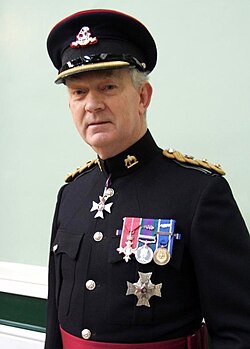
Rank Insignia and Uniforms
Historical Development
Rank badges for field officers were introduced in 1810, initially featuring a crown and star on shoulder epaulettes. By 1855, insignia moved to the collar, and by 1880, they returned to the shoulder boards in full dress, adding a second star. The current pattern of a crown above two stars has remained the standard since 1880.
Modern Identification
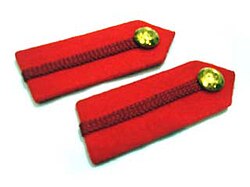
The current insignia consists of two diamond-shaped pips, known as Bath Stars, positioned below a crown. Officers of the substantive rank of colonel also wear gorget patches (crimson lace with a brass button, colloquially called "red tabs") as part of their general staff uniform. Regimental colonels, however, do not wear these patches.
Summary of Colonel Rank Equivalencies
| Service Branch | Rank Title | NATO Code | Role Type |
|---|---|---|---|
| British Army / Royal Marines | Colonel | OF-5 | Staff / Administrative |
| Royal Navy | Captain | OF-5 | Command |
| Royal Air Force | Group Captain | OF-5 | Command / Staff |
Frequently Asked Questions
What is the difference between a Colonel and a Colonel-in-Chief?
A Colonel is a professional military rank (OF-5) with administrative and staff responsibilities. A Colonel-in-Chief is a ceremonial patron, usually a member of the royal family, who maintains a link between the monarchy and the regiment without operational duties.
Why is the word "Colonel" pronounced like "Kernel"?
The pronunciation is derived from the French variant coronel, which entered the English language in the mid-16th century.
What are "Bath Stars"?
Bath Stars are the diamond-shaped pips used in British Army rank insignia. A colonel's insignia features two of these stars positioned below a crown.
Did the Royal Air Force ever have Colonels?
Yes, the RAF maintained the rank of colonel from April 1, 1918, to July 31, 1919. On August 1, 1919, the rank was replaced by Group Captain.
What was the "Colonel of Marines" title?
This was an honorific, salaried title given to post-captains in the Royal Navy for distinguished service. It was a sinecure that provided extra pay but no additional duties; Horatio Nelson held this title in 1795.