Collagen: The Structural Powerhouse of Animal Connective Tissues
Collagen is the primary structural protein found in the extracellular matrix of connective tissues across many animal species. As the most abundant protein in mammals, it accounts for approximately 25% to 35% of the total protein content of the body. Unlike keratin, which provides structure to hair and nails, collagen provides the essential framework for organs, skin, and skeletal structures.
This protein is ubiquitous, appearing in high concentrations in bones, cartilage, tendons, ligaments, and the skin. Depending on its level of mineralization, collagen can vary from being highly rigid, as seen in bone, to highly compliant, as seen in tendons. It also plays a critical role in the corneas, blood vessels, the gut, intervertebral discs, and dentin. In skeletal muscle, collagen makes up about 6% of the weight and is a major component of the endomysium.
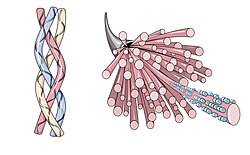
Key Facts
- Abundance: Makes up 25% to 35% of all mammalian protein.
- Primary Cell: The fibroblast is the most common cell responsible for collagen production.
- Essential Nutrient: Vitamin C is vital for the synthesis of collagen.
- Structure: Characterized by a unique triple helix of elongated fibrils.
- Distribution: Found in skin, bone, cartilage, tendons, and blood vessels.
Molecular Structure and Composition
At its most basic level, collagen consists of amino acids bound together to form a collagen helix. This structure is a triple helix composed of three left-handed polyproline type II helices that assemble via axial hydrogen bonds to create a right-handed tertiary structure.
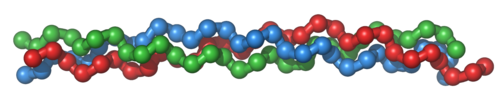
The amino acid composition of collagen is highly specialized. Proline makes up about 17% of the protein, and hydroxyproline—a derivative of proline—is also prevalent. Glycine is the most abundant amino acid in both mammal and fish skin collagen.
| Amino Acid | Mammal Skin | Fish Skin |
|---|---|---|
| Glycine | 329 | 339 |
| Proline | 126 | 108 |
| Alanine | 109 | 114 |
| Hydroxyproline | 95 | 67 |
| Glutamic acid | 74 | 76 |
| Arginine | 49 | 52 |
Collagen Synthesis and Hierarchy
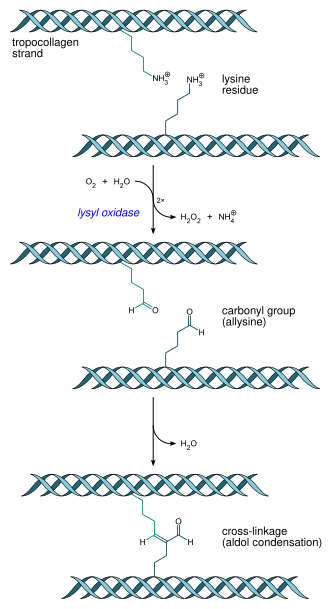
The production of collagen begins with the formation of pro-collagen. The pre-pro-peptide undergoes three modifications to become an alpha peptide, starting with the removal of the signal peptide on the N-terminal to create a "propeptide."
Using Type I collagen as a typical example, the process moves from inside the cell to the extracellular space. Three polypeptides coil together to form tropocollagen. These tropocollagen units then bind together to form a fibril, and multiple fibrils eventually assemble into a fiber.
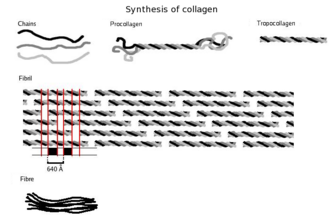
The resulting collagen fibrils exhibit a specific D-period, which creates visible 67nm bands when viewed under an electron microscope.
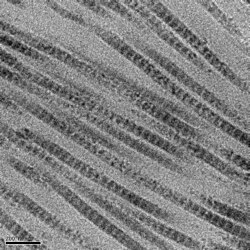
The mechanical properties of collagen change based on its hierarchical level. While molecular-level atomistic modeling shows a Young's modulus (a measure of stiffness) of 2.4-7 GPa, a non-cross-linked rat tail tendon fiber measures significantly lower, between 50-250 MPa.
Types of Collagen
Collagen is categorized into several groups based on its structure and function:
- Fibrillar: Types I, II, III, V, and XI.
- Non-fibrillar: Includes various subgroups such as:
- FACIT (Fibril-associated collagens with interrupted triple helices): Types IX, XII, XIV, XVI, XIX, XXI.
- Basement membrane: Type IV.
- MACIT (Membrane-associated collagens with interrupted triple helices): Types XIII, XVII.
- Others: Short-chain (VIII, X), Multiplexin (XV, XVIII), Microfibril-forming (VI), and Anchoring fibrils (VII).
The Five Most Common Types
- Type I: Found in skin, tendons, vasculature, organs, and is the main organic component of bone.
- Type II: The primary collagenous component of cartilage.
- Type III: The main component of reticular fibers, often found alongside Type I.
- Type IV: Forms the basal lamina of the basement membrane.
- Type V: Found in most interstitial tissue and the placenta.
Clinical Significance and Disorders
Genetic mutations in collagen genes can lead to severe systemic disorders. For example, mutations in COL1A1 or COL1A2 (Type I) can result in Osteogenesis imperfecta or Ehlers–Danlos syndrome. Mutations in Type IV collagen (COL4A1-COL4A6) are associated with Alport syndrome and Goodpasture's syndrome.
Beyond genetic disorders, collagen is essential for medical recovery. It is used in reconstructive surgery, cardiac repair, and dental repair. During the four phases of wound healing, collagen provides the necessary structural integrity for tissue regeneration.
Applications and Uses
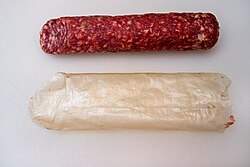
Due to its biocompatibility, collagen is harvested from animals for various uses. It is widely used in cosmetics and as a dietary supplement. In the food industry, it is used for products such as collagen casings for sausages.
Frequently Asked Questions
What is the difference between collagen and keratin?
Collagen is the main structural protein of the extracellular matrix in connective tissues (like bone and skin), whereas keratin is the primary structural protein found in hair and nails.
Why is Vitamin C important for collagen?
Vitamin C is a vital cofactor for collagen synthesis; without it, the body cannot properly produce the protein, which can lead to connective tissue failure.
Which type of collagen is most common in bone?
Type I collagen is the main component of the organic part of bone, as well as skin and tendons.
What are the mechanical properties of collagen?
Collagen's stiffness varies by structure. At the molecular level, it is very stiff (2.4-7 GPa), but as a non-cross-linked fiber, its Young's modulus is much lower (50-250 MPa).
What is a fibroblast?
A fibroblast is the most common type of cell in animals responsible for creating collagen.