Codex Osuna: A Legal Record of Indigenous Struggle in Colonial Mexico
The Codex Osuna is a rare and significant Aztec codex dating back to 1565. Unlike many early manuscripts, it was created on European paper and blends indigenous pictorial art with alphabetic Nahuatl text. This document serves as a poignant historical record of a legal battle fought by a Nahua community against Spanish authorities during the early colonial period in Mexico.
The codex is a fragment of a much larger original text, with the first numbered folio in its facsimile beginning at 464. It consists of seven distinct parts, the majority of which focus on economic matters—specifically tribute—while one section is dedicated to historical accounts.
Key Facts
- Origin: Created in early 1565 as evidence in a lawsuit against the government of Viceroy Luís de Velasco.
- Composition: Combines indigenous pictorials, alphabetic Nahuatl text, and Spanish translations.
- Purpose: To document non-payment for goods and services, including domestic help and construction labor.
- Provenance: Named after the 12th Duke of Osuna; now held by the Biblioteca Nacional in Madrid.
- Key Figures: Involves the inquiry of Jerónimo de Valderrama (1563-66) and the administration of Viceroy Luís de Velasco.
Historical Context and Legal Purpose
The Codex Osuna was produced to provide evidence during an inquiry led by Jerónimo de Valderrama between 1563 and 1566. Indigenous leaders used the document to formally claim that they had not been paid for various services and goods provided to the Spanish government. These grievances included labor for building construction and domestic assistance.
Originally, the codex was entirely pictorial. However, as it was reviewed by Spanish authorities, alphabetic Nahuatl text was added to the pages, followed by Spanish translations. This layering of languages reflects the complex intersection of indigenous and colonial administrative systems.
Visual Narratives and Pictorial Evidence
The pictorial elements of the codex provide a vivid window into the social hierarchy and economic activities of the 16th century. One notable illustration (folio 471v) depicts Viceroy Don Luís de Velasco alongside indigenous lords dressed in colonial attire appropriate to their rank, as well as a nahuatlato (a Nahuatl translator) wearing Spanish clothing.
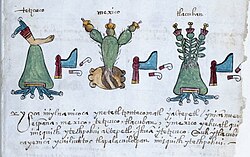
Other critical imagery includes depictions of Spaniards punishing indigenous people and detailed lists of encomienda holders (land grants given to Spanish settlers), including those that reverted to the Spanish crown. The codex also documents specific economic activities, such as the cultivation of cacti to produce cochineal (a valuable red dye) and indigenous men working in an obraje (a textile workshop).
The final pictorial depicts indigenous men extracting and transporting stone for the construction of a church, accompanied by a written complaint regarding unpaid wages.
Preservation and Modern Study
The manuscript remained in the library of Mariano Francisco de Borja José Justo Téllez-Girón y Beaufort-Spontin, the twelfth Duke of Osuna, until his death in 1882, after which it entered the collection of the Biblioteca Nacional in Madrid.
In 1947, the Instituto Indigenista Interamericano published a black and white facsimile in Mexico. This edition was expanded by Luis Chávez Orozco, who added 158 pages of Spanish documentation from the Archivo General de la Nación. These additions include a residencia (a formal review of an official's tenure), which provides essential context and may represent the "lost portion" of the original legal record.
| Feature | Details |
|---|---|
| Date of Creation | 1565 |
| Materials | European paper |
| Languages | Pictorials, Nahuatl, and Spanish |
| Primary Content | Economic tribute, labor disputes, and historical records |
| Current Location | Biblioteca Nacional, Madrid |
Frequently Asked Questions
Why is the codex named "Osuna"?
It is named after the twelfth Duke of Osuna, Mariano Francisco de Borja José Justo Téllez-Girón y Beaufort-Spontin, who owned the manuscript in his private library until 1882.
What was the primary goal of the indigenous leaders who created it?
The leaders sought to present evidence of non-payment for goods and services, such as domestic help and construction labor, during a legal inquiry into the government of Viceroy Luís de Velasco.
What is a nahuatlato?
A nahuatlato is a translator of the Nahuatl language, serving as a linguistic bridge between the indigenous population and the Spanish colonial administration.
What economic activities are depicted in the pictorials?
The codex illustrates the production of cochineal red dye from cacti, labor within textile workshops (obrajes), and the extraction and transport of stone for church construction.
How was the codex modified over time?
It began as a purely pictorial document. Later, during Spanish review, alphabetic Nahuatl text was added, followed by translations into Spanish.