Clerical Fascism: Historical Examples and Theoretical Debates
Clerical fascism refers to political movements that integrate elements of religious orthodoxy—specifically the influence of clergy and theological doctrine—into a fascist ideological framework. While fascism is often viewed as a secular movement, various regimes and parties throughout the 20th century sought to fuse ultranationalism with the authority of established churches to legitimize their power and reshape society.
These movements typically emerged as a reaction against liberal capitalism and secularism, proposing a "Third Way" that combined authoritarian governance with religious morality. The degree of integration varied, ranging from strategic alliances between the state and church to regimes led directly by ordained clergy.
Key Facts
- Core Definition: A fusion of fascist political structures with religious clericalism and theology.
- Economic Model: Often utilized corporatism, a system replacing class conflict with state-supervised vocational corporations.
- Primary Era: Most prominent during the "fascist epoch" between the end of World War I and World War II (1918–1945).
- Extreme Example: The Croatian Ustaše regime is frequently cited as the most extreme manifestation due to its militant Catholicism and genocidal policies.
- Theoretical Debate: Scholars disagree on whether the term applies to entire regimes or only to specific factions within a movement.
Prominent Historical Examples
Southern and Western Europe
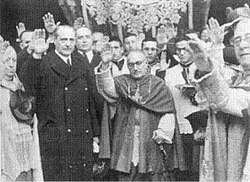
In Spain, the FET y de las JONS under Francisco Franco developed National Catholicism (Nacionalcatolicismo). This ideology restored the Catholic Church's hegemony over Spanish public life, including family law, censorship, and education.
Portugal's National Union, led by António de Oliveira Salazar and Marcelo Caetano, presents a point of scholarly contention. While some historians label it fascist, others, including Robert Paxton and Roger Griffin, argue that Salazar distanced himself from the "pagan Caesarism" of Nazism and even banned National Syndicalists.
In Belgium, the Rexist Party was led by the Catholic Léon Degrelle, while Austria's Fatherland Front, under Chancellors Engelbert Dollfuss and Kurt Schuschnigg, established the Ständestaat (Christian Corporatist State). This system modeled its authoritarian structure on Catholic teachings, though some historians describe it as "semi-fascist" rather than fully fascist.
Central and Eastern Europe
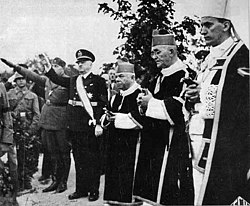
The Independent State of Croatia was ruled by the Ustaše movement under Ante Pavelić. This regime combined militant Catholicism with extreme nationalism to facilitate genocide against Serbs, Jews, and Roma.
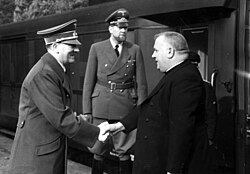
In Slovakia, the Slovak People's Party (Ľudaks) was led by President Jozef Tiso, who was a Roman Catholic priest.
Other notable movements include the Iron Guard in Romania, led by the Romanian Orthodox Corneliu Zelea Codreanu, and the ZBOR movement in Serbia, led by Dimitrije Ljotić and supported by the Serbian Orthodox Church. In Poland, the National Radical Camp incorporated Polish Catholicism, particularly within its Falangist faction.
The Americas and Other Regions
In Brazil, Plínio Salgado led the Brazilian Integralist Action, while Juan Queraltó led the Nationalist Liberation Alliance in Argentina. Mexico saw the National Synarchist Union under José Antonio Urquiza, a revival of the Catholic reaction associated with the Cristero War.
In the United States, the Silver Legion of America, led by William Dudley Pelley, blended Protestantism with white nationalism. In Finland, the Lapua Movement and the Patriotic People's Movement (IKL) were led by Lutherans such as Vihtori Kosola and Vilho Annala.
The Economic and Theological Basis
Many clerical fascist states adopted corporatism to replace liberal capitalism. This economic model sought to organize society into vocational corporations supervised by the state to eliminate class struggle. This approach was often justified using papal encyclicals, specifically Rerum Novarum and Quadragesimo Anno, which advocated for a socio-economic order based on Catholic doctrine.
| Movement/Regime | Country | Key Leader(s) | Religious Affiliation |
|---|---|---|---|
| FET y de las JONS | Spain | Francisco Franco | Catholic |
| Ustaše | Croatia | Ante Pavelić | Catholic |
| Slovak People's Party | Slovakia | Jozef Tiso | Catholic |
| Iron Guard | Romania | Corneliu Zelea Codreanu | Orthodox |
| Fatherland Front | Austria | Dollfuss / Schuschnigg | Catholic |
| Lapua Movement | Finland | Vihtori Kosola | Lutheran |
Scholarly Debates and Definitions
The term "clerical fascism" is subject to significant academic debate. Some scholars argue that a regime does not become clerical simply because members of the clergy support it. Others restrict the term strictly to the interwar period (1918–1945).
Political theorist Roger Griffin warns against the "hyperinflation" of the term. He argues that clerical fascism should only describe instances where professional theologians or clerics collude with secular fascism or mix religious beliefs with a commitment to saving a race or nation from collapse. Griffin maintains that fascism is fundamentally a secular, revolutionary variant of ultranationalism, meaning clerical fascism can only be a faction within a larger fascist movement, not the regime in its entirety.
In contemporary contexts, some scholars apply the term to movements such as Christian Identity and Christian Reconstructionism in the U.S., Hindutva in India, and certain forms of Islamism.
Frequently Asked Questions
What is the difference between fascism and clerical fascism?
While fascism is generally a secular, revolutionary movement focused on national rebirth, clerical fascism specifically incorporates the authority, personnel, and doctrines of a religious church into its political ideology.
What was the role of corporatism in these regimes?
Corporatism served as an economic "Third Way," attempting to replace both liberal capitalism and socialism. It organized society into state-controlled vocational groups, often citing Catholic papal encyclicals as a moral justification.
Was every religious-nationalist movement considered clerical fascist?
No. Scholars debate the label extensively. For example, some historians argue that the regime of António de Oliveira Salazar in Portugal was not fascist because he distanced himself from the "pagan" elements of Nazism and banned fascist syndicalists.
Who is Roger Griffin and what is his view on the term?
Roger Griffin is a political theorist who argues that "clerical fascism" should be used sparingly. He believes it describes a specific collusion between theologians and fascist ideology rather than a type of regime, as fascism is inherently secular.
Which regime is considered the most extreme example?
The Croatian Ustaše regime is widely cited as the most extreme example due to its fusion of militant Catholicism and ultranationalism, which was used to justify a brutal program of genocide.