Claire Curran: A Parliamentary Career in New Zealand Politics
Claire Curran served as a prominent member of the New Zealand Parliament representing the Labour Party from 2008 to 2020. Throughout her tenure, she represented the Dunedin South electorate, navigating the complexities of both opposition and ministerial roles during a period of significant digital and social transition in New Zealand.
Key Facts
- Electorate: Represented Dunedin South across four consecutive terms (2008–2020).
- Ministerial Roles: Served as Minister of Broadcasting, Communications, and Digital Media, and Minister for Government Digital Services.
- Key Initiatives: Proposed the creation of a Government Chief Technology Officer (CTO) role.
- Retirement: Stepped down from Parliament in 2020, succeeded by Ingrid Leary.
Early Parliamentary Career (2008–2017)
Curran's political journey began in 2007 when she successfully challenged incumbent MP David Benson-Pope for the Labour Party nomination in Dunedin South. She won the 2008 general election against National's Conway Powell. While she maintained her seat in 2011 and 2014, her majority fluctuated, notably decreasing during the 2011 election against Jo Hayes.
During the 49th Parliament, Curran served on the Commerce Committee and acted as the Labour spokesperson for Communications and Information Technology. As a member of the Opposition, she was a vocal critic of several government policies, including the closure of the public broadcaster TVNZ 7 and the inclusion of software in the Patents Bill. She also advocated for local interests in South Dunedin, specifically regarding the return of rail engineering to the Hillside Engineering site and the region's vulnerability to rising sea levels.
Ministerial Tenure and the Labour Coalition (2017–2020)
Following the formation of a coalition government between Labour, New Zealand First, and the Greens in 2017, Curran was appointed to the Cabinet. On October 26, 2017, she assumed the portfolios of Minister of Broadcasting, Communications, and Digital Media, and Minister for Government Digital Services. She also held associate roles for the State Services Commission (focusing on open government) and the Accident Compensation Corporation (ACC).
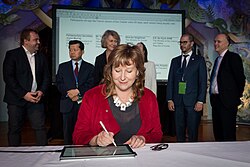
One of Curran's primary goals was the modernization of government technology. At the 2017 NetHui, she proposed establishing a Chief Technology Officer (CTO) for the New Zealand Government. Despite significant interest from over 60 candidates, the position remained unfilled by February 2018, with Curran stating the search for a suitable candidate would be widened.
Controversies and Resignations
Curran's time in the Cabinet was marked by several high-profile controversies regarding transparency. In early 2018, it was revealed she had a pre-arranged meeting with Radio New Zealand manager Carol Hirschfeld, which Curran initially claimed was coincidental. This led to Hirschfeld's resignation and criticism from the National Party.
In August 2018, Prime Minister Jacinda Ardern dismissed Curran from the Cabinet after it emerged that Curran had failed to record a meeting in her ministerial diary with tech entrepreneur Derek Handley. While she initially retained some portfolios, Curran resigned from all ministerial positions in September 2018, citing the "relentless pressure" she faced, particularly following questioning regarding her use of a personal Gmail account for official business.
Retirement and Allegations of Political Bullying
Curran announced her retirement from Parliament on August 27, 2019, spending her final months on the Justice and Electoral select committees. Following her departure, she spoke openly about the "toxicity and bullying" she encountered during her career, revealing that she received treatment for post-traumatic stress disorder (PTSD).
Curran alleged several instances of misconduct, including a 2012 incident where National MP Michael Woodhouse allegedly participated in mocking her with a toilet seat featuring her photo. She also claimed that Nick Smith had compared her to Joseph Goebbels in 2006 and that National MPs had derided Jacinda Ardern's childless status. Additionally, she described an encounter with an unnamed senior Labour colleague who made disparaging remarks about her sexuality. While Michael Woodhouse stated he did not remember the toilet seat incident, former National MP Jami-Lee Ross apologized to Curran for the tactics used by his former party.
Parliamentary Summary
| Parliament | Term | Electorate | Party | List Rank |
|---|---|---|---|---|
| 49th | 2008–2011 | Dunedin South | Labour | 45 |
| 50th | 2011–2014 | Dunedin South | Labour | 28 |
| 51st | 2014–2017 | Dunedin South | Labour | None |
| 52nd | 2017–2020 | Dunedin South | Labour | 23 |
Frequently Asked Questions
Which electorate did Claire Curran represent?
Claire Curran represented the Dunedin South electorate for the duration of her parliamentary career from 2008 to 2020.
What ministerial portfolios did she hold?
She served as the Minister of Broadcasting, Communications, and Digital Media, and the Minister for Government Digital Services, along with associate roles for the ACC and the State Services Commission.
Why was Claire Curran dismissed from the Cabinet?
She was dismissed by Prime Minister Jacinda Ardern in August 2018 after acknowledging that she had failed to disclose a meeting with tech entrepreneur Derek Handley in her official ministerial diary.
What was the outcome of her proposed CTO role?
Despite proposing a Chief Technology Officer for the New Zealand Government and receiving over 60 applications, no appointment was made at that stage.
What did Curran reveal after leaving Parliament?
Curran spoke about experiencing toxicity and bullying from members of both the National and Labour parties, which she stated led to her being treated for post-traumatic stress disorder (PTSD).