City Lights Bookstore: A Legacy of Literature and Counterculture
Nestled in the heart of San Francisco's North Beach neighborhood, City Lights Bookstore stands as more than just a retail space; it is a global symbol of alternative culture and literary rebellion. From its audacious beginnings as the first all-paperback bookstore in the United States to its status as a designated historic landmark, City Lights has served as a beacon for writers, activists, and thinkers for over seven decades.
The store's journey began not with a shop, but with a magazine. In 1952, Peter D. Martin, a sociology teacher who had moved from New York City, launched a publication titled City Lights—a name chosen as a tribute to a Charlie Chaplin film. This magazine became a vital outlet for early Bay Area writers, including Philip Lamantia, Pauline Kael, Jack Spicer, Robert Duncan, and Lawrence Ferlinghetti (who wrote under the pseudonym "Lawrence Ferling").
Founding and Early Growth
In 1953, Peter D. Martin expanded the City Lights brand by establishing a "Pocket Book Shop." This was a bold move at the time, as it was the first bookstore in the U.S. to sell exclusively paperbacks. The shop was located in the Artigues Building at 261 Columbus Avenue, a structure designed by Oliver Everett in 1907 on the site of ruins left by the 1906 earthquake and fire.
The partnership that defined the store's future happened by chance. While walking past the building, Lawrence Ferlinghetti noticed Martin hanging the shop's sign. Having always dreamed of owning a bookstore, Ferlinghetti proposed a partnership. Both men invested $500 to launch the venture. They soon hired Shig Murao, who started as a clerk and eventually became the store manager, playing a pivotal role in shaping the unique atmosphere of the shop.
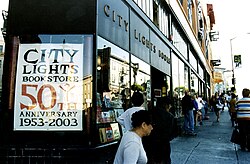
By 1955, Martin sold his share to Ferlinghetti for $1,000 and relocated to New York to open the New Yorker Bookstore, which focused on cinema. Under Ferlinghetti's leadership, City Lights grew, gradually expanding to occupy the entire Artigues Building as other neighboring shops became vacant.
Professionalizing the Chaos
In the late 1960s, Ferlinghetti hired Joseph Wolberg, a former philosophy professor from SUNY Buffalo, to manage the store. Wolberg brought much-needed order to the previously chaotic shelves and convinced Ferlinghetti to install metal detectors to prevent shoplifting. Beyond management, Wolberg used his connection to the store to produce records for renowned Beat poets, including Shel Silverstein and Charles Bukowski.
The Era of Activism and Survival
During the 1970s, City Lights solidified its role as a center for social and political protest. In 1970, the store hired Paul Yamazaki, an activist who had been imprisoned for protesting for Ethnic and Black studies departments at San Francisco State University. Yamazaki's dedication to the store spanned over fifty years, earning him the National Book Foundation's Literarian Award for Outstanding Service to the Literary Community in 2023.
In 1971, Nancy Peters joined the team after working at the Library of Congress. She described the bookstore as a hub for revolutionary ideas, frequented by figures such as Tim Leary and Paul Krassner, as well as individuals working with underground presses during a time of FBI infiltration and persecution of alternative media.
The business faced a severe financial crisis in 1984, leading Nancy Peters to become a co-owner. Ferlinghetti credited Peters with the survival and subsequent growth of the business. Their partnership culminated in 1999 when they purchased the Artigues Building itself.
Historic Recognition and Modern Legacy
In 2001, the San Francisco Board of Supervisors granted City Lights the status of an historic landmark. This was a groundbreaking decision, as it was the first time a business—rather than just a building—received such a designation. The board cited the bookstore's seminal role in the cultural development of both San Francisco and the United States.
The building's architecture, featuring a small mezzanine balcony and clerestory windows (high windows that allow light and air into a space), also qualified it as a landmark due to its typical post-1906 earthquake commercial design. This designation ensures the preservation of the building's external features against the pressures of urban redevelopment.
Despite its fame, the store has often operated on thin margins. In 2003, with 15 employees, Peters estimated annual profits to be around $1,000. Peters served as executive director for 23 years before stepping down in 2007, handing the role to Elaine Katzenberger while remaining on the board of directors.
Key Facts
- Founded: 1953 as the first all-paperback bookstore in the U.S.
- Location: The Artigues Building, 261 Columbus Avenue, San Francisco.
- Founders: Peter D. Martin and Lawrence Ferlinghetti.
- Landmark Status: First business in San Francisco to be named an historic landmark (2001).
- Logo: A medieval guild mark from Rudolf Koch's The Book of Signs.
- Affiliation: Member of the American Booksellers Association.
| Year | Event | Significance |
|---|---|---|
| 1952 | City Lights Magazine launched | Published early work of Bay Area writers. |
| 1953 | Bookstore opened | First all-paperback store in the U.S. |
| 1955 | Ferlinghetti becomes sole owner | Purchased Martin's share for $1,000. |
| 1984 | Nancy Peters becomes co-owner | Saved the business from financial crisis. |
| 2001 | Historic Landmark designation | Recognized for cultural and literary contributions. |
Frequently Asked Questions
Who founded City Lights Bookstore?
The bookstore was founded in 1953 by Peter D. Martin and Lawrence Ferlinghetti, who each invested $500 to start the venture.
Why is City Lights considered a historic landmark?
In 2001, it became the first business in San Francisco to be named a landmark because of its seminal role in the literary and cultural development of the city and the nation, as well as the architectural significance of the Artigues Building.
What makes the bookstore's origin unique?
It was the first bookstore in the United States to sell only paperback books, which was considered an audacious business idea at the time.
Who was Nancy Peters and what was her role?
Nancy Peters joined City Lights in 1971 and became a co-owner in 1984. She is credited with saving the business during a financial crisis and served as executive director for 23 years.
What is the significance of the City Lights logo?
The logo is a medieval guild mark selected by Lawrence Ferlinghetti from a work called The Book of Signs by Rudolf Koch.