Cisticolidae: The Diverse World of Old World Warblers
The Cisticolidae are a diverse family of small passerine birds, commonly known as warblers. Comprising approximately 160 to 168 species, these birds are primarily found in the warmer southern regions of the Old World. While they were once classified within the Sylviidae family (the Old World warblers), modern taxonomy recognizes them as a distinct group with unique evolutionary trajectories.
Most species in this family are characterized by their small size and understated plumage, typically appearing in shades of drab brown or grey. This camouflage makes them difficult to spot in their preferred habitats—open country, grasslands, and scrublands. Because many species look nearly identical, birdwatchers and researchers often rely on their distinct songs for accurate identification.
Key Facts
- Distribution: Primarily Africa, with representatives in tropical Asia, Australasia, and one European breeding species (the zitting cisticola).
- Diet: They are insectivorous, feeding mainly on insects.
- Habitat: Open landscapes including scrub and grasslands.
- Nesting: They typically build their nests low within vegetation.
- Diversity: The family contains 26 genera and up to 168 species.
Taxonomy and Evolution
The family was first introduced as Cisticolinae by Swedish zoologist Carl Jakob Sundevall in 1872. Evidence suggests that the family likely originated in Africa, which remains the region with the highest species diversity.
Recent advancements in molecular phylogenetics—the study of evolutionary relationships using genetic data—have refined the classification of these birds. A significant 2013 study by Urban Olsson and collaborators provided a new genus-level cladogram, helping to organize the family into subfamilies such as Neomixinae, Priniinae, Cisticolinae, and Eremomelinae.
One notable taxonomic shift involves the genus Prinia. Molecular data from 2013 supported moving the red-winged prinia and the red-fronted prinia into the Prinia genus, as they were found to be closely related to other prinias rather than belonging in their own monotypic (single-species) genera.
Genera and Species Distribution
The Cisticolidae family is broad, spanning 26 genera. The most populous genus is Cisticola, with 53 species, followed by Prinia with 30 species and Apalis with 26 species. Other notable groups include the tailorbirds (genus Orthotomus), which consist of 13 species.
Some genera are monotypic, meaning they contain only one species. Examples include the Socotra warbler (Incana incanus), the Namaqua warbler (Phragmacia substriata), and the rufous-eared warbler (Malcorus pectoralis).
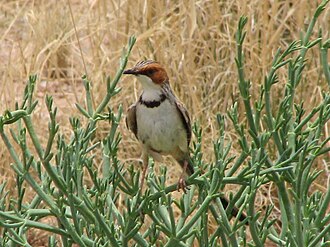
Summary of Major Genera
| Genus | Common Name/Group | Approx. Species Count |
|---|---|---|
| Cisticola | Cisticolas | 53 |
| Prinia | Prinias | 30 |
| Apalis | Apalises | 26 |
| Orthotomus | Tailorbirds | 13 |
| Eremomela | Eremomelas | 10 |
| Neomixis | Jeries | 3 |
Frequently Asked Questions
Where are Cisticolidae birds primarily found?
They are mainly found in the warmer southern regions of the Old World, with the highest concentration of species in Africa. They also inhabit tropical Asia and Australasia, and the zitting cisticola breeds in Europe.
Why is it difficult to identify these birds by sight?
Most species have drab brown or grey plumage and live in dense scrub or grassland, making them hard to see. Because many species look similar, their songs are often the most reliable way to identify them.
What do Cisticolidae birds eat?
These birds are insectivorous, meaning their diet consists primarily of insects.
How has their classification changed over time?
They were previously included in the Sylviidae family. However, they are now recognized as their own family, Cisticolidae, with modern placements often determined by molecular phylogenetic studies.
What is a monotypic genus in the context of this family?
A monotypic genus is one that contains only a single species. In the Cisticolidae family, examples include the genus Malcorus (rufous-eared warbler) and Incana (Socotra warbler).