Circus History: From Roman Arenas to Contemporary Performance Art
The image of the circus today usually evokes a massive "Big Top" tent filled with acrobats, clowns, and daring feats. However, the evolution of the circus is a complex journey that spans millennia. While some historians trace its roots back to the grandeur of the Roman Empire, others point to the 18th-century innovations of a single English cavalry officer. From ancient chariot races to the high-concept narratives of modern troupes, the circus has constantly reinvented itself to capture the public's imagination.
The Ancient Roots: The Roman Circus
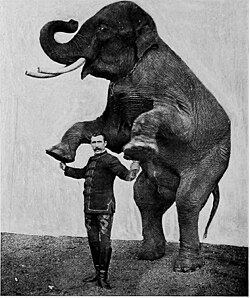
In Ancient Rome, the circus was not a tented show but a massive, roofless arena. These structures were rectangular with semi-circular ends, designed primarily for horse and chariot races, equestrian displays, and gladiatorial combat. They also hosted staged battles and fights involving trained animals. In some instances, the arenas were even flooded with water to recreate naval battles.
The most famous of these was the Circus Maximus, located between the Palatine and Aventine hills. Originally built from wood, it was eventually reconstructed in stone, reaching a staggering capacity of 250,000 people with dimensions of 400m by 90m. Other notable venues included the Circus Flaminius and the Circus Neronis. Interestingly, the Roman circus was the only public spectacle where men and women were not required to sit separately.
While some historians argue that these ancient spectacles are fundamentally different from the modern circus, others see a clear lineage. This connection continued through the Hippodrome of Constantinople until the 13th century, eventually evolving through the medieval era's jesters and troubadours.
The Birth of the Modern Circus
Philip Astley and the 42-Foot Ring
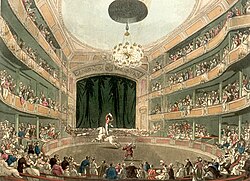
The modern circus format is widely attributed to Philip Astley, an English cavalry officer. On April 4, 1768, Astley established an amphitheatre in Lambeth, London. While he didn't invent trick riding or acrobatics, he was the first to combine these diverse acts into a single cohesive show.
Astley discovered that riding in a circle, rather than a straight line, provided better centrifugal force for his stunts. He performed in a ring with a diameter of 42 feet—a measurement that remains the global standard for circus rings today. To keep the audience engaged between equestrian acts, he hired jugglers, tightrope walkers, acrobats, and clowns.
Expansion in Britain and Europe
Following Astley, performers like Andrew Ducrow helped solidify circus traditions. In England, shows often took place in permanent buildings, such as the London Hippodrome, which featured menageries and elaborate special effects like simulated volcanic eruptions. The era also saw the rise of Joseph Grimaldi, the first mainstream clown, who debuted as "Little Clown" in 1781.
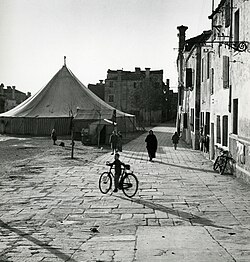
The term "circus" was coined by Charles Dibdin, who opened the Royal Circus in London in 1782. As the phenomenon spread, Astley established the Amphithéâtre Anglais in Paris, sparking a wave of permanent circuses across Europe. By 1826, the first performance under a canvas "big top" took place, liberating the circus from permanent architecture.
The American Revolution and the Traveling Show
Bringing the Circus to the United States
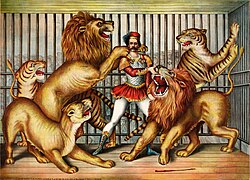
John Bill Ricketts, an Englishman, introduced the modern circus to America, opening the first US circus building in Philadelphia on April 3, 1793. The spectacle was so compelling that it even attracted George Washington. Later, Victor Pépin became the first American to operate a major circus in the US.
The Barnum Era and Industrialization
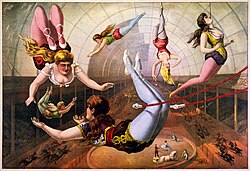
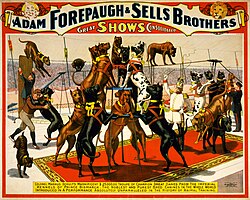
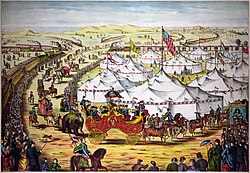
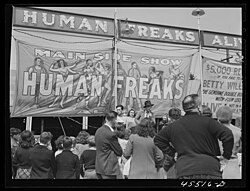
The American circus was transformed by P.T. Barnum and William Cameron Coup. In the 1870s, they launched the traveling P.T. Barnum's Museum, Menagerie & Circus, which introduced the "freak show." Coup further revolutionized the industry by introducing multiple-ring circuses and utilizing circus trains to transport massive productions between cities.
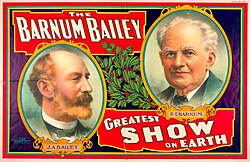
By the late 19th century, the Barnum & Bailey "Greatest Show On Earth" toured Europe (1897–1902), exporting the American model of large-scale tents, trains, and combined zoological and variety acts. This shift moved the circus away from intimate comic dialogue toward grander, more ambitious acrobatic displays and expensive machinery.
Global Evolution and Specialized Traditions
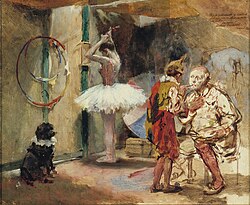
The circus spread globally through innovators like Giuseppe Chiarini, Louis Soullier, and Jacques Tourniaire, who brought the art to Latin America, Asia, and Africa. In the 20th century, different nations developed unique approaches:
- Russia: In 1919, Vladimir Lenin nationalized circuses to make them a "people's art-form." The Moscow Circus School (est. 1927) integrated Soviet gymnastics, leading to world-renowned levels of artistic skill.
- China: The Chinese State Circus continues to tour globally, drawing on deep-rooted traditions of acrobatics.
![Circus Ronaldo [nl]](/images/23/40/234027ec6f62f6a5f974bc89dad383222656fb047f36887f5ffe2cc70ea023fa.jpg)
The Rise of New and Contemporary Circus
Cirque Nouveau (New Circus)
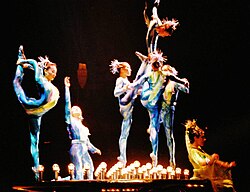
Emerging in the 1970s across Australia, Canada, France, and the UK, New Circus (cirque nouveau) shifted the focus from animal acts to theatrical storytelling. This genre emphasizes aesthetic impact, character development, and original music and lighting. Pioneers include Circus Oz and the world-famous Cirque du Soleil, which has seen nearly 90 million spectators across five continents.
Contemporary and Social Circus
Contemporary circus, emerging around 1995 with works like 'Le Cri du Caméléon', moves away from linear stories toward abstract concepts and interdisciplinary movement. Parallel to this is the Social Circus movement, which uses circus arts as a tool for social justice, working with marginalized youth to foster personal growth.
Key Facts
- Standard Ring Size: 42 feet in diameter, established by Philip Astley in 1768.
- Roman Capacity: The Circus Maximus could hold up to 250,000 spectators.
- US Innovation: P.T. Barnum and W.C. Coup introduced circus trains and multiple-ring shows.
- New Circus: A 1970s movement that replaced animal acts with theatrical narratives and high production values.
- Social Circus: An application of circus arts for social good and youth empowerment.
| Era/Type | Primary Focus | Key Feature | Notable Example |
|---|---|---|---|
| Roman Circus | Chariot races & combat | Rectangular stone arenas | Circus Maximus |
| Modern (Early) | Equestrian tricks | The 42ft circular ring | Philip Astley |
| American Golden Age | Mass spectacle & variety | Big Top & Circus Trains | Barnum & Bailey |
| New Circus | Theatrical narrative | No animals; high aesthetics | Cirque du Soleil |
| Contemporary | Abstract concepts | Interdisciplinary movement | CNAC (France) |
Frequently Asked Questions
Who is considered the father of the modern circus?
Philip Astley, an English cavalry officer, is credited with founding the modern circus in 1768 by combining equestrian tricks with acrobats and clowns in a circular arena.
How did the Roman circus differ from the modern one?
Roman circuses were permanent, rectangular stone structures used for chariot racing and gladiatorial combat, whereas the modern circus is characterized by a circular ring and, historically, a portable canvas tent.
What is the difference between New Circus and Contemporary Circus?
New Circus focuses on theatrical storytelling, character development, and high production values. Contemporary Circus tends to avoid linear narratives, favoring abstract concepts and the development of new movement languages.
Why did the popularity of traditional circuses decline after WWII?
The rise of new entertainment mediums, such as television, changed public tastes. Additionally, increasing criticism from animal rights activists led many traditional circuses to close or merge.
What is a Social Circus?
A Social Circus is a movement that uses circus arts as a pedagogical tool to support marginalized or at-risk youth, focusing on social justice and personal development rather than commercial entertainment.