Christian Social People's Service: The Protestant Conservative Voice of the Weimar Republic
The Christian Social People's Service (German: Christlich-Sozialer Volksdienst, abbreviated as CSVD) was a Protestant conservative political party that operated during the volatile era of the Weimar Republic. Positioned between the center-right and the right wing, the CSVD sought to provide a Protestant alternative to the Catholic Centre Party, blending traditional conservatism with a commitment to social welfare.
The Origins of the CSVD
The roots of the CSVD can be traced back to Adolf Stoecker's Christian Social Party, which had merged into the German National People's Party (DNVP) in 1918. Within the DNVP, the Christian socials acted as a labor-focused wing. While figures like Franz Behrens heavily influenced the DNVP's 1918 platform, a fundamental rift existed regarding labor rights; the Christian socials advocated for trade unions, whereas the DNVP preferred company unions.
This ideological tension reached a breaking point in 1929 when Alfred Hugenberg assumed leadership of the DNVP. Hugenberg's radical nationalist approach and his attacks on the employment insurance scheme alienated the moderate Christian socials. In response, these moderates formed the Christliche-soziale Reichsvereinigung (Christian-social Imperial Association) to oppose Hugenberg. This conflict ultimately led to a combination of resignations and expulsions, pushing the Christian socials out of the DNVP.
The CSVD was officially established in December 1929 through a merger of several movements. This included the Christlicher Volksdienst (CVD), a group founded in 1924 that drew support from Pietists (Christians emphasizing personal holiness and biblical study) and Christian trade unions. Additionally, the Evangelische Volksgemeinschaft (EV), a Hessian party, was absorbed into the CVD in 1929 before the final merger created the CSVD.
Ideology and Political Position
The CSVD defined itself through Christian democracy and political Protestantism. While it was supported largely by the middle class, it maintained strong ties to the league of Christian unions and supported Christian trade unions. In regions influenced by Calvinism, the party's theocratic currents led it to support state welfare and workers' participation in corporate management.
Ideologically, the CSVD stood in firm opposition to Materialism, Atheism, Liberalism, and Marxism. Because of these shared values, the party frequently cooperated with the Catholic Centre Party. This alignment allowed the CSVD to serve as a cabinet party during the second, third, and fourth ministries led by Chancellor Heinrich Brüning.
Electoral Performance and Dissolution
The CSVD contested the parliamentary elections of 1930 and 1932. In the 1930 Reichstag elections, the party secured 14 out of 577 seats. To increase its influence, the CSVD formed a joint parliamentary group with the Christian-National Peasants' and Farmers' Party and entered into an electoral alliance known as the Christian-National Bloc in 1933.
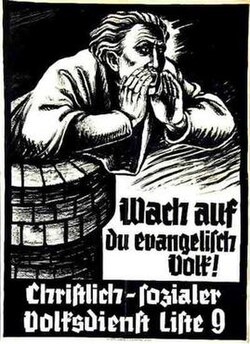
The party's existence came to an abrupt end in 1933 following the Nazi takeover of the German government, at which point the CSVD was dissolved.
Key Facts
- Founded: December 1929.
- Dissolved: 1933.
- Leader: Wilhelm Simpfendörfer.
- Ideology: Christian democracy, Conservatism, and Political Protestantism.
- Political Position: Centre-right to right-wing.
- Peak Representation: 14 seats in the 1930 Reichstag.
- Notable Member: Gustav Heinemann, later President of the Federal Republic of Germany (1969–74).
| Attribute | Details |
|---|---|
| Full Name | Christlich-Sozialer Volksdienst |
| Primary Base | Protestant middle class and Christian trade unions |
| Key Alliances | Centre Party, Christian-National Bloc |
| Core Opponents | Marxism, Liberalism, Atheism |
| Party Colors | Blue and Grey |
Frequently Asked Questions
Why did the CSVD split from the DNVP?
The split was primarily caused by ideological differences over labor rights and the radical nationalist leadership of Alfred Hugenberg, who attacked employment insurance schemes that the Christian socials supported.
Who were the primary supporters of the CSVD?
The party was mainly supported by middle-class Protestants, Pietists, and members of the league of Christian unions.
How did the CSVD differ from the Centre Party?
While both shared a commitment to Christian values and opposed Marxism and Liberalism, the CSVD was specifically a Protestant party, whereas the Centre Party was Catholic.
What happened to the CSVD in 1933?
The party was dissolved following the Nazi takeover of Germany in 1933.
Did any prominent later figures belong to the CSVD?
Yes, Gustav Heinemann, who served as the President of the Federal Republic of Germany from 1969 to 1974, was a member of the CSVD during the Weimar Republic.