Chlorogenic Acid: Chemistry, Natural Occurrence, and Biological Research
Chlorogenic acid (CGA) is a naturally occurring ester formed from the combination of caffeic acid and quinic acid. It plays a vital role in plant biology, functioning as a key intermediate in the biosynthesis of lignin, the organic polymer that provides structural support to plants. While it is most famously associated with coffee, this compound and its various isomers are widespread across a diverse range of plant species and common foods.
Despite its name, chlorogenic acid contains no chlorine. The term is derived from the Greek words khloros (light green) and genos (giving rise to), referring to the distinct green color that appears when the compound is oxidized.

Key Facts
- Chemical Nature: An ester of caffeic acid and quinic acid.
- Primary Role: Acts as an intermediate in lignin biosynthesis.
- Common Sources: Coffee beans, eggplants, peaches, prunes, and potatoes.
- Chemical Formula: C16H18O9 with a molar mass of 354.311 g/mol.
- Safety Status: Not approved as a prescription drug or a GRAS (Generally Recognized as Safe) food additive.
Chemical Structure and Properties
Structurally, chlorogenic acid is formed when caffeic acid binds to the 3-hydroxyl group of L-quinic acid. However, the compound exists in several isomeric forms depending on where the caffeoyl ester attaches to the quinic acid ring. These include 4-O-caffeoylquinic acid (also known as cryptochlorogenic acid or 4-CQA) and 5-O-caffeoylquinic acid (neochlorogenic acid or 5-CQA).
When a molecule contains more than one caffeic acid group, it is classified as an isochlorogenic acid. These are frequently found in coffee and include variants such as 3,4-dicaffeoylquinic acid, 3,5-dicaffeoylquinic acid, and cynarine (1,5-dicaffeoylquinic acid).
| Property | Value |
|---|---|
| Preferred IUPAC Name | (1S,3R,4R,5R)-3-{[(2E)-3-(3,4-Dihydroxyphenyl)prop-2-enoyl]oxy}-1,4,5-trihydroxycyclohexane-1-carboxylic acid |
| CAS Number | 202650-88-2 / 327-97-9 (E/Z) |
| Molar Mass | 354.311 g·mol |
| Density | 1.28 g/cm³ |
| Melting Point | 207 to 209 °C |
| Chemical Formula | C16H18O9 |
Biosynthesis and Natural Occurrence
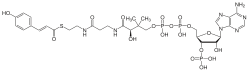
The production of chlorogenic acid begins with cinnamic acid, which leads to the formation of 4-coumaroyl-CoA. This precursor contains a single hydroxyl group on the aryl ring. A cytochrome P450 enzyme then catalyzes the hydroxylation process, installing the second hydroxy group to complete the synthesis.
Chlorogenic acid is found in a wide array of botanical sources. It is present in the bamboo species Phyllostachys edulis and the shoots of common heather (Calluna vulgaris). In the culinary world, it is a prominent component of coffee beans, the flesh of eggplants, peaches, and prunes, as well as in potatoes. Additionally, the leaves of Hibiscus sabdariffa contain chlorogenic acid along with its cryptochlorogenic and neochlorogenic isomers.
Safety, Research, and Hazards
Current scientific research is investigating the potential biological effects of chlorogenic acid, including its possible role in regulating blood pressure. However, there is currently insufficient evidence to confirm its effectiveness or safety for human health in concentrated forms.
Health experts caution that high doses—such as those resulting from the excessive consumption of green coffee—may lead to adverse effects. It is important to note that chlorogenic acid is not approved as a prescription medication or a recognized safe food additive.
From a laboratory safety perspective, the compound is classified with a "Warning" signal word. It can cause skin irritation (H315), serious eye irritation (H319), and respiratory irritation (H335). Proper handling requires protective equipment and adequate ventilation.
Frequently Asked Questions
Why is it called "chlorogenic" if it contains no chlorine?
The name comes from the Greek words khloros (light green) and genos (giving rise to), because the compound produces a green color when it undergoes oxidation.
Where is chlorogenic acid most commonly found in food?
It is found in coffee beans, eggplants, peaches, prunes, potatoes, and the leaves of Hibiscus sabdariffa.
What is the difference between chlorogenic acid and isochlorogenic acid?
Chlorogenic acid is an ester of one caffeic acid and one quinic acid. Isochlorogenic acids are structures that contain more than one caffeic acid group.
Is chlorogenic acid safe for human consumption?
While found naturally in many foods, there is insufficient evidence to determine if it is safe or effective as a supplement. High doses, such as those from excessive green coffee intake, may have adverse effects.
What is the role of chlorogenic acid in plants?
It functions as an intermediate in the biosynthesis of lignin, which is essential for the structural integrity of the plant.