China Vocational Education Society: The History of 80 Yandang Road
The evolution of vocational training in China is deeply tied to the legacy of the China Vocational Education Society. From its humble beginnings in a provincial hall to the establishment of a landmark architectural site in Shanghai, the Society has served as a cornerstone for educational reform and social activity for nearly a century.
The Vision and Construction of a Landmark
The Society initially operated out of the Jiangsu Provincial Education Hall at the Fangxie intersection of Lin Yin Road, near the west gate of Shanghai. As their initiatives expanded, the need for a dedicated headquarters became apparent. An organizing committee, led by Qian Yongming and including prominent figures such as Xu Qiusi and Huang Yanpei, was formed to secure funding and a location for a new edifice.
After years of effort, the committee acquired a plot at the intersection of Hualong Road and Huanlong Road (currently known as 80 Yandang Road), identified by deed inventory number 2823. The resulting structure was a five-story building designed in the Spanish architectural style. The project cost approximately 50,000 taels of silver, funded through a combination of community donations and loans.
Construction began on August 7, 1929, and was completed on July 20, 1930. The building featured the Biluo Hall, which bore a plaque inscribed by Ma Xiangbo.
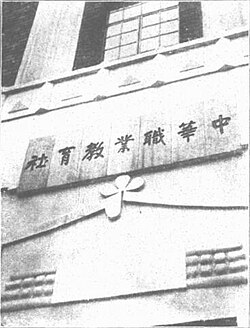
A Hub for Intellectual and Political Activity
Once completed, the facility became more than just an office; it evolved into a vibrant liaison center and a hub for intellectual discourse. The ground floor was particularly active, housing the circulation department and editorial office of Life Weekly, managed by Zou Taofen, with a capacity to hold two hundred people. Additionally, Dong Zhujun established the Jinjiang Tea Room on the ground floor.
The building hosted several distinguished figures who delivered remarks on-site, including Cai Yuanpei, Wang Yunwu, Tao Xingzhi, Zhang Naiqi, Shu Xincheng, and Du Zhongyuan. Its significance extended into the political sphere in January 1946, when the Preparatory Committee of the Shanghai Branch of the China Democratic League was formed there, holding its first meeting in November of that year. Furthermore, in August 1946, the China Vocational Education Society established the Bile High School within the building.
Post-1949 Evolution and Legacy
Following the founding of the People's Republic of China, the China Vocational Education Society moved its primary headquarters to Beijing. However, it maintained a strong presence in Shanghai by establishing a branch that continued to operate from the historic 80 Yandang Road location.
The Society's commitment to education continued to grow in the latter half of the 20th century. This dedication resulted in the founding of the Zhonghua Employees' Middle School in 1984 and the Shanghai Zhonghua Vocational College in 1988.
Key Facts
- Location: 80 Yandang Road, Shanghai (formerly Hualong/Huanlong Road intersection).
- Architecture: Five-story building in the Spanish architectural style.
- Construction Timeline: August 7, 1929, to July 20, 1930.
- Funding: Approximately 50,000 taels of silver via loans and donations.
- Key Institutions: Home to Life Weekly, Bile High School, and later the Shanghai Zhonghua Vocational College.
| Feature | Details |
|---|---|
| Deed Inventory Number | 2823 |
| Primary Architects/Leaders | Qian Yongming, Xu Qiusi, Huang Yanpei |
| Notable Ground Floor Tenants | Life Weekly, Jinjiang Tea Room |
| Associated Schools | Bile High School, Zhonghua Employees' Middle School, Shanghai Zhonghua Vocational College |
Frequently Asked Questions
Where was the China Vocational Education Society located before moving to Yandang Road?
The Society initially used the grounds of the Jiangsu Provincial Education Hall at the Fangxie intersection of Lin Yin Road, adjacent to the west gate of Shanghai.
What architectural style was used for the building at 80 Yandang Road?
The five-story building was designed in the Spanish architectural style.
How was the construction of the new edifice funded?
The construction cost approximately 50,000 taels of silver, which was sourced primarily from loans and a portion from community donations.
Which famous publication operated out of the building's ground floor?
Life Weekly, managed by Zou Taofen, operated its editorial office and circulation department on the ground floor.
What educational institutions were established by the Society in later years?
The Society founded the Zhonghua Employees' Middle School in 1984 and the Shanghai Zhonghua Vocational College in 1988.