Chickpeas: A Comprehensive Look at Cicer arietinum
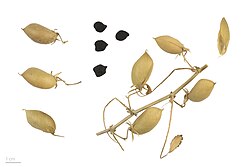
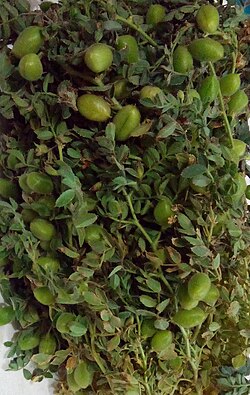
The chickpea, scientifically known as Cicer arietinum, is a versatile legume that has served as a cornerstone of human nutrition for millennia. Belonging to the family Fabaceae, these pulses are prized globally for their high protein content and adaptability to various climates. From the ancient fields of the Near East to modern industrial farms, the chickpea has evolved from a wild grass pea into one of the world's most important food crops.
Key Facts
- Scientific Name: Cicer arietinum
- Primary Producer: India is the world's leading producer of chickpeas.
- Nutritional Powerhouse: Rich in folate (43% DV) and manganese (45% DV).
- Ancient Origins: Evidence of cultivation dates back to the 8th millennium BCE in modern Syria.
- Global Reach: Introduced to the New World by Spanish and Portuguese explorers in the 16th century.
History and Domestication
The journey of the chickpea began in the Fertile Crescent. Archaeological findings at sites such as Tell Abu Hureyra and Tell El-Kerkh in modern Syria reveal that grain legumes, including chickpeas and bitter vetch, were present as early as the 8th millennium BCE. Analysis of these samples shows a transition from the wild C. reticulatum to the cultivated C. arietinum.
By 3300 BCE, domesticated chickpea cultivation was well-established across the Middle East and Egypt. During the Neolithic Era, the crop spread westward into Greece, and by the Bronze Age, it reached Crete and upper Egypt. Simultaneously, it moved eastward, appearing in the Indian subcontinent between 1750 and 1500 BCE at sites like Lal Quila and Daimabad. By the Iron Age, the crop had reached as far south as Lalibela in Ethiopia.
Etymology and Language
The names we use for chickpeas today reflect ancient migrations. The Proto-Indo-European roots *kek- and *k'ik'-, which originally referred to both peas and oats, evolved into various regional dialects. The Latin cicer appeared around 700 BCE, eventually becoming pois chiche in French and chich-pease in Old English. Separately, the Greek word erebinthos—mentioned in Homer's The Iliad—evolved into the Spanish garbanzo, a term used in American English since 1759.
Global Production and Agriculture
Today, chickpea production is concentrated in a few key regions, with India dominating the global output. The crop is essential for food security in these regions due to its ability to grow in semi-arid environments.
| Country/Region | Production Quantity |
|---|---|
| India | 12.3 |
| Australia | 0.94 |
| Turkey | 0.58 |
| Russia | 0.53 |
| Ethiopia | 0.45 |
| Myanmar | 0.41 |
| World Total | 16.5 |
Pathogens and Plant Health
Agricultural productivity is often threatened by pathogens, including bacteria, fungi, viruses, and nematodes. Between 1978 and 1995, the number of recorded pathogens rose from 49 to 172. Some of the most widespread threats include Ascochyta rabiei, which thrives in wet weather, and Fusarium oxysporum f.sp. ciceris, a fungus that can reduce yields by 10% to 15%.
To combat these threats, C. arietinum produces heat shock proteins (specifically an orthologue of AtHSP70-1) to help the plant respond to fungal stress.
Nutrition and Culinary Uses
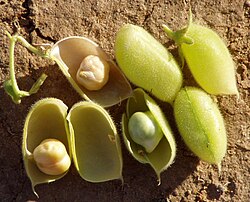
Cooked chickpeas are highly nutritious, consisting of approximately 60% water, 27% carbohydrates, 9% protein, and 3% fat. They are particularly valued for providing significant amounts of folate and manganese.
Nutritional Value (per 100g cooked)
- Energy: 160 kcal (690 kJ)
- Protein: 8.86 g
- Dietary Fibre: 7.6 g
- Folate: 43% of Daily Value (DV)
- Manganese: 45% of Daily Value (DV)
- Iron: 16% of Daily Value (DV)
Culinary Diversity
Chickpeas are used in a vast array of global cuisines. In India, they are used to make Chana dal (split Bengal gram) and Dhokla (a steamed flour snack). Italian cuisine features Farinata di ceci, while Algerian cuisine uses them in Chakhchoukha. In Spain, they are a staple in Manchego stews, such as potaje de garbanzos y collejas.
Frequently Asked Questions
What is the scientific name of the chickpea?
The scientific name for the cultivated chickpea is Cicer arietinum.
Which country produces the most chickpeas?
India is the leading producer, contributing 12.3 million tonnes to the global total of 16.5 million tonnes.
What are the primary health benefits of chickpeas?
Chickpeas are a rich source of plant-based protein, dietary fiber, folate, and manganese, making them excellent for overall nutrition.
How did chickpeas reach the Americas?
Chickpea cultivation was introduced to the New World by Spanish and Portuguese explorers during the 16th century.
What is the difference between a chickpea and a garbanzo bean?
They are the same plant. "Garbanzo" comes from the Greek erebinthos via Spanish, while "chickpea" evolved from Latin and Old English roots.