Charter Schools: Global Models, Implementation, and Performance
Charter schools represent a diverse approach to education, blending public funding with private-sector autonomy. While the specific definitions vary by country, the core concept typically involves schools that are independently operated but receive government support to provide alternative educational paths or specialized curricula. From the widespread adoption in the United States to the voucher-based systems in Chile and Sweden, these institutions aim to increase school choice and improve academic outcomes.
Key Facts
- United States: Approximately 8,000 charter schools enrolled 3.7 million students as of December 2021.
- Chile: Nearly 60% of students studied in charter-like private subsidized schools as of 2012.
- Spain: Known as escuela concertada, these schools account for roughly 27% of students in Catalonia.
- Sweden: The friskolor system, established in 1992, includes about 900 publicly funded schools.
- Canada: Alberta is the only province that has enabled charter schools, removing its cap on the number of schools in 2020.
Global Implementations of Charter-Style Education
North America
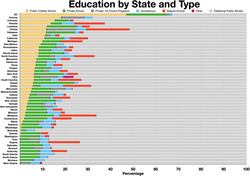
In the United States, the charter movement began in Minnesota in 1991, with the first approved school being Bluffview Montessori School. The model has expanded significantly, though it varies by state. For instance, California prohibits the conversion of private schools to charters, while Arizona and Michigan allow it under specific conditions. New Orleans stands as a unique case; following Hurricane Katrina, the city decentralized its system, leading to a majority of students attending charter schools by the 2011–12 school year.
Canada's approach is more localized. Alberta enacted legislation in 1994, leading to the 1995 establishment of schools like New Horizons and Suzuki Charter School. As of 2015, it remains the only province with such legislation.
Europe
European nations have adopted various versions of autonomous, publicly funded schooling. In Spain, escuela concertada schools follow the official curriculum but are privately owned, a model established by the 1985 Organic Law on the Right to Education (LODE). Sweden's friskolor (free schools) use a voucher system and can be run for-profit, though they are prohibited from charging tuition.
Norway also utilizes friskoler, including Montessori and Steiner (Waldorf) schools, though profit is only permitted for non-governmental funded institutions. In Germany, private schools are permitted under Article 7 of the Grundgesetz (constitution), provided they are not inferior to state schools in facilities or training. In Finland, private schools must be non-profit and generally follow the national curriculum, with the state and municipalities providing per-pupil grants.
England and Wales transitioned from grant-maintained schools (established 1988) to foundation schools and academies, the latter of which are publicly funded schools with significant autonomy.
Other International Models
Chile has a long history of private subsidized schooling. Following neoliberal reforms in the 1980s under Augusto Pinochet, a competitive voucher system was adopted in 1981, allowing vouchers to be used in both public and for-profit private subsidized schools.
In Australia, while no true charter schools exist because all private schools charge tuition, Western Australia has trialled Independent Public Schools (IPS) since 2009, which offer autonomy similar to the charter model. New Zealand introduced Partnership schools (kura hourua) in 2013, specifically targeting students who struggled in the state system, particularly Maori and Pacific Islander students.
Comparative Summary of Global Charter Models
| Country | Local Term/Model | Funding Source | Key Characteristic |
|---|---|---|---|
| United States | Charter School | Public/Taxpayer | High autonomy; varies by state law |
| Sweden | Friskolor | Vouchers | Can be for-profit; no tuition allowed |
| Spain | Escuela Concertada | Government | Privately owned; follows official curriculum |
| Finland | Private Schools | State/Municipal Grants | Must be non-profit; mostly national curriculum |
| Chile | Private Subsidized | Vouchers/Government | Strong neoliberal, competitive voucher system |
Performance and the Rise of Cyber Schools
Academic Outcomes
The effectiveness of charter schools remains a subject of debate. Some studies suggest that charter students, particularly those from disadvantaged backgrounds, perform better than their public school peers, gaining more learning days in reading and math. However, sustainability is a concern; one study indicated that roughly half of new US charter schools closed within 15 years of operation.
Cyber Charter Schools
Cyber schools are independently organized institutions conducted entirely or partially over the internet. While they offer flexibility, a major study by the University of Washington, Stanford, and Mathematica Policy Research found significantly weaker academic performance in math and reading compared to conventional schools. In mathematics, the gap was equivalent to online students missing a full academic year.
These non-traditional diplomas are sometimes viewed differently by post-secondary institutions and the US military, which may apply quotas or lower-tier classifications unless offset by high ASVAB test scores.
Frequently Asked Questions
What is the main difference between a charter school and a traditional public school?
Charter schools are typically independently operated and have greater autonomy over their curriculum and management, though they are still publicly funded and held accountable to performance standards via operating contracts.
Do charter schools charge tuition?
In the United States and many European models like Sweden's friskolor, charter schools are prohibited from charging tuition because they receive public funding. However, some models, such as the Direct Subsidy Scheme in Hong Kong, allow for tuition charges.
Are cyber charter schools as effective as brick-and-mortar schools?
Research suggests they may be less effective in core subjects. A national study found that cyber charter students showed weaker performance in reading and mathematics, largely due to difficulties in keeping students focused in an online environment.
Can private schools convert into charter schools?
This depends on the jurisdiction. In the US, some states like Arizona and Michigan allow conversion under specific rules (such as requiring a percentage of new students), while others, like California, prohibit it entirely.
What is a school voucher system?
A voucher system, used in countries like Chile and Sweden, provides government funding to parents, who can then use that "voucher" to pay for tuition at either a public or a participating private/charter school.