Charles Gibson: A Legacy of American Broadcast Journalism
Charles Gibson stands as one of the most recognizable faces in the history of American television news. From his early days as a local reporter to his tenure as the anchor of one of the world's most-watched evening news programs, Gibson's career is a testament to the evolution of broadcast journalism over four decades.
Early Career and Foundations
Gibson began his professional journey in 1966, joining RKO General as a producer. He quickly transitioned into reporting and anchoring at WLVA (now WSET) in Lynchburg, Virginia, before moving to the ABC network affiliate in Washington, D.C., WMAL-TV (now WJLA), in 1970.
In 1974, Gibson joined the syndicated news service Television News Inc. (TVN). This period proved pivotal, as he covered two of the most significant political events of the era: the Watergate scandal investigations and the subsequent resignation of President Richard Nixon.
The ABC News Era
Gibson joined ABC News in 1975, embarking on a versatile path through various high-profile roles. Between 1976 and 1987, he served as a White House correspondent, a general assignment reporter, and a House of Representatives correspondent. His versatility led him to become a stand-in anchor for World News Tonight with Peter Jennings, as well as a substitute anchor for Nightline and World News This Morning.
The Good Morning America Years
On February 23, 1987, Gibson stepped into the role of co-anchor for Good Morning America (GMA) alongside Joan Lunden. During his tenure, GMA was the most-watched morning show in America from 1985 to 1995. Beyond the morning desk, Gibson demonstrated his range by hosting and narrating the 1990 Maryland Public Television documentary Lucky Number, which explored the complexities of problem gambling.
Gibson's interviewing style often placed him at the center of political discourse. In 1991, an interview with Reform Party candidate Ross Perot regarding the U.S. Constitution became a point of contention when Vice President Dan Quayle used the segment to claim Perot showed contempt for the nation's founding document. Gibson also made headlines for his persistent questioning of then-Governor Bill Clinton regarding his vice presidential pick in 1992.
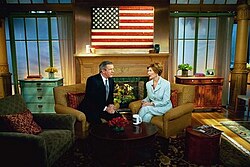
After a brief departure from the program in May 1998—during which time GMA saw a decline in viewership compared to NBC's Today show—Gibson was reinstated on January 18, 1999, co-hosting with Diane Sawyer. He remained a staple of the morning program until June 2006.
Reporting on History
One of the most defining moments of Gibson's career occurred on September 11, 2001. While anchoring GMA, Gibson was among the first to recognize that the second plane hitting the South Tower of the World Trade Center was a deliberate attack, a clear-eyed assessment praised by his colleagues.
World News with Charles Gibson
Gibson's transition to the evening news began in the summer of 2005, when he filled in for Peter Jennings during Jennings's battle with lung cancer. Following Jennings's death on August 7, 2005, Gibson eventually became the sole anchor of the program on May 29, 2006, after the resignation of Elizabeth Vargas.
The program was subsequently rebranded as World News with Charles Gibson. Under his leadership, the show remained a fierce competitor against NBC's Nightly News, occasionally taking the top spot in the ratings for household viewers and the key 25–54 advertiser demographic.
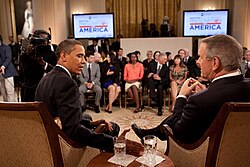
Gibson's role as a moderator also expanded. He moderated the second 2004 presidential debate between George W. Bush and John Kerry. In 2008, he co-moderated a Democratic debate with George Stephanopoulos, though the event faced criticism for "gotcha"-style questions, including a query about Senator Barack Obama's lack of a flag pin.
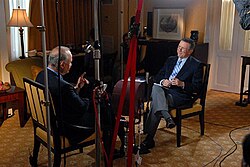
Toward the end of his tenure, Gibson produced the critically acclaimed documentary Over a Barrel: The Truth About Oil, which earned him several awards for its investigation into the oil industry. He anchored his final edition of World News on December 18, 2009, passing the torch to Diane Sawyer.
Key Facts
- Career Start: Joined RKO General in 1966.
- Major Roles: Co-anchor of Good Morning America (1987–1998, 1999–2006) and anchor of World News (2006–2009).
- Political Coverage: Covered the Watergate scandal and moderated the 2004 second presidential debate.
- Notable Achievement: Produced the award-winning documentary Over a Barrel: The Truth About Oil.
- Retirement: Officially retired from ABC News on December 18, 2009.
| Period | Role/Program | Key Focus/Achievement |
|---|---|---|
| 1975–1987 | Field Correspondent | White House and House of Representatives coverage |
| 1987–2006 | Good Morning America | Co-anchored the most-watched morning show (1985-1995) |
| 2006–2009 | World News | Sole anchor; competed for #1 spot in evening ratings |
Frequently Asked Questions
When did Charles Gibson leave Good Morning America?
Gibson left the program twice: first on May 1, 1998, and later on June 28, 2006, to become the anchor of World News Tonight.
Who replaced Charles Gibson as the anchor of World News?
Diane Sawyer replaced Charles Gibson as the anchor of World News following his retirement in December 2009.
What was the controversy regarding the 2008 Democratic debate?
Gibson and co-moderator George Stephanopoulos were criticized by media outlets for asking "insubstantial" or "gotcha" questions, specifically a question regarding why Barack Obama was not wearing a flag pin.
What was "Over a Barrel"?
Over a Barrel: The Truth About Oil was a special documentary about the oil industry produced by Gibson during his final months as anchor, which achieved both critical and ratings success.
How did Gibson contribute to the coverage of 9/11?
While anchoring Good Morning America, Gibson was praised for his immediate and clear-eyed recognition that the second plane hitting the South Tower was part of an "attack."