Central Bank of Ecuador: A History of Monetary Evolution
The financial stability of a nation often rests on the strength of its central monetary authority. For Ecuador, the journey toward a structured financial system was born out of necessity, emerging from a period of intense macroeconomic instability and political upheaval in the early 20th century.
During the first three decades of the 1900s, Ecuador struggled with a lack of control over monetary issuance and unregulated private banking. These internal weaknesses were exacerbated by the global fallout of World War I and the subsequent Great Depression of 1929. Locally, the economy suffered a severe blow in the early 1920s when international demand for cacao—the country's primary export—plummeted, while crop pests further crippled production, leading to widespread political instability.
The Path to Foundation
The mounting social and economic discontent culminated in the July Revolution of 1925, a revolt led by young army officers. Among the key figures was Luis Napoleon Dillon, the Minister of Finance, who first advocated for a central bank to manage currency issuance, state deposits, and financial transfers. Although the "Law of the Ecuadorian Central Bank" was approved in October 1925, early political friction led to the resignation of the first board of directors in January 1926.
The vision was eventually realized under President Isidro Ayora. In June 1926, the Central Issuance and Amortization Fund (Caja Central de Emisión y Amortización) was established to recognize payment methods and authorize banknote circulation. To modernize the system, the provisional board recruited Edwin Kemmerer, a distinguished economist and professor from Princeton University.
Kemmerer's commission presented the Central Bank Organic Law on February 11, 1927. He recommended that the new institution be granted a 50-year authorization to issue money, manage the foreign exchange market, act as the government's fiscal agent, and implement fixed-rate rediscounting (the process where the central bank lends to other banks at a set rate to regulate liquidity).
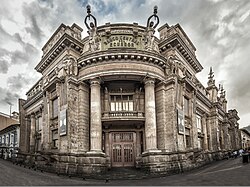
The bill was approved on March 4, 1927, and the Central Bank of Ecuador (BCE) officially opened its doors on August 10, 1927, in Quito. It soon expanded with a main branch in Guayaquil and operations in Cuenca by 1928.
Early Operations and the Gold Standard
The BCE's primary initial goal was to unify and stabilize the national currency, the sucre. To achieve this, the bank adopted a gold standard, fixing the price of one sucre at 0.300933 grams of fine gold—exactly one-fifth of the U.S. dollar's gold value at the time. However, the global economic volatility of the Great Depression eventually forced a return to deficit spending and government credit, mirroring the instability of the previous decade.
Evolution Through Internal Reforms
As price instability persisted due to expansionary monetary policies, the bank underwent several critical transformations:
The Gómez Morín Reforms (1937)
Mexican monetary expert Manuel Gómez Morín and banker Víctor Emilio Estrada pushed for a new Organic Law in 1937. They argued that the monetary authority should use the discount rate to steer credit toward productive economic sectors critical for national development.
The Triffin Era and the Monetary Board (1948)
Following World War II, inflation and balance of payment issues led manager Guillermo Pérez Chiriboga to seek the expertise of Robert Triffin from the U.S. Federal Reserve. This resulted in the Monetary Regime Law and the International Exchange Law of 1948. This era introduced the Monetary Board, a governing body that included government participation to co-manage monetary policy, devalue currency when necessary, and execute counter-cyclical policies to stabilize the economy.
Crisis, Dollarization, and Modern Autonomy
The late 20th century brought severe challenges. The Latin American external debt crisis of the 1980s and 90s forced a reorganization of public finances. In 1992, the BCE was granted the ability to intervene in the financial system via open market operations, and the Monetary Board was replaced by a Board of Directors to increase autonomy from government influence.
The 1998 Constitution formally enshrined the bank's technical autonomy, which proved vital during the 1999 banking crisis. This crisis ultimately led to the abandonment of the sucre and the adoption of dollarization, fundamentally changing the BCE's role as it no longer issued national currency.
The bank's autonomy fluctuated in the following years; the 2008 Constitution removed its independence, making it dependent on the central government. However, on April 22, 2021, the BCE recovered its technical autonomy through the Organic Reformatory Law to the Organic Monetary and Financial Code for the Defense of the Dollarization.
As part of its new legal framework, the BCE reached an agreement on June 30, 2021, to return shares of public banks (CFN, BanEcuador, and Conafips) to the Ministry of Economy and Finance (MEF), with the MEF agreeing to pay the BCE US$2.378 million by 2035.
Key Facts
- Founded: August 10, 1927, in Quito, Ecuador.
- Key Architect: Edwin Kemmerer, a Princeton University professor, designed the Organic Law.
- Original Currency: The sucre, originally pegged to gold at 0.300933 grams per unit.
- Major Shift: Transitioned from issuing the sucre to a dollarized economy following the 1999 banking crisis.
- Current Status: Recovered technical autonomy in April 2021 to defend dollarization.
| Period/Year | Key Event/Reform | Primary Objective/Outcome |
|---|---|---|
| 1927 | Foundation (Kemmerer Mission) | Establishment of monetary control and currency issuance. |
| 1937 | Gómez Morín Reform | Channeling credit to productive economic sectors. |
| 1948 | Triffin Reform | Creation of the Monetary Board for price stability. |
| 1999 | Banking Crisis | End of the sucre; implementation of dollarization. |
| 2021 | Organic Reformatory Law | Recovery of technical autonomy to protect dollarization. |
Frequently Asked Questions
Why was the Central Bank of Ecuador created?
It was created to solve chronic macroeconomic problems, including uncontrolled monetary issuance, private banking instability, and the economic collapse caused by the decline of cacao exports and the Great Depression.
Who was Edwin Kemmerer and what was his role?
Edwin Kemmerer was an economist and professor from Princeton University who advised the Ecuadorian government on modernizing its economic measures and drafting the Central Bank Organic Law in 1927.
What happened to the sucre?
The sucre was the national currency of Ecuador until the banking crisis of 1999, which led the country to adopt the U.S. dollar as its official currency (dollarization).
What is the current status of the bank's autonomy?
After losing its independence under the 2008 Constitution, the Central Bank of Ecuador recovered its technical autonomy on April 22, 2021, through legislation designed to defend the dollarized system.
What is the Numismatic Museum?
The Numismatic Museum is located in the building acquired from Banco Pichincha, where the Central Bank of Ecuador operated from November 23, 1927, until 1968.