Cave Paintings: The Ancient Origins of Human Art and Storytelling
For millennia, the deep recesses of the earth have served as the world's first galleries. Cave paintings, a form of parietal art (art found on cave walls or ceilings), provide a profound window into the dawn of human consciousness. While often associated with early Homo sapiens, these works are not solely the product of modern humans; evidence suggests that Neanderthals and Denisovans also left their mark on the stone.
Beyond their aesthetic value, these prehistoric markings are vital to archaeology. They offer clues about the development of abstract thought, spirituality, and the capacity for sentimental thinking in our ancestors, marking the transition from survival-based existence to creative expression.
Key Facts
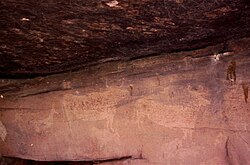
- Oldest Cave Painting: A handprint on Muna Island, Indonesia, dated to at least 67,800 years ago.
- Oldest Rock Art: A small rock fragment from Blombos Cave, South Africa, featuring ochre lines dating back 73,000 years.
- Earliest Figurative Art: A depiction of anthropomorphic figures hunting a pig in Leang Karampuang, Sulawesi, dated to approximately 51,200 years ago.
- Non-Human Artists: Red non-figurative symbols in Spain are attributed to Neanderthals, dating back 64,000 years.
- Global Distribution: Significant sites are found across Europe, Asia, Africa, Australia, and the Americas.
The Timeline of Prehistoric Art

Determining the age of cave art is a complex scientific process. While radiocarbon dating is common, uranium-thorium dating of calcium carbonate crusts has allowed scientists to push back the timeline of human creativity significantly.
The Earliest Markings
The current record for the oldest cave painting belongs to a handprint found in Liang Metanduno on Muna Island, Indonesia, dated to at least 67,800 years ago. This discovery predates other early works, including a Neanderthal painting in the Maltravieso cave. However, the absolute oldest known piece of rock art—though not a wall painting—is a 73,000-year-old ochre drawing found in South Africa's Blombos Cave.
The Rise of Figurative Art
Figurative art—art that represents recognizable objects or beings—appeared later than simple symbols. For years, the Lubang Jeriji Saléh cave in Borneo held the record with a bovine depiction over 40,000 years old.
![One of the oldest known figurative paintings, a depiction of an unknown bovine, was discovered in the Lubang Jeriji Saléh cave and dated to be more than 40,000 (perhaps as old as 52,000) years old.[6][7]](/images/fb/2a/fb2ad6a82eead2a314863c14e018c09ca8ea431bb5b929e18323191782784a09.jpg)
Recent findings in the Maros-Pangkep karst of Sulawesi, Indonesia, have rewritten this history. A painting of anthropomorphic figures interacting with a pig in Leang Karampuang is estimated to be 51,200 years old, representing the earliest known instance of storytelling in human history.

Regional Highlights of Paleolithic Art

Europe
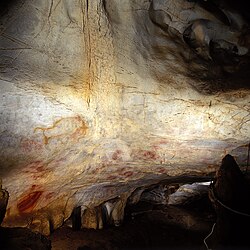
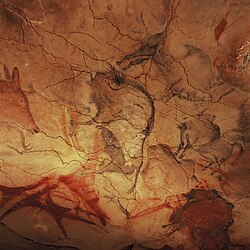
Europe is home to some of the most famous Upper Paleolithic sites. The Cave of El Castillo in Spain hosts some of the earliest figurative works in Europe, dating to 40,000 BC.
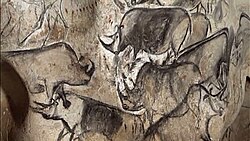
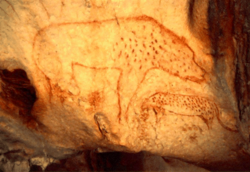
France's Chauvet Cave is renowned for its sophisticated depictions of animals, including rhinoceroses and hyenas, created between 30,000 and 32,000 years ago.
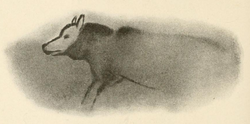
Other notable European sites include the polychrome wolf paintings of Font-de-Gaume and the celebrated Paleolithic art of Altamira in Northern Spain.
Asia and Oceania
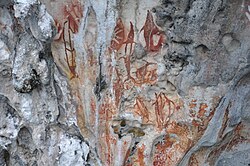
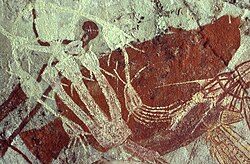
Indonesia has emerged as a primary hub for the world's oldest art, particularly in Sulawesi and Borneo. In Australia, the Arnhem Land plateau features depictions of extinct megafauna, while the Nawarla Gabarnmang site contains charcoal drawings dated to 28,000 years ago.
Africa
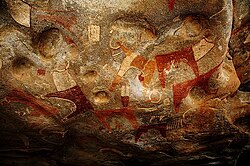
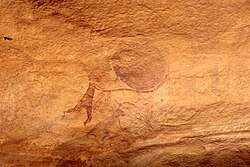
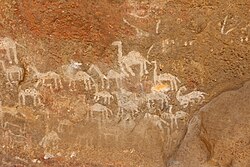
African rock art spans a vast timeline. The Apollo 11 Cave in Namibia contains works from roughly 25,500 to 27,500 years ago. In more recent history, the Laas Geel complex in Somaliland (approx. 5,000 years old) and the Tassili n'Ajjer site in Algeria provide records of animal migrations and climatic shifts in the Sahara.
The Americas
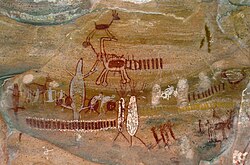
Rock art is found throughout the Americas, from the Painted Cave in California to the Serra da Capivara National Park in Brazil, and the stenciled hands of Cueva de las Manos in Argentina.

![Cueva de las Manos, Perito Moreno, Argentina. The art in the cave is dated between 7,300 BC and 700 AD;[a] stenciled, mostly left hands are shown.[3][4]](/images/52/f2/52f2c2d3655dc586d16e5eadaa5e465212741ae05dbbeda6c9626db4d5286cde.jpg)
Summary of Major Cave Art Sites
| Site / Location | Estimated Age | Key Feature |
|---|---|---|
| Blombos Cave, South Africa | 73,000 years | Oldest known rock painting (fragment) |
| Muna Island, Indonesia | 67,800 years | Oldest known cave painting (handprint) |
| Leang Karampuang, Indonesia | 51,200 years | Earliest figurative storytelling (pig hunt) |
| Maltravieso, Spain | 64,000 years | Neanderthal non-figurative symbols |
| Chauvet Cave, France | ~30,000-32,000 years | Sophisticated animal depictions |
| El Castillo, Spain | ~40,000 BC | Earliest European figurative art |
Frequently Asked Questions
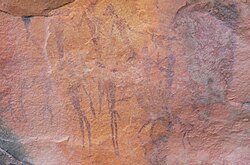
Who created the oldest cave paintings?
While many were created by Homo sapiens, evidence from sites like the Maltravieso cave in Spain suggests that Neanderthals also produced non-figurative art approximately 64,000 years ago.
What is the difference between cave paintings and rock art?
Rock art is a broad term that includes any human-made markings on natural surfaces. Cave paintings are a specific type of parietal art found specifically on the walls and ceilings of caves.
What are the most common subjects in prehistoric art?
The most common subjects include animals (such as bovines, pigs, and rhinoceroses), hand stencils, and simple geometric shapes. Later works include anthropomorphic figures and hunting scenes.
Where is the oldest figurative painting located?
The oldest known figurative painting is located in the Maros-Pangkep karst region of Sulawesi, Indonesia, specifically the depiction of anthropomorphic figures hunting a pig in Leang Karampuang, dated to about 51,200 years ago.
How do scientists date these paintings?
Scientists use various methods, including radiocarbon dating of charcoal and uranium-thorium dating of the calcium carbonate crusts that form over the artwork over thousands of years.