Cattle: Biology, Husbandry, and Global Impact
Cattle, scientifically known as Bos taurus, are among the most significant domesticated mammals in human history. From providing essential proteins like beef and milk to serving as draft animals for agriculture, these bovines have shaped civilizations across the globe. Their complex biology, social structures, and genetic diversity make them a cornerstone of global agriculture and economy.
Key Facts
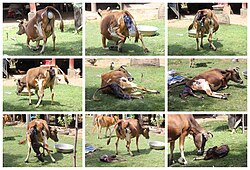
- Scientific Name: Bos taurus.
- Digestive System: Specialized four-chambered stomachs for fermenting plant matter.
- Global Utility: Primary sources of beef, dairy, leather (hides), and draft power.
- Genetics: Five main sub-types identified through genomic analysis.
- Environmental Impact: Beef production has the highest greenhouse gas impact of any agricultural commodity.
Biological Characteristics and Anatomy
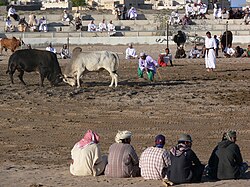
Cattle are large ungulates characterized by a robust skeletal structure and a highly specialized digestive system. As ruminants, they possess a four-chambered stomach that allows them to break down cellulose from grass and forage through a process of fermentation.
The rumen microbiome, dominated by bacteria, is essential for this digestion; notably, the composition of these microbes can change substantially based on the animal's diet.
![Bacteria dominate the rumen microbiome; composition can change substantially with diet.[10]](/images/1c/3a/1c3aa2fc04c3204e938fcda29a1d2746ab8392050c7d1dd51c597d0200416cfd.png)
Senses and Cognition
Bovines possess sophisticated cognitive abilities, including the capacity for spatial memory. Research indicates that cattle can remember the locations of preferred food sources over extended periods. They are also capable of discriminating between familiar and unfamiliar members of their own species using visual cues from the head.
Behavior and Emotion
Cattle are social animals that establish a dominance hierarchy within their herds. They exhibit a range of personality traits, such as varying levels of fearfulness and sociability. Their emotional states and overall welfare can often be interpreted through physical indicators, such as ear postures.
![Individual cattle differ in personality traits such as fearfulness and sociability.[21]](/images/a8/5b/a85b4528a224de3926351455c25a03a94292600c1f66ef521d974098b45befe8.jpg)
![Ear postures of cows indicate emotional state and overall welfare.[50]](/images/e0/ed/e0ed327d3c84c2148e8b404dfdfb1f0bd0baf56797c3e982fb2277df2b103ad9.jpg)
Genetics and Evolution
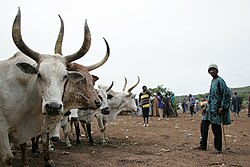
The evolutionary history of cattle involves complex migrations and at least two separate domestication events. Genomic analysis has revealed five main cattle sub-types, often categorized by their continent of origin.
![Genomic analysis shows there are five main cattle sub-types, here labelled by continent.[62]](/images/d8/6d/d86d4b935856c44d78a62b212487faffe817012d7afef7d18181f775ba73685e.png)
![Cattle phylogeny and migrations involve two major species, at least two domestications, and migrations between these.[72]](/images/f1/38/f138635f6f632b16e7d11497d5b76a7317d72cc1beead3e4a8c6c751e3e7fc09.webp)
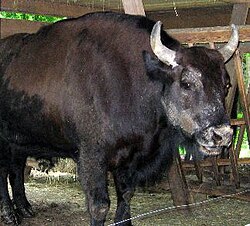
While Bos taurus is the primary domestic species, hybrids also exist, such as the Żubroń, which is a cross between European bison and cattle.
Husbandry and Economic Importance
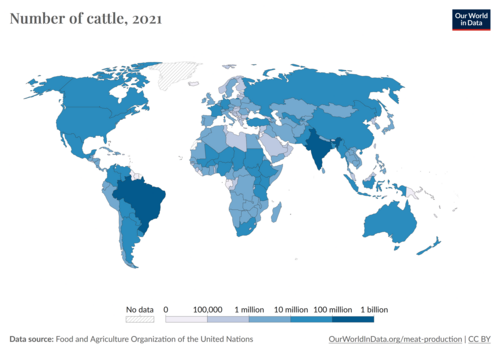
Cattle husbandry is divided into several primary sectors based on the intended output of the animal.
Beef and Dairy Production
Beef cattle, such as the Hereford and Aberdeen Angus, are bred for meat production. In many regions, these animals are raised in concentrated animal feeding operations (CAFOs), where they are kept in feedlots rather than grazing in open pastures.
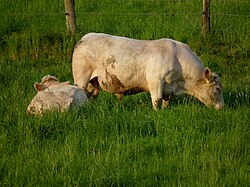
![In concentrated animal feeding operations, the cattle are not allowed to wander and graze, as food is brought to them in a feedlot.[91]](/images/86/58/865866e7c6a2aa92241c1513a1519064ec2dc7fd8048695321262bb933ef3838.webp)
Dairy cattle are managed for milk production. While milking was historically done by hand, modern operations utilize advanced technology, such as rotary milking parlours, to increase efficiency.
Draft Animals and Other Uses
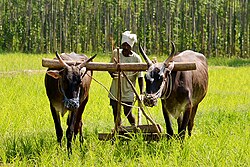
Beyond food, oxen (castrated male cattle) are still used in various parts of the world for traditional ploughing and hauling. Additionally, cattle provide hides used in the production of leather.
| Category | Primary Product/Service | Key Examples/Methods |
|---|---|---|
| Beef | Meat | Hereford, Aberdeen Angus, Feedlots |
| Dairy | Milk | Rotary parlours, Holstein-Friesian |
| Draft | Labor/Traction | Oxen for ploughing |
| Industrial | Leather | Hides and skins |
Environmental and Welfare Considerations
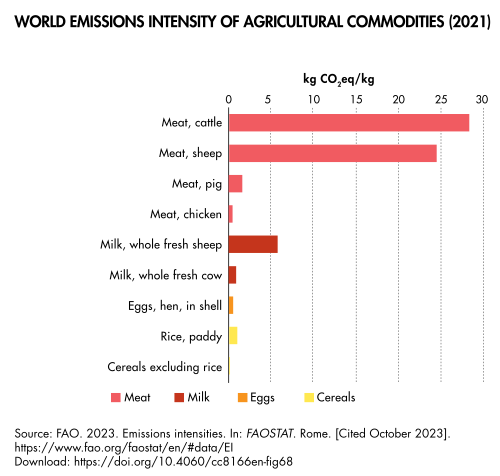
The scale of modern cattle farming has led to significant environmental and ethical discussions. Beef production is noted for having the highest greenhouse gas impact of any agricultural commodity, surpassing mutton.
Climate change also poses a threat to production; higher temperatures and heat stress are projected to lower production levels in many of the top 10 beef-producing countries.
![Most of the top 10 beef-producing countries are likely to see lower production with greater temperatures (left) and heat stress (right).[121]](/images/b9/08/b908ed0cbd6dea77e2f77bdd5136ce5d2ff273a66f14023f187905af99d16ff0.png)
Animal Welfare
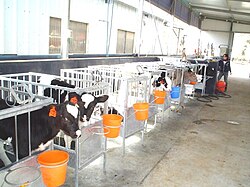
Welfare concerns vary by practice. For instance, the confinement of calves in individual crates for veal production has drawn significant criticism. Other concerns include the methods used for dehorning, branding, and the stress associated with separation between cows and calves.
Frequently Asked Questions
How do cattle digest grass?
Cattle use a four-chambered stomach to ferment tough plant fibers. Bacteria in the rumen break down cellulose, allowing the animal to extract nutrients from grass that most other mammals cannot digest.
What is the difference between beef and dairy cattle?
Beef cattle are bred primarily for muscle growth and meat quality, whereas dairy cattle are bred for high milk production and mammary development.
How does climate change affect cattle farming?
Increased global temperatures lead to heat stress in livestock, which can reduce growth rates, lower milk yields, and overall decrease meat production in major producing nations.
Are cattle intelligent animals?
Yes, cattle exhibit complex social behaviors, form long-term memories of food locations, and can recognize individual members of their herd through visual cues.
What are CAFOs?
Concentrated Animal Feeding Operations (CAFOs) are industrial livestock facilities where animals are kept in confined spaces and fed brought-in feed rather than grazing on open pasture.