Capture of DamascusWorld War IDesert Mounted CorpsGeneral Edmund AllenbyAustralian Light Horse

Capture of Damascus: The Allied Advance and Fall of the City in 1918

Capture of Damascus The capture of Damascus in late September and early October 1918 marked a decisive turning point in the Middle Eastern theatre of World War I. This strategic victory w...

Capture of Damascus

The capture of Damascus in late September and early October 1918 marked a decisive turning point in the Middle Eastern theatre of World War I. This strategic victory was the culmination of a rapid Allied advance involving a diverse coalition of forces from the United Kingdom, India, Australia, and New Zealand, working alongside Prince Faisal's Arabian Sherifial Force.

The operation was characterized by a high-speed pursuit of the retreating Ottoman and German forces, often described as a "race for Damascus." Through a combination of coordinated cavalry charges, aerial reconnaissance, and strategic encirclement, the Allied forces managed to collapse the remnants of the Ottoman Fourth, Seventh, and Eighth Armies.
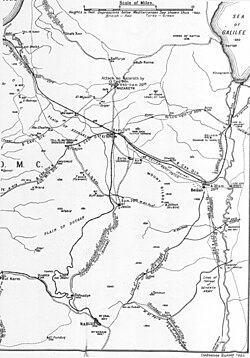
Falls Map 21 Cavalry advances 19 to 25 September 1918. Detail shows 5th Cavalry Division advance to Nazareth, 4th Cavalry Division advance to Afulah and Beisan, Australian Mounted Division advance to Lajjun, 3rd Light Horse Brigade advance to Jenin, 19th Lancers advance to Jisr el Mejamie and 4th Light Horse Brigade advance to Samakh. Also shown are the three main lines of retreat bombed by aircraft and the retreat of the Seventh Ottoman Army and Asia Corps across the Jordan River.

Key Facts

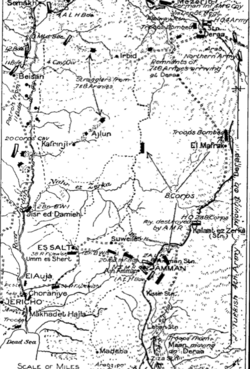
Gullett's Map 43 shows the Jordan River from the Dead Sea and Jericho to Semakh and the Pilgrims Road from Ziza to Deraa with the 4th Light Horse Brigade at Samakh, retiring Ottoman columns, the Ottoman Fourth Army headquarters at Deraa and Chaytor's Force at Amman on 25 September
  • Date: 26 September – 1 October 1918.
  • Allied Commanders: General Edmund Allenby, Lieutenant General Sir Harry Chauvel, and Prince Faisal bin Hussein.
  • Ottoman/German Commanders: Liman von Sanders and Mustafa Kemal Pasha.
  • Prisoners Captured: Approximately 47,000 total since September 19, with 20,000 taken in and around Damascus.
  • Outcome: Decisive Allied victory and the occupation of Damascus.

The Allied Pursuit
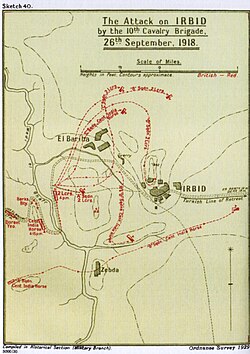
Falls Sketch Map 40 10th Cavalry Brigade attack on Irbid

The 4th Cavalry Division's Advance

The 4th Cavalry Division played a critical role in the push toward the city. Starting from Jisr el Mejamie on September 26, the 10th Cavalry Brigade advanced rapidly toward Irbid and Deraa to establish contact with Prince Feisal's Arab forces. This movement was essential for cutting off Ottoman retreat paths.
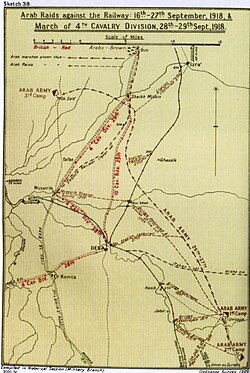
Falls Sketch Map 38 shows Arab raids on the Hejaz railway between 17 and 27 September, the advance of the Sherifial Army and the 4th Cavalry Division in the Deraa region

The advance was not without logistical challenges. Transporting supplies across difficult terrain, such as the Wadi el Bireh near Jisr el Mejamie, proved grueling; in one instance, it took two days to move 30 lorries, with 14 German vehicles abandoned in the mud.
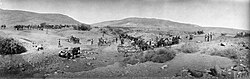
Transport crossing the Wadi el Bireh near Jisr el Mejamie on 27 September—it took two days to get 30 lorries across. Here 14 German lorries were bogged and abandoned.

The Australian Mounted Division and Quneitra

Simultaneously, the Australian Mounted Division pushed north. On September 27, they secured Jisr Benat Yakub and moved toward Deir es Saras. By September 28, they occupied Quneitra, where they captured 24 officers and 421 other ranks. The 4th Light Horse Brigade remained in the town to maintain order and organize communication lines to Damascus.
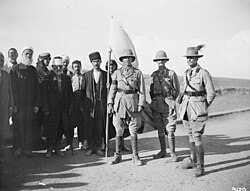
After the surrender of Quneitra to Major General H. W. Hodgson, commander of the Australian Mounted Division (centre), on 28 September 1918. (Brigadier General Grant on right)

The cost of these operations was felt in the loss of livestock. Between September 19 and 30, the 4th Light Horse Brigade lost 73 horses, primarily during the action at Samakh.

The Final Encirclement of Damascus
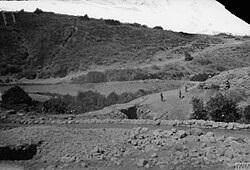
Road from Jisr el Majamie to Irbid at the Wadi Ghafur on 29 September when 30 lorries which supplied the 4th Cavalry Division passed by; the bridge breaking under the pressure so the lorries crossed the stream bed on the right

The Action at Sa'sa and Kaukab

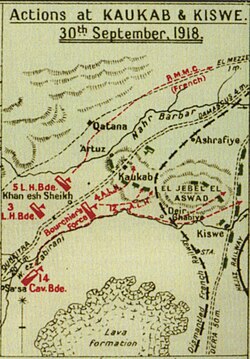
As the Allies closed in, aerial reconnaissance spotted retreating Ottoman and German columns south of the city. On September 30, at Kaukab, the 4th and 12th Light Horse Regiments executed a mounted charge "with the sword," breaking the Ottoman defenders and capturing 72 prisoners and 12 machine guns.
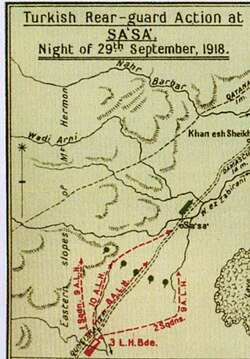
Falls Sketch Map 39 detail Sa'sa

The Fall of the City

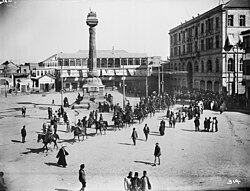
By midnight on September 30, Damascus was effectively encircled. The Australian Mounted Division held El Mezze to the west, the 5th Cavalry Division was at Kaukab, and the 4th Cavalry Division was positioned at Zeraqiye. On October 1, the city surrendered. Nearly 12,000 prisoners were captured before noon, including a massive haul of artillery and machine guns.
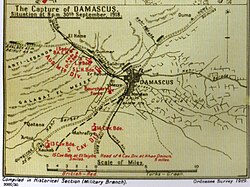
Falls Sketch Map 39 detail Capture of Damascus

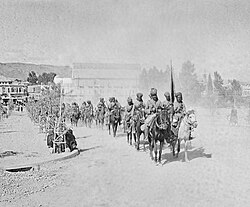
On October 2, Lieutenant General Sir Harry Chauvel led the Desert Mounted Corps in a formal march through the city, with units including the Gloucester Yeomanry, Indian Cavalry, and Hodson's Horse participating in the procession.
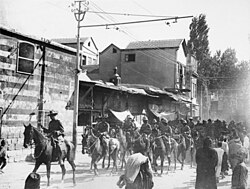
Lieutenant General Sir Harry Chauvel commanding Desert Mounted Corps leads his corps through Damascus on 2 October 1918

Post-Capture Challenges and Aftermath
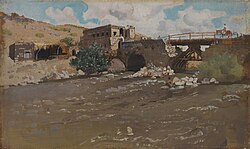
George Lambert's painting of the repaired bridge at Jisr Benat Yakub showing the buildings at the western end in 1919

The Kaukab POW Camp

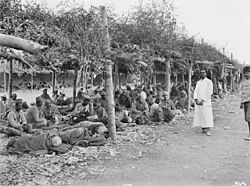
Following the surrender, the Allies faced the immense task of managing approximately 18,000 prisoners of war at the Kaukab camp. The situation was complicated by severe supply shortages and a burgeoning medical crisis.
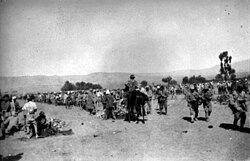
Distribution of rations to some of the 18,000 prisoners of war camped at Kaukab in October 1918

Disease and Attrition

The victory was tempered by the outbreak of the Spanish flu and malaria. These diseases significantly impacted the effectiveness of the Egyptian Expeditionary Force (EEF). For example, Driver Joseph Albert Murphy and Trooper Raymond Talbot Cowan both succumbed to malaria in Damascus in October 1918.
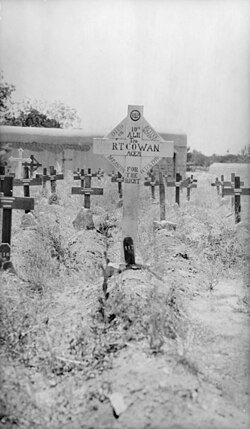
Original graveyard at Damascus includes the grave of Trooper Raymond Talbot Cowan 10th Light Horse Regiment who died of malaria on 24 October 1918

The Push to Aleppo

The momentum did not stop at Damascus. The pursuit continued north, leading to the capture of Aleppo on October 25 by Prince Feisal's Sherifian army, supported by armoured cars and the 15th (Imperial Service) Cavalry Brigade.
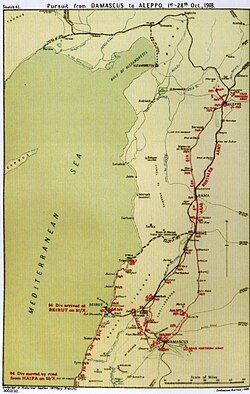
Falls Sketch Map 41 Pursuit from Damascus to Aleppo 1 to 28 October. Australian Mounted Division advance to Homs 29 October to 1 November not shown

Summary of Campaign Logistics

Falls Sketch Map 39 detail Actions at Kaukab and Kiswe
Allied Forces and Results in the Damascus Campaign
Force/Unit Key Objective/Action Primary Result
4th Cavalry Division Irbid and Deraa Cut off Ottoman retreat paths
Australian Mounted Division Quneitra and El Mezze Secured western flank and occupied Quneitra
5th Cavalry Division Kaukab and Kiswe Encircled city from the east
Sherifial Army Deraa and Aleppo Captured Deraa and later Aleppo
Desert Mounted Corps Damascus City Captured 47,000 total prisoners

Frequently Asked Questions

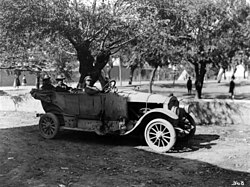
Lieutenant Dinning sitting behind his driver
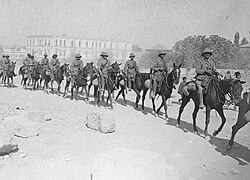
Gloucester Yeomanry in General Chauvel's march through Damascus on 2 October 1918
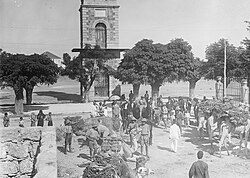
Indian Cavalry entering the central square in Damascus, Syria, 2 October 1918.
9th Hodson's Horse in General Chauvel's march through Damascus 2 October 1918
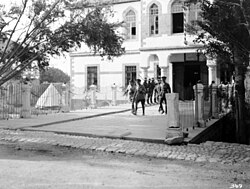
General Chauvel at Desert Mounted Corps Headquarters, Damascus
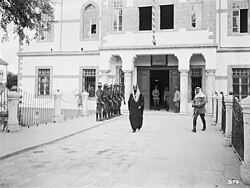
Prince Feisal leaving Chauvel's Desert Mounted Corps Headquarters in Damascus
Part of the hospital attached to the Ottoman prisoner of war camp at Kaukab
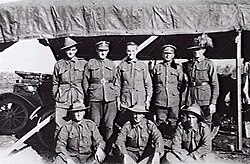
Damascus, November 1918. Drivers who served with Major Wilfrid Kent Hughes; left to right, back row; M.B. McCulloch, Jock Don, R. McLeod, C.E. Bell, G.A.G. Herbert; front row; H. Bellamy, A.E. Tom, M.R. McCulloch. Absent; W.A. Erickson, A.W. Pryor, E.P. Yeatman.
British troops and camels in Tripoli, reached by the armoured cars and XXth Corps Cavalry on 13 October, by the 19th Brigade on 18 October, the remainder of the 7th Division on 28 October and the Australian Mounted Division on 7 November 1918
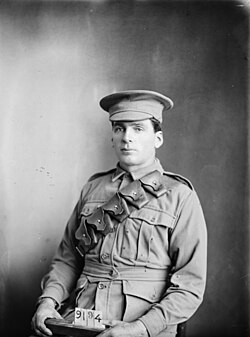
Studio portrait of Driver Joseph Albert Murphy 1030 4th Light Horse Regiment embarked Sydney on 25 June 1915 died of malaria in Damascus on 17 October 1918

Who were the primary commanders of the Allied forces?

The campaign was led by General Edmund Allenby, Lieutenant General Sir Harry Chauvel (commanding the Desert Mounted Corps), and Prince Faisal bin Hussein of the Arabian Sherifial Force.

How many prisoners were captured during the fall of Damascus?

Approximately 20,000 sick and disorganized Ottoman troops were taken prisoner in and around Damascus, with nearly 12,000 captured within the city before noon on October 1, 1918.

What role did the Australian Light Horse play?

The Australian Light Horse were instrumental in the advance, specifically in the occupation of Quneitra and the mounted charge at Kaukab, which helped break the Ottoman rearguard.

What medical issues affected the troops after the victory?

The Allied forces suffered significantly from malaria and the Spanish flu, which caused numerous deaths and reduced the overall operational effectiveness of the Egyptian Expeditionary Force.

What happened after Damascus was captured?

The Allied forces continued their pursuit north, eventually capturing Aleppo on October 25, 1918, with the support of the Sherifian army and the 15th (Imperial Service) Cavalry Brigade.

References

  1. These advances have been characterised as a "race for Damascus". [Gullett 1919 pp. 39–40, Falls 1930 Vol. 2 p. 567]
  2. This is the 38th King George's Own Central India Horse, not to be confused with the 39th King George's Own Central India Horse which had remained in India [Preston 1921, p.335[dubiousdiscuss]]
  3. The 1/1st Dorset Yeomanry was serving in the EEF in April 1917 when they formed part of the 6th Mounted Brigade, Imperial Mounted Division by October 1917 they had been transferred to the Yeomanry Mounted Division. [Falls 1930 Vol. 1 pp. 401–2, Vol. 2 pp. 661–2]
  4. The barrel and breech were carried separately, and screwed together for action. See the British example RML 2.5-inch mountain gun.
  5. They were Trooper Charles William Heywood, Regimental No. 32 (temporary corporal) and Lance Corporal James Alfoncis Moodie, Regimental No. 1104 (temporary sergeant). (G. Massey 2007 pp. 55, 75. See also Australian War Memorial Recommendation AWM28-2-128-0098 Archived 3 February 2014 at the Wayback Machine)