Caprivi Strip Conflict: The Struggle for Secession in Namibia
The Caprivi Strip, located in the northeast of Namibia, is a region defined by its unique geography and complex ethnic ties. Primarily inhabited by the Lozi people, the area shares deep linguistic and historical bonds with neighboring Zambia, Angola, Botswana, and South Africa. These cross-border connections have often fostered a sense of identity that transcends the national boundaries of Namibia, laying the groundwork for political tension and aspirations for self-rule.
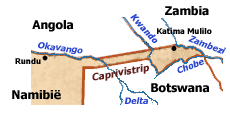
Key Facts
- Primary Ethnic Group: The Lozi people.
- Key Political Figure: Mishake Muyongo, former SWAPO Vice-President and DTA President.
- Militant Group: The Caprivi Liberation Army (CLA), formed in 1994.
- Major Political Parties: SWAPO and the Democratic Turnhalle Alliance (DTA).
- International Involvement: Alleged ties between the CLA and the Angolan rebel movement UNITA.
The Roots of Political Tension
The conflict in the Caprivi Strip is deeply rooted in a power struggle involving Mishake Muyongo and the leadership of SWAPO (South West Africa People's Organisation), the party that dominates Namibian politics. During his exile in Angola, Muyongo served as the Vice-President of SWAPO until July 1980, when he was ousted. He was accused of pursuing secessionist ambitions and engaging in subversive activities, leading to his detention in Tanzania and Zambia.
Following these events, an alleged purge of Caprivians within SWAPO further strained relations. Upon returning to Namibia in 1985, Muyongo shifted his political alignment, forming the United Democratic Party (UDP) and joining the Democratic Turnhalle Alliance (DTA). He led the DTA as president from 1991 until his expulsion in 1998.
The Rise of the Caprivi Liberation Army
In 1994, the Caprivi Liberation Army (CLA) was established with the explicit goal of achieving self-rule for the region. The Namibian government viewed the CLA as a threat, accusing the group of collaborating with UNITA, an Angolan rebel movement. UNITA was particularly controversial in Namibia due to its history of assisting South Africa against SWAPO during the South African Border War.
Political leanings in the region were evident as early as the 1989 elections, where the DTA held a significant advantage over SWAPO in the Caprivi area.
Escalation and the 1998 Crisis
The situation reached a breaking point in October 1998. The Namibian Defence Force, supported by the Special Field Force, discovered and raided a CLA training camp. This military action triggered a mass exodus: over 100 armed CLA members and approximately 2,500 civilians fled into Botswana, fearing government repression, including reports of torture and rape.
Among the refugees were CLA leaders Mishake Muyongo and Boniface Bebi Mamili (a leader of the Mafwe people), both of whom were granted asylum in Denmark. Despite demands from President Nujoma—who labeled the rebels "traitors and murderers"—Denmark and Botswana refused to extradite them. Other notable figures who joined the exiles in Botswana included Caprivi governor John Mabuku, councilor Fani Francis Sizimbo, and the chief of the Kxoe people, leading several thousand men.
Political Aftermath and Regional Elections
The displacement of thousands of residents had a direct impact on the regional political landscape. In December 1998, regional elections were held. Because a vast number of DTA supporters had fled the country, SWAPO was able to win all six available seats in the region. Voter turnout in the areas most affected by the refugee crisis was remarkably low, falling below 20%.
| Entity | Role/Affiliation | Primary Objective/Status |
|---|---|---|
| Lozi People | Regional Ethnic Group | Shared history across Namibia, Zambia, Angola, and Botswana |
| Mishake Muyongo | Political Leader | Former SWAPO VP; later leader of the secessionist movement |
| CLA | Militant Group | Sought self-rule/independence for Caprivi |
| SWAPO | Ruling Political Party | Maintained Namibian national sovereignty |
| DTA | Political Alliance | Strong regional support in Caprivi prior to 1998 |
Frequently Asked Questions
Who are the Lozi people?
The Lozi people are the primary inhabitants of the Caprivi Strip in northeast Namibia, sharing a common language and history with Lozi populations in Zambia, Angola, Botswana, and South Africa.
What was the goal of the Caprivi Liberation Army (CLA)?
The CLA was formed in 1994 with the primary objective of achieving self-rule for the Caprivi region.
Why was the alliance with UNITA controversial?
UNITA was an Angolan rebel movement that had helped South Africa fight against SWAPO during the South African Border War, making any alliance with them highly contentious within Namibia.
What happened after the 1998 raid on the CLA camp?
More than 100 armed CLA members and about 2,500 civilians fled to Botswana. Leaders Mishake Muyongo and Boniface Bebi Mamili eventually received asylum in Denmark.
How did the 1998 refugee crisis affect the regional elections?
The flight of many DTA supporters led to a SWAPO sweep of all six regional seats, with voter turnout dropping below 20% in the areas where refugees had originated.